
India Chase Down 226 to Beat New Zealand in Christchurch T20 Thriller
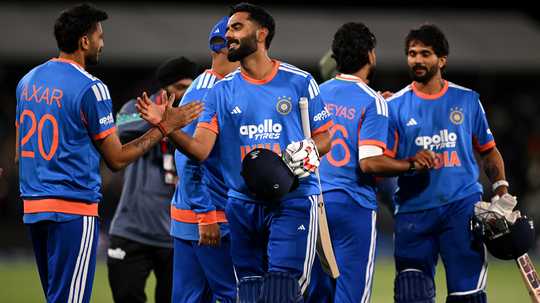
India turned a high-scoring contest at Christchurch’s Hagley Oval into a statement of intent, chasing 226 to defeat New Zealand by four wickets with two balls to spare. Sanju Samson’s explosive start put the visitors firmly ahead, but a middle-overs spin squeeze briefly threatened to derail the pursuit. Naman Dhir’s unbeaten finish, however, ensured India claimed an early lead in the series and completed their highest successful chase in men’s T20 internationals.
New Zealand had set a formidable target of 225 for four, their highest home total in T20Is, powered by Glenn Phillips’ unbeaten 82 and Finn Allen’s brisk 45. India’s response reached 230 for six in 19.4 overs, with Samson scoring 67 from 33 deliveries and Dhir sealing the result with 42 not out from just 15 balls. Shreyas Iyer also made 42, while Michael Bracewell’s two wickets helped make the chase far more tense than its opening suggested.
Samson and Abhishek Set the Chase Ablaze
India began with the urgency required for a target of this size. Abhishek Sharma struck his first delivery for six, and Samson quickly found his timing against New Zealand’s pace attack. The defining burst came in the third over, when Samson took 22 runs from Lockie Ferguson. Adam Milne’s next over proved even more expensive, costing 26 as Abhishek twice pulled the fast bowler over the boundary.
India’s opening pair added 93 runs inside the Powerplay, giving the chase a rapid start and pushing the required rate comfortably below a run a ball. Samson’s 67 came from a blend of clean hitting and smart placement, while Abhishek contributed 29 from 12 deliveries. Their partnership made a total above 220 look attainable, although New Zealand’s spinners soon changed the mood of the contest.
Abhishek fell trying to attack Bracewell’s offspin, slicing a catch to backward point. The wicket was significant not only because it ended a fast-scoring stand, but also because it handed New Zealand the matchup they wanted: spin against India’s left-handed batters. The hosts tightened their lines and slowed the scoring, turning what had looked like a straightforward chase into a test of composure.
New Zealand’s Spinners Create a Mid-Innings Squeeze
India’s decision to send Tilak Varma in at No. 3 brought a left-hander to the crease, but Bracewell and captain Mitchell Santner made scoring difficult. Boundaries became scarce after the Powerplay, and the pressure eventually brought Samson’s dismissal. Reaching for a wide delivery, he attempted to cut and dragged the ball onto his stumps.
Tilak was out for six from 11 balls in the following over, and Ishan Kishan soon departed after picking out a fielder off Santner. India had lost three wickets in a short spell, and the momentum that Samson and Abhishek had built was suddenly under threat. Bracewell and Santner’s control through the middle overs was central to New Zealand’s revival, as they combined to restrict India and take key wickets.
Axar Patel’s promotion helped stabilise the innings. He joined Iyer and counterattacked, striking Santner for four before clearing the boundary against Bracewell. The pair rebuilt the chase without abandoning the scoring rate, and their partnership forced New Zealand to reconsider its defensive plans.
Fielding errors then proved costly. Santner dropped Axar at mid-off, and India made New Zealand pay by taking 20 runs from Matt Henry’s next over. Ferguson eventually removed Axar for 24 off 14 balls, but another missed chance—Allen dropping Iyer—gave India’s captain a further opportunity to guide the finish.
Dhir Delivers Under Pressure
Iyer and Dhir shifted the pressure back onto the hosts, taking 19 runs from a Santner over to put India in control again. Iyer fell before the finish, but Dhir showed little sign of nerves. He attacked the final over with confidence, finding the boundary and clearing it for six as India crossed the line at 230 for six.
Dhir’s unbeaten 42 from 15 balls was decisive in a match where India’s top-order burst had not been enough on its own. His innings combined power with clear decision-making: rather than allowing the required rate to dictate the contest, he picked his scoring options and finished the chase before New Zealand could force another twist.
Phillips Leads New Zealand to a Record Home Total
Earlier, New Zealand’s innings had recovered strongly after India claimed three wickets. Allen made 45, while Tim Seifert was removed by Mayank Yadav, who had been selected ahead of Prince Yadav. India had an opportunity to dismiss Daryl Mitchell soon after, but Abhishek put down a catch at long-on. Mitchell responded with boundaries, helping the hosts maintain their momentum.
Axar Patel later won an important contest with Allen, drawing a mistimed shot that was caught at long-off. Arshdeep Singh then removed Mitchell in the 13th over, leaving New Zealand at 122 for three. Phillips and Bevon Jacobs took charge from there, adding 73 runs and giving the innings a powerful finish.
Jacobs announced himself by hitting his first ball for six, while Phillips repeatedly found gaps and cleared the rope. He reached his half-century from 27 balls and finished unbeaten on 82. An 18-run final over against Mayank Yadav helped New Zealand surge beyond 200, with the last five overs costing India 67 runs. All five Indian bowlers conceded more than 40, underlining the difficulty of containing a well-set batting lineup on a dewy evening.
Dew, Depth and the Match Prediction Takeaway
Conditions played a major part in shaping the contest. Dew made the ball harder for bowlers to grip and encouraged it to skid onto the bat, a factor that favoured India during the chase. The toss therefore mattered: India could set their plans around a target, knowing that batting might become easier as the evening progressed. Yet the result was not simply a product of conditions. New Zealand’s spinners exposed a vulnerable stretch in India’s innings, while India’s batting depth ultimately provided the answer.
For cricket fans considering a match prediction, the game offered a reminder that a huge total does not guarantee control in T20 cricket. Powerplay scoring, spin matchups, fielding standards and the ability to finish under pressure can all reshape expectations. India’s early assault created a cushion, but the missed chances and Dhir’s late hitting were just as important to the final outcome.
Brief score: New Zealand 225/4 in 20 overs (Glenn Phillips 82 not out, Finn Allen 45; Mayank Yadav 1/40) lost to India 230/6 in 19.4 overs (Sanju Samson 67, Naman Dhir 42 not out, Shreyas Iyer 42; Michael Bracewell 2/39) by four wickets.