

FIDE Refers Magnus Carlsen’s Budapest Forfeits for Review After Total Chess Pilot
FIDE has referred Magnus Carlsen’s conduct at the Total Chess World Championship Tour Pilot in Budapest to its Ethics and Disciplinary Commission (EDC), calling his repeated forfeits “unacceptable.” The international chess federation has also ordered a separate review of the tournament arbiters’ decisions, turning a player controversy into a broader debate about sporting responsibility, tournament rules and professional chess governance.
The dispute followed five forfeited games by Carlsen during the event’s final four days. The world number one finished 17th after withdrawing from scheduled games, including a fast classical encounter on Friday, before winning the deciding Armageddon game against Vladislav Artemiev. FIDE says some forfeits came after match results were already settled, while others occurred when the outcome was still undecided—a distinction central to its criticism.
Why FIDE singled out the Artemiev match
In its statement, signed by FIDE President Timur Turlov and Deputy President Viswanathan Anand, the federation congratulated medalists Alireza Firouzja, Anish Giri and Fabiano Caruana, and thanked organizers and Hungarian hosts for staging the pilot. But it also expressed “serious concern” about players failing to appear for scheduled games.
FIDE acknowledged that some forfeits did not change the outcome of their matches. Carlsen’s three missed games against Artemiev, however, came across two days while those contests were still unresolved. They included two rapid games on Thursday and a fast classical game on Friday. The federation said the forfeits had a significant effect on the tournament’s upper rating standings and described the conduct as unprecedented at the highest level of professional chess.
Unplayed games do not affect a player’s rating, unlike a played draw or loss. That detail has fueled debate over whether the format unintentionally made forfeiting financially or competitively attractive in certain circumstances. FIDE’s statement nevertheless emphasized that the tournament regulations required players to contest all scheduled games, regardless of whether a match result appeared secure.
Arbiters also face scrutiny
The EDC will independently assess whether Carlsen breached the FIDE Ethics and Disciplinary Code. If it finds a violation, possible sanctions could include a warning, a fine or suspension. The referral is not a finding of guilt; it initiates a review of the relevant facts and rules.
FIDE has also referred the arbiters’ handling of the incidents to its Arbiters’ Commission and Disciplinary Sub-Committee. The federation said officials had “effectively abdicated their responsibility” to enforce the Laws of Chess and tournament regulations. That criticism has itself prompted a response: the event’s chief arbiter reportedly challenged FIDE’s public comments, seeking a retraction and apology and arguing that the reputations of the tournament’s arbiters had been harmed before formal proceedings began.
The separate reviews highlight the difficult position of tournament officials. Arbiters must apply written rules consistently, but a pilot event can expose gaps in regulations that were not fully tested in practice. FIDE says it will work with Total Chess to clarify rules on forfeits and their consequences before the Tour’s planned full season in 2027.
Carlsen cites fatigue, motivation and rating concerns
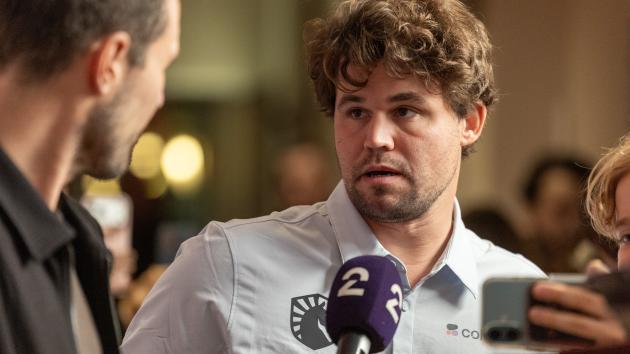
Carlsen gave several explanations for his decisions. Speaking to Norwegian broadcaster TV 2, he said he had felt tired, fed up and unwilling to play the final fast classical game. He also described a “negative spiral,” saying he arrived with limited motivation and increasingly wanted to be at home with his family.
He acknowledged that rating considerations influenced his decision to skip the rapid games against Artemiev. At the time, he was at risk of falling below 2,800 in both classical and rapid ratings. Carlsen said the calculation was “cynical,” but argued that rating points mattered when he was competing for 17th place and had little energy for rapid chess.
He also defended his freedom to make personal choices, saying that organizers often need his participation more than he needs theirs. Carlsen described himself as accustomed to operating on his own terms, while insisting that he speaks candidly about his intentions. He said he does not share the same priorities as players focused on the classical world championship and questioned what top-level chess should look like.
The controversy began after Carlsen went winless in his 10 group-stage fast classical games and entered the lower placement matches. In an earlier match against Bibisara Assaubayeva, he had built an 11.5–0.5 lead before declining to play the final scheduled game. Assaubayeva waited through the 15-minute default period and was awarded the forfeit win. A report from TV 2 said Carlsen tried to find her to explain his decision, then expected tournament staff to pass on the message, but the information did not reach her.
Grandmasters disagree over responsibility
Several prominent players criticized Carlsen’s approach. Fabiano Caruana compared skipping a game in the middle of a match to a tennis player abandoning a set and returning for the next one. Maxime Vachier-Lagrave called for a player who refuses to compete to be removed from the event, while other grandmasters described the decision as disrespectful to opponents and spectators.
Levon Aronian offered a more sympathetic interpretation, suggesting that the episode could prompt useful change and draw attention to a new generation of ambitious players. Former FIDE presidential candidate and organizer Wadim Rosenstein also defended Carlsen in part, while acknowledging that Assaubayeva deserved an opponent and clear communication.
Rosenstein’s central question was whether the tournament’s incentives were properly designed. If a player could protect rating points by forfeiting a game after securing a match, but risk losing points by playing and drawing, the rules may have rewarded absence over competition. He argued that organizers and federation officials should examine those incentives alongside individual conduct. The debate therefore reaches beyond one grandmaster: it concerns how chess events can ensure that every scheduled game remains meaningful.
A test case for the 2027 chess tour
Carlsen said the Total Chess format had potential, suggesting changes such as seeded groups and a daily schedule featuring all three formats. He did not commit to returning, saying the issue was less physical strain than a lack of desire to spend time on the event. He indicated he was more likely to play Norway Chess and considered the shorter World Rapid and Blitz Championships more manageable.
For FIDE and Total Chess, Budapest was designed as a trial run before a larger launch. Its most consequential lesson may be that innovative chess formats need precise rules for unfinished matches, rating consequences, player communication and arbiter authority. The EDC and arbiter reviews will determine whether existing rules were broken; the organizers’ next challenge is to make sure the same uncertainty does not define the Tour’s future.