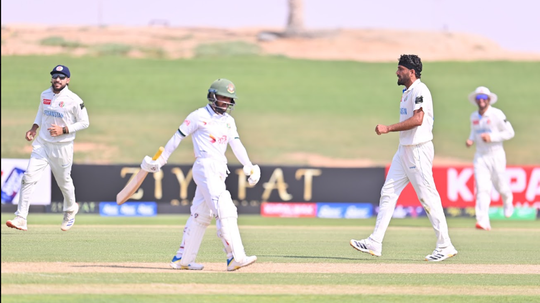

Afghanistan’s disciplined bowling turns the tide against Bangladesh on Test’s opening day
Afghanistan fast bowler Yamin Ahmadzai said patience and commitment to a clear plan helped his team recover after a challenging start on the first day of the one-off Test against Bangladesh. Although the hosts dominated the opening session with aggressive batting, Afghanistan’s bowlers stayed focused on their approach and struck back after lunch, leaving the contest finely poised.
Bangladesh began confidently, with Tanzid Tamim setting the pace through a rapid innings. His attacking strokeplay put pressure on the Afghanistan attack and gave the hosts early momentum. But after his departure, the visitors tightened their lines, varied their lengths and made better use of the conditions. Three wickets fell in quick succession after the break, including the prized dismissal of experienced batter Mushfiqur Rahim.
One-channel bowling brings Afghanistan back into the match
Ahmadzai explained that Afghanistan’s response was not to abandon its strategy when Bangladesh scored freely, but to execute it more consistently. The bowlers sought to operate in a disciplined channel, making the batters play their shots rather than reacting to every boundary with a change of plan.
“After the first session, the plan was that they were coming a bit aggressively and we were trying to just be in one channel and let them play their shots according to their plan, but we were not going to change our plan,” Ahmadzai said after play.
That patience became a defining feature of Afghanistan’s recovery. The pace trio of Mohammad Saleem, Ahmadzai and Ismat Alam accounted for seven of the eight wickets to fall, combining probing deliveries with occasional short balls. Ahmadzai focused largely on fuller lengths, aiming to draw batters forward and create opportunities for movement off the pitch or through the air.
Conditions were demanding, with intense heat adding to the physical strain on the bowlers. Even so, Afghanistan maintained pressure across spells. The visitors’ ability to keep their plans intact offered a useful lesson in Test cricket: a strong first session does not guarantee control of the day, particularly when the bowling side can build pressure through accuracy and patience.
Ahmadzai’s plan to dismiss Mushfiqur Rahim
One of the day’s most significant moments came when Ahmadzai removed Mushfiqur, a batter known for his experience and ability to steady an innings. The Afghanistan seamer said he had spent several deliveries targeting a line around the fifth and sixth stumps, encouraging Mushfiqur to play at balls outside his body. When that approach did not produce the response he wanted, Ahmadzai adjusted his angle and attacked a straighter line.
The change brought the breakthrough. The ball moved in the air through reverse swing, and Mushfiqur was dismissed as Afghanistan’s pressure finally paid off. Ahmadzai described the wicket as the result of a deliberate adjustment rather than a sudden change in direction.
“I have bowled plenty of my balls before this on the fifth and sixth stump and I was trying to bring him to play in my line. Unfortunately, he was not doing that. Suddenly, I decided to go one straighter and it reversed a bit and I got his wicket,” he said.
Reverse swing can be particularly valuable in hot, dry conditions, where the ball may wear unevenly and begin to move late in its flight. Ahmadzai said he had worked on his wrist position to improve his ability to generate that movement. He also described practising a wider angle from the crease, allowing him to shape the ball away from the batter rather than following the more familiar route of bringing it back in.
That experimentation reflects the demands placed on Afghanistan’s bowlers. Ahmadzai noted that pitches at home are not always especially helpful to fast bowlers, so he has learned to seek out new methods rather than rely on conditions alone. For a pace attack competing away from home, control of angle, wrist position and length can be just as important as raw speed.
Sharp fielding adds to Afghanistan’s late momentum
Afghanistan’s response was not limited to its bowling. Ahmadzai produced an important catch in the deep to dismiss Litton Kumar Das, preventing Bangladesh from building a stronger total late in the day. The effort was especially valuable because it came during the closing stages, when the hosts could have looked to accelerate and regain momentum.
Ahmadzai said he had taken plenty of catches throughout his career but was pleased to hold on to this one. His contribution underlined how fielding can shape a Test match just as decisively as a spell of bowling. A well-timed catch can end a partnership, halt a scoring surge and reinforce the pressure created by the bowlers.
For Afghanistan, the combination of disciplined bowling and alert fielding turned a difficult morning into a more encouraging finish. Bangladesh had made the better start, but the visitors’ response ensured the hosts could not carry that early advantage through the full day.
Hard work behind Ahmadzai’s progress
Ahmadzai credited long-term preparation for his ability to execute plans under pressure. He said he had worked with coaches in Afghanistan on developing his angles and improving his control of reverse swing. The fast bowler also pointed to consistency and effort as the foundation of his progress, describing hard work as a commitment he has maintained for 18 years.
“I’m a strong believer of hard work and I’ve been doing it for the last 18 years. I just believe in those efforts that I’m doing back home. And I think the only thing is the hard work behind my success,” he said.
His comments offer a glimpse into the preparation behind a successful spell. Test cricket rewards bowlers who can repeat a demanding action, adapt to changing conditions and remain patient when batters attack. Ahmadzai’s performance showed how technical adjustments, thoughtful field settings and sustained discipline can help a team regain control even after an opponent’s explosive start.
What the first day means for the Test
Ahmadzai acknowledged that the pitch appeared suitable for batting first, making Bangladesh’s opening-session scoring understandable. Yet he felt Afghanistan had finished the day in a stronger position than the early exchanges suggested. The contest now hinges on whether the visitors can complete the remaining work with the ball and whether Bangladesh’s lower order can add valuable runs.
For fans following the cricket, the opening day has created plenty to assess: Bangladesh’s aggressive start, Afghanistan’s response after lunch and the impact of reverse swing in the heat. Any prediction about the match remains uncertain at this stage, with the balance likely to shift according to how quickly Afghanistan can wrap up the innings and how effectively its batters handle Bangladesh’s attack.
What is clear is that Afghanistan’s bowlers have shown the value of sticking to a plan without becoming inflexible. Ahmadzai’s spell, his dismissal of Mushfiqur and his catch of Litton all helped transform the day. If Afghanistan can carry that discipline into the next phase, its late recovery could prove more than a brief interruption to Bangladesh’s early dominance.