
South Africa’s pace attack puts Australia under pressure on a weather-shortened Durban day
South Africa seized the early advantage on the opening day of the first Test against Australia in Durban, using movement, bounce and disciplined fast bowling to reduce the visitors to 187 for 6. Despite playing without Kagiso Rabada, the hosts made the most of helpful conditions at Kingsmead, leaving Australia’s lower order with plenty to do after a shortened final session.
Australia chose to bat first on a surface carrying a covering of grass. The pitch offered enough early assistance to keep the South African seamers interested, while its cracks could become more influential as the match progresses. That combination made the toss decision understandable, but it also placed a premium on surviving the new ball—a challenge Australia’s top order could not fully meet.
Maddinson’s return begins with a testing spell
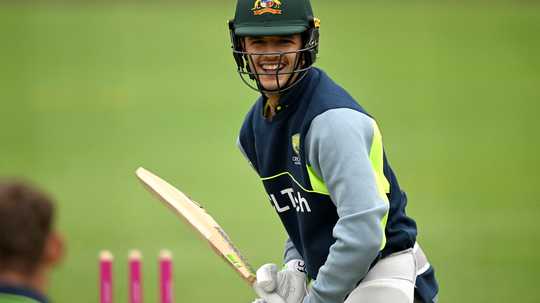
Nic Maddinson’s recall gave the innings an added storyline. The left-hander was back in Test cricket after a decade away, but his return began with a long period of restraint rather than a rush of runs. Marco Jansen and Wiaan Mulder opened the attack, with Mulder taking the new ball instead of Anrich Nortje, who was also returning to red-ball action in Rabada’s absence.
Both opening bowlers repeatedly angled the ball into Australia’s left-handed batters. Jansen also found occasional movement away from the bat, making good use of the carry and early life in the pitch. Maddinson struggled to find his timing and was still scoreless after facing 29 deliveries. An early leg-before-wicket appeal against him was not reviewed, a decision that might have become a talking point had the innings unfolded differently.
Before Maddinson could settle, Travis Head fell to a faint edge down the leg side. The dismissal gave South Africa an early breakthrough and brought Marnus Labuschagne to the crease under pressure. Labuschagne arrived amid a prolonged run of modest scores, while Australia’s opening partnership had produced little momentum.
Maddinson’s difficult stay ended after 33 balls without a run. Attempting to break free, he played at a delivery from Jansen and edged it onto his stumps. It was a frustrating end to a cautious comeback, and it left Australia needing its more experienced batters to rebuild.
Smith attacks spin as Labuschagne searches for form
Steve Smith’s arrival prompted Nortje’s introduction, adding extra pace to South Africa’s attack. Labuschagne tried to remain positive, although he was struck on the body as Nortje generated steep bounce. A crisp straight drive past Jansen helped him get moving, but several of his later scoring shots carried an element of risk.
Smith, initially measured in his approach, changed the tempo when Keshav Maharaj was brought into the attack. He launched two sixes in the spinner’s second over, looking to seize control before turn became more significant. The aggressive burst also brought a personal milestone: Smith moved past Steve Waugh’s Test run tally to become Australia’s third-highest run-scorer in the format.
That landmark could not prevent South Africa from removing him after lunch. Jansen switched to a round-the-wicket angle and found the outside edge, with the ball carrying low to gully. Smith’s dismissal checked Australia’s progress just as the innings appeared to be gaining some shape.
Labuschagne’s stay ended soon afterwards. Mulder produced a delivery that nipped back sharply and beat the batter, who was given out lbw. Labuschagne reviewed the decision, but the replay confirmed the call. He finished with 37, including a handful of streaky boundaries, and extended his sequence without a half-century to 11 Test innings. For Australia, the continuing search for a substantial contribution from him remains a concern.
Nortje strikes twice in a decisive over
South Africa continued to probe after the break, although one review went against them when a hostile Jansen delivery struck Matt Renshaw on the forearm rather than the glove. Simon Harmer entered the attack in the 36th over, but it was Nortje who delivered the next major blow.
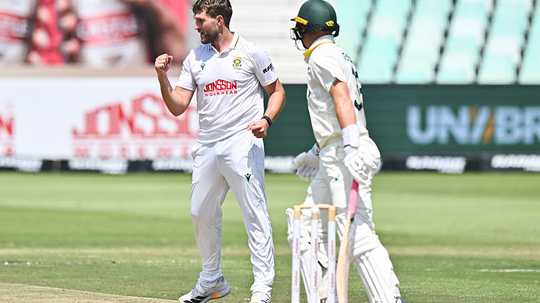
Nortje removed Alex Carey and Beau Webster in the same over, repeatedly targeting the off stump and drawing edges behind the wicket. The double strike left Australia in deeper trouble and highlighted the value of Nortje’s pace on a surface where batters had little room to relax. His comeback was particularly important with Rabada unavailable, giving South Africa another fast-bowling option capable of unsettling a set batter.
Renshaw responded with patience, choosing to leave carefully and defend rather than force a counterattack. Pat Cummins joined him, and the pair carried Australia through to tea without another loss. Their partnership offered the visitors a measure of stability after a difficult middle session.
Renshaw and Cummins provide a late-day resistance
The final session brought more determined batting from Renshaw and Cummins. Renshaw continued to trust his defence, while Cummins balanced caution with purposeful scoring and looked composed against the spin. Together, they added an important stand of more than 50 runs—the second partnership of that size in Australia’s innings.
Nortje returned in search of another breakthrough, but the pair held firm. Conditions became increasingly gloomy over Kingsmead, and the floodlights were switched on as cloud cover thickened. With visibility worsening, officials eventually brought out the light meters, and the day ended with Australia’s recovery still in progress.
Renshaw was unbeaten on 46, with Cummins alongside him, as Australia closed on 187 for 6. The partnership prevented the innings from slipping further and gave the visitors a platform to build on, but South Africa had controlled most of the day. The hosts’ seamers shared the work effectively, with Mulder taking 2 for 31 and Jansen claiming 2 for 35.
Day 1 score and match outlook
Australia 187/6: Matt Renshaw 46 not out, Marnus Labuschagne 37; Wiaan Mulder 2/31, Marco Jansen 2/35.
The first-day cricket prediction now depends largely on how much Renshaw and Cummins can add when play resumes. If they extend their stand and Australia approaches or passes 250, the visitors could turn a difficult start into a competitive first-innings total. If South Africa breaks through early, the remaining batters will face a demanding task against a pace attack that has already found movement and bounce.
The pitch’s grass cover helped the fast bowlers on day one, while the possibility of cracks developing later may offer further assistance as the Test progresses. South Africa will be eager to finish the Australian innings quickly and then make the most of their own batting opportunity. Australia, meanwhile, needs resilience from its lower order and a stronger collective response from the top half. With weather and changing pitch conditions likely to shape the contest, the opening day has set up a closely watched battle in Durban.