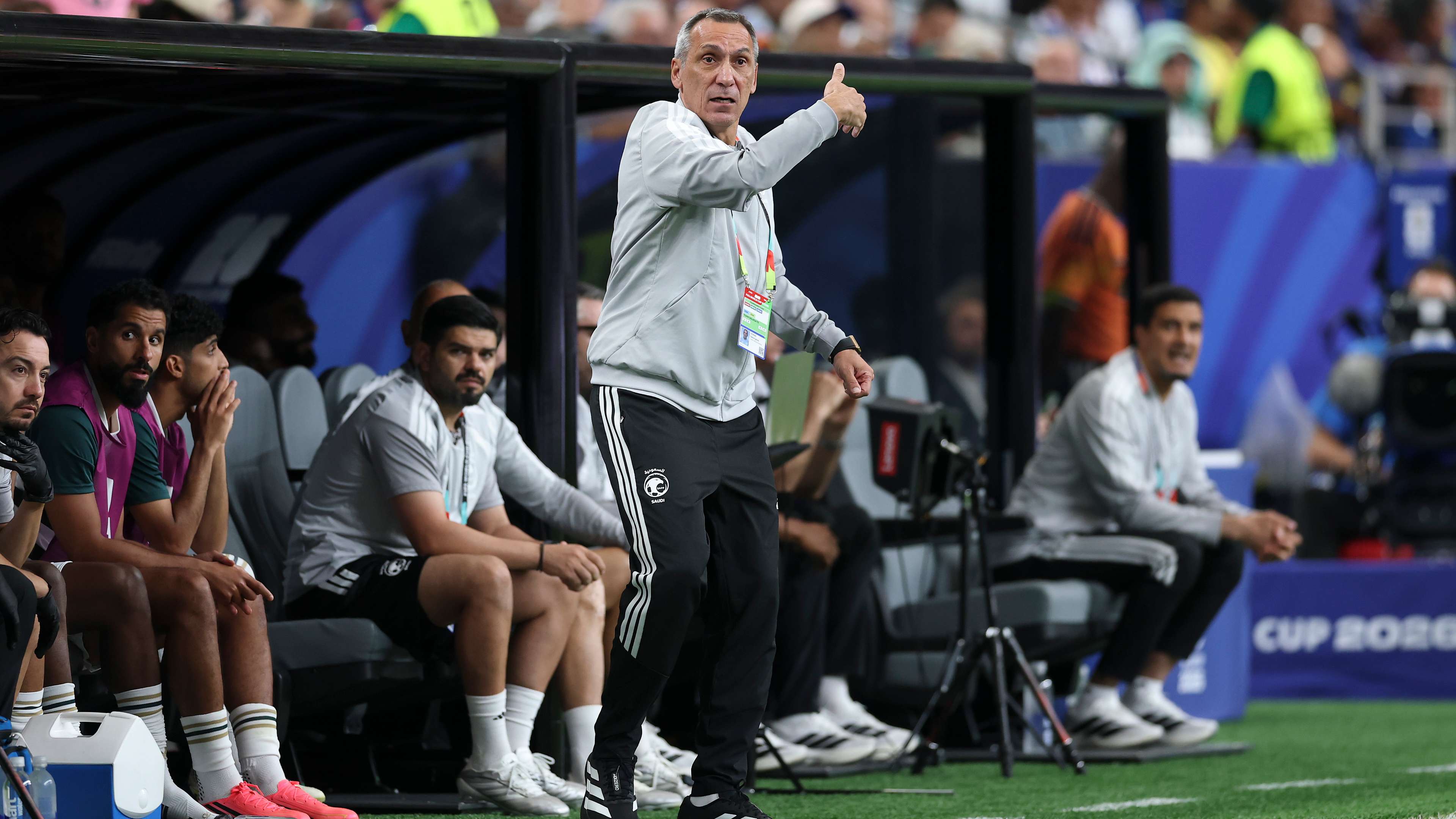

Georgios Donis urges Saudi Arabia to take Asian Cup challenge “step by step”
Saudi Arabia coach Georgios Donis has offered a measured response to questions about his team’s chances at the upcoming Asian Cup, choosing to focus on steady progress rather than bold promises. The Greek manager’s comments came only days after the Green Falcons lifted the Arabian Gulf Cup, giving supporters fresh reason to believe the side could compete for another major honour.
Asked by a reporter from Saudi network Thmanyah whether Saudi Arabia could challenge for the continental title, Donis kept his answer brief: “I hope so, but step by step.” It was a modest reply, but one that reflected the approach he appears to be taking with a team still building momentum under his leadership.
Gulf Cup success raises expectations
Saudi Arabia’s recent Gulf Cup triumph has added excitement ahead of the Asian Cup. The Green Falcons defeated the United Arab Emirates 2-0 in the final, securing the trophy for the fourth time in the country’s history. The result gave Donis an early achievement to point to and offered players a confidence boost before the next demanding test.
Winning a regional competition can provide more than silverware. It gives a squad the chance to practise under pressure, strengthen relationships on the pitch and develop belief in its approach. A final against a familiar opponent such as the UAE also tests a team’s ability to manage a high-stakes match, where patience, concentration and defensive discipline can be just as important as attacking quality.
However, the Gulf Cup and the Asian Cup present different challenges. The continental tournament brings together a wider range of playing styles, stronger opposition and greater scrutiny. Saudi Arabia will need to show that its recent form can be sustained against teams with varied tactical approaches, not simply rely on the confidence generated by one successful run.
Why Donis is keeping the focus on the next step
Donis’s “step by step” message suggests he is keen to avoid allowing expectations to run ahead of the work required. Rather than publicly declaring Saudi Arabia a title favourite, he has signalled that the team must concentrate on preparation, performance and progress from one match to the next.
That kind of caution can be useful ahead of a major tournament. A prediction about winning the Asian Cup may attract attention, but it does not help a team solve the practical problems it will face on the field. Coaches must build a balanced squad, identify reliable combinations, prepare for different opponents and ensure players can respond when a match does not follow the planned script.
For supporters, Donis’s words may sound deliberately restrained. Yet they also leave room for ambition: he said he hoped Saudi Arabia could challenge, while making clear that success would depend on taking each stage seriously. The message is not that the Green Falcons lack belief, but that belief must be supported by consistent performances.
A coach appointed during a period of change
Donis took charge of Saudi Arabia after replacing Frenchman Hervé Renard, arriving only weeks before the country’s most recent World Cup campaign. That timing gave him limited opportunity to shape the team before stepping into one of football’s most demanding environments. Since then, his task has involved more than choosing a starting eleven: he has had to establish his ideas, assess the available players and build a clear identity for the national side.
Taking over a national team close to a major competition is a particularly difficult assignment. Unlike a club coach, a national-team manager has limited time with players between fixtures. Training camps and international windows must therefore be used efficiently, with tactical instructions made clear and squad roles established quickly.
The Gulf Cup victory offers a positive sign that Donis’s group is making progress. Still, one tournament cannot answer every question. The Asian Cup will provide a more substantial measure of how well the team has adapted to his methods and whether it can maintain its composure against top-level continental opposition.
What Saudi Arabia must show at the Asian Cup
To turn recent success into a genuine title challenge, Saudi Arabia will need to combine attacking intent with consistency at the back. Tournament football often rewards teams that can control the tempo, limit costly mistakes and make effective use of scoring opportunities. A strong opening performance can build momentum, but the ability to recover from setbacks is equally important as the competition progresses.
Squad depth will also matter. Injuries, suspensions and changes in form can quickly alter a team’s options during a tournament. Donis will need dependable alternatives in key positions, along with players capable of adapting to different match situations. The balance between experienced figures and emerging talent could be central to Saudi Arabia’s prospects.
There is also a psychological dimension. Winning the Gulf Cup may increase confidence, but it can raise expectations at the same time. The challenge for the coaching staff will be to use the achievement as motivation without allowing it to become a distraction. Keeping the group focused on its immediate objectives appears to be precisely what Donis’s short answer was intended to do.
A promising start, with the bigger test still ahead
Saudi Arabia enters the Asian Cup conversation with a recent trophy, a coach who has already experienced the pressure of major international football and a squad encouraged by its latest result. Those factors make the Green Falcons an intriguing team to watch, although a Gulf Cup title alone cannot guarantee success on the continental stage.
Donis has avoided making a dramatic prediction, but his response leaves the door open to a serious challenge. For now, his priority appears to be building on the 2-0 final victory over the UAE and ensuring that each performance moves the team forward. Whether Saudi Arabia can convert that steady approach into a deep Asian Cup run will depend on how effectively it handles the tougher tests to come.