
Starc’s late burst turns Cape Town Test into a dramatic contest
Australia’s decision to bowl first looked questionable for much of the opening session in Cape Town. South Africa’s batters made the most of a firm, true pitch, scoring freely and putting the visitors under immediate pressure. But a remarkable change in momentum followed: Australia claimed five wickets for 29 runs in the afternoon, then Mitchell Starc used the second new ball to rip through the tail. South Africa were all out for 329, leaving a first day that swung sharply between dominance and collapse.
The contest offered an early reminder that a cricket prediction based only on the toss can be misleading. Pat Cummins had seen enough moisture to back his bowlers, yet the hard surface—shaped in part by an unusually dry winter—proved excellent for batting at first. Australia’s attack, missing Scott Boland and without Steve Smith, who was sidelined by a neck injury, struggled to make an impression as the hosts raced ahead.
A record-setting start for South Africa
Marques Ackerman and Aiden Markram took full advantage of the conditions, building South Africa’s first 100-run opening partnership in 42 innings. Markram set the tone with crisp cuts and drives, while a confident pull for six off Cummins showed how little the new ball was troubling the batters. The opening session produced 140 runs at 5.18 an over, a statement of intent from a side that had been looking for a strong start.
Ackerman, playing only his second Test, began more cautiously than his partner but soon found his rhythm. After slashing at Josh Hazlewood just after a drinks break, he began to attack with greater freedom. He launched Nathan Lyon for six, repeatedly charged the spinner and later struck four consecutive boundaries off Starc. A six off Cummins added to the spectacle as Ackerman moved rapidly towards a landmark score.
His innings ended on 95, however, when he stepped down the track to Lyon and was beaten by the flight. Alex Carey completed the stumping, bringing David Bedingham to the crease. Ackerman’s near-century was still a major contribution, and his scoring rate helped South Africa finish the morning in control. Travis Head had also dropped a chance off Markram, adding to Australia’s frustration during a session in which the visitors could not find a reliable way to slow the scoring.
Australia exploit risky shot selection
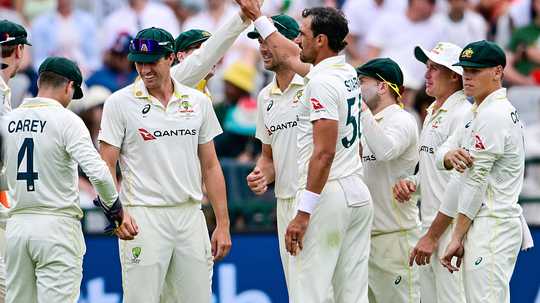
The afternoon session brought a very different kind of cricket. Markram and Bedingham initially kept South Africa moving, but the hosts began to lose wickets as aggressive choices turned into opportunities for Australia. Markram, on 78, pulled a short delivery from Hazlewood towards backward square. Starc, stationed in the area, dived to take the catch.
Four balls later, Temba Bavuma was bowled by Lyon. The delivery did not turn sharply, but its drift was enough to beat the batter and hit the off stump. With Cameron Green unable to bowl and Beau Webster left out, Australia also turned to Cooper Connolly for a different angle. Connolly claimed his first Test wicket when Matthew Breetzke was dismissed after a forward defensive shot. Replays resolved the initial uncertainty over whether the ball had struck pad or bat first.
South Africa’s score shifted from 158 without loss to 216 for four, then 232 for six. The collapse was not simply the result of a sudden change in the pitch; several batters appeared to offer Australia chances through hurried or overly ambitious shots. As the day wore on, occasional deliveries gripped or stayed low, making it harder to attack the spinners safely. One Connolly ball dropped unexpectedly and passed Carey for four byes, illustrating that the surface had become less predictable than it was in the morning.
Bedingham provided some stability amid the damage. Rather than match the opening session’s fast pace, he worked patiently towards a composed half-century, punching the quicks when they offered width. But at 50, he too fell to the short ball, sending a delivery towards deep backward square. Hazlewood completed the catch after juggling it, and South Africa’s brief recovery was interrupted again.
Jansen and Rickelton rebuild before Starc strikes
Wiaan Mulder’s two-ball duck left the hosts in deeper trouble, but Ryan Rickelton and Marco Jansen resisted with the old ball. Jansen brought force to the partnership, pulling Cummins for four and repeating the same square-cut stroke against Hazlewood. Rickelton played the quieter role, helping the pair restore some order after the middle-order collapse.
The partnership mattered because it prevented Australia from finishing the innings quickly with the older ball. South Africa had gone from a commanding opening stand to a vulnerable position, but Jansen and Rickelton gave the lower order a platform to extend the total. Their stand also set up the day’s final turning point: the arrival of the second new ball.
Starc made the most of it. Instead of continuing Australia’s earlier short-ball approach, he switched to full deliveries and found late swing. Rickelton and Jansen were both dismissed by movement through the air, and the tail had little time to settle. Kagiso Rabada and Gerald Coetzee followed in the same burst, as Starc claimed four wickets across two overs. The spell delivered his third five-wicket haul against South Africa and left the hosts all out for 329.
What the first day means for the Test
South Africa’s total reflected two contrasting innings within a single day. Ackerman and Markram’s opening stand showed that the pitch could reward positive batting, while the later collapses highlighted the danger of forcing the pace once the conditions changed. Australia’s comeback, meanwhile, was built on patience, improved discipline and Starc’s ability to exploit the new ball at precisely the right moment.
For the next phase, the key question is how Australia’s batters respond to a surface that was initially hard and reliable but offered more assistance as the day progressed. Lyon’s two wickets and Connolly’s breakthrough also give Cummins useful options, while Starc’s six-wicket haul may have shifted the psychological balance. Any cricket prediction for the remainder of the Test must account for both the pitch’s early batting value and the late movement that transformed South Africa’s innings.
Brief score: South Africa 329 all out (Marques Ackerman 95, Aiden Markram 78; Mitchell Starc 6-72, Nathan Lyon 2-71) versus Australia.