
New Zealand Tighten Their Grip as Dhruv Jurel’s 88 Fails to Erase India’s Deficit
New Zealand remain firmly in control of the second Test in Christchurch after a demanding third day left India facing a steep fourth-innings challenge. Dhruv Jurel produced a determined 88 to lift the visitors to 246, but India still conceded a first-innings lead of 110. By stumps, Devon Conway’s half-century and Rachin Ravindra’s composed unbeaten knock had helped New Zealand reach 133 for 3, extending their overall advantage to 243 runs.
The day offered India a measure of resistance, particularly through Jurel and the lower order, but the hosts repeatedly found ways to break partnerships. With the pitch appearing to slow and New Zealand’s batters settled at the close, the match situation strongly favoured the home side. Any cricket prediction for Day 4 will depend on how quickly India can strike with the new ball and whether New Zealand choose to bat on or declare.
Jurel Leads India’s Lower-Order Fightback
India resumed at 116 for 6, still 240 runs behind New Zealand’s first-innings total of 356. The visitors needed a substantial contribution from their remaining batters to avoid falling further behind, and Jurel provided exactly that. His innings combined patience with timely aggression, helping India recover from a difficult position and reach 246.
Anshul Kamboj’s stay was brief. He was dismissed for a duck after edging Matt Henry to third slip, leaving India seven down and putting additional pressure on Jurel. Akash Deep, however, offered valuable support. New Zealand tested him with a short-ball plan, and although he took blows on his helmet, he responded positively rather than retreating into defence.
Akash scored 29 from 52 deliveries, and his partnership with Jurel added 46 runs for the eighth wicket. The stand gave India momentum and forced New Zealand to work for the breakthrough. Nathan Smith eventually ended it by having Akash caught behind, but the resistance had helped reduce the deficit and shifted some pressure back onto the bowlers.
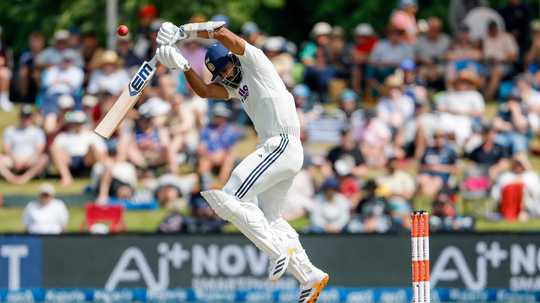
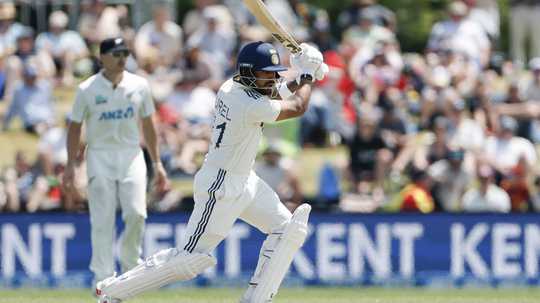
Jurel, who had initially played the supporting role, took on more responsibility after Akash’s dismissal. He reached a composed half-century—his fourth in Test cricket—and began finding the boundary more regularly. At lunch, he was unbeaten on 55 from 121 balls, with Gurnoor Brar alongside him. India had reached 206 for 8, having added 90 runs in 25 overs during the morning session.
Jurel’s 88 Keeps the Innings Alive
The ninth-wicket partnership between Jurel and Brar grew to 64, providing India with a final opportunity to narrow the gap. Brar contributed 10 from 46 balls before Kyle Jamieson bowled him after New Zealand took the second new ball. Jurel continued to attack, adding 19 with Jasprit Bumrah and carrying India past 240.
His innings ended at 88 when he edged Jamieson behind. The New Zealand fast bowler finished with four wickets, while his ability to return at key moments prevented India from turning a recovery into a more substantial total. Jurel’s knock was the standout effort of the innings, but India’s 246 remained 110 short of New Zealand’s first-innings score.
Conway and Ravindra Build New Zealand’s Advantage
India’s bowling options were affected before New Zealand began their second innings. Akash Deep was ruled out because of concussion, and Prasidh Krishna came in as his replacement—the first concussion substitute used by India in Test cricket. Jasprit Bumrah and Kamboj opened the attack, with Prasidh waiting to bowl after the initial spell.
Conway began aggressively, striking Bumrah for three boundaries. The early runs extended Bumrah’s wicketless sequence to 292 deliveries, a notably lean stretch for India’s premier fast bowler. He eventually ended it by dismissing Tom Latham, who played on to a short-of-a-length delivery. It was the third time Bumrah had removed Latham in the series, giving India a timely breakthrough.
Conway and Henry Nicholls then saw New Zealand safely through to tea at 36 for 1. After the interval, Prasidh joined the attack, but India struggled to disrupt the partnership. Conway and Nicholls added 41 runs, steadily increasing the lead and making the hosts’ position more secure.
Nicholls’ innings ended when he struck a leading edge back towards Bumrah, who took the catch. Conway then received a reprieve when an edge off Bumrah flew through KL Rahul’s hands at first slip and raced away for four. The chance was difficult, but the escape allowed Conway to continue building his innings.
Conway Reaches Fifty Before Jaiswal’s Spectacular Catch
Washington Sundar and Prasidh Krishna bowled together as the pitch began to look slower. Ravindra survived a close moment when he edged Prasidh, but the ball fell short of gully. At the other end, Conway showed patience against both pace and spin, picking his scoring opportunities carefully before reaching his second score of 50 or more in the series.
His innings ended when he sliced a delivery from Washington towards short third man. Yashasvi Jaiswal produced a superb one-handed catch to give India a much-needed third wicket. Conway’s 51 had helped New Zealand move beyond the danger of a quick collapse and put the innings on a solid footing.
Ravindra and Daryl Mitchell ensured there was no late breakthrough. They added an unbroken 40-run partnership, negotiating spells from Bumrah, Prasidh and Brar to take New Zealand to 133 for 3 at stumps. Ravindra was unbeaten on 42, while Mitchell remained alongside him as the hosts’ lead climbed to 243.
Day 4 Outlook: India Need Early Wickets
New Zealand’s advantage is substantial, but the precise target will depend on how long they bat on the fourth morning. A declaration could give India a demanding chase with time still available, while further runs would increase the pressure on the visitors. For India, early wickets are essential: allowing Ravindra and Mitchell to extend their partnership could make an already difficult task considerably harder.
The surface’s slower pace may offer some assistance to the bowlers, but New Zealand have shown they can score patiently and avoid unnecessary risks. India will also need to manage their attack carefully without Akash Deep. Bumrah has already broken through, while Washington’s dismissal of Conway showed that spin can create opportunities when batters are forced to manufacture shots.
End-of-day score: New Zealand 356 and 133 for 3 (Devon Conway 51, Rachin Ravindra 42 not out; Jasprit Bumrah 2 for 34), lead India 246 (Dhruv Jurel 88; Kyle Jamieson 4 for 69) by 243 runs.
Jurel’s innings gave India a reason to fight, but New Zealand finished Day 3 with the stronger hand. The next phase will test India’s ability to strike early and sustain pressure—and will shape the most important prediction of the match: whether the visitors can turn a difficult position into a genuine contest.