
JP Morgan Chase Wins North American Corporate Chess League Title
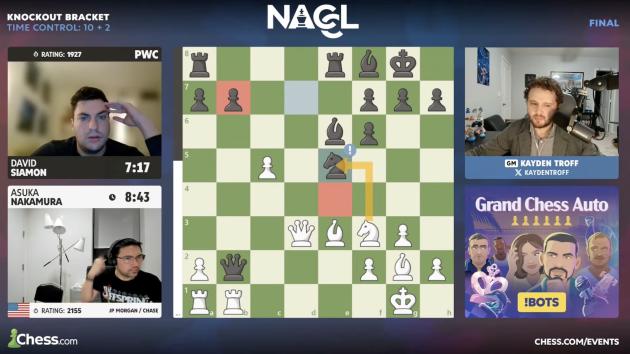
JP Morgan Chase captured its first championship in the North American Corporate Chess League, edging PwC 3-2 in a dramatic final. The victory capped a memorable run through the knockout rounds and gave the company its first title in the league’s 14-season history.
The championship match delivered the close team competition that makes corporate chess compelling: individual games swung momentum from board to board, and the result remained uncertain until the final points were secured. JP Morgan Chase’s lineup featured a mix of experienced international masters, FIDE Masters and rising talent, with Hikaru Nakamura among the team’s key contributors. His three victories across the playoff day helped propel the squad to the trophy.
The North American Corporate Chess League brings together companies based in the United States, Canada and Mexico for seven weeks of team competition on Chess.com. Its format gives employees and professional players the chance to represent their organizations in a fast-paced setting, where preparation, composure and teamwork can be just as important as individual brilliance.
Quarterfinals: Top-seeded JP Morgan Chase survives NVIDIA challenge
JP Morgan Chase entered the knockout stage as the top seed after a strong regular-season campaign. Its quarterfinal opponent was NVIDIA, a technology company led by International Master (IM) Christopher Song. On paper, the matchup promised a test for the top seed, and the games quickly became more complicated than the final score alone might suggest.
NVIDIA’s hopes took an early hit when Song encountered technical problems at the start of the playoffs. He was unable to complete his game against Vioreanu, handing JP Morgan Chase a point by forfeit. Technical difficulties can be especially costly in online chess, where a connection or platform issue may disrupt a player before the first move is even made.
NVIDIA managed one victory, but JP Morgan Chase collected points through Yang and Nakamura to secure a narrow 3-2 win. The result sent the top seed into the semifinals, while also showing how little room for error there is in a team match: even a single disrupted board can shape the outcome of an entire round.
Semifinals: Nakamura and Bian deliver decisive wins
In the semifinals, JP Morgan Chase faced Susquehanna, which had advanced by defeating Jane Street in the previous round. The matchup brought together two strong teams, and the contest again came down to a series of tightly fought games rather than a runaway performance.
Nakamura once more played a central role, earning a crucial victory for JP Morgan Chase. Bian added another point with a sharp win against Susquehanna’s opponent, giving the top seed important breathing room. Their results put JP Morgan Chase in a strong position, but Susquehanna continued to press.
Susquehanna struck back when its player defeated Yang, keeping the match alive and adding tension to the closing stages. JP Morgan Chase ultimately held on for a 3-2 victory. The narrow margin reflected the quality of the opposition and set up a final against PwC, which had defeated Meta to reach the championship match.
Finals: A 3-2 thriller decides the championship
PwC arrived in the final led by Grandmaster (GM) Alexander Baryshpolets. The team began strongly: Baryshpolets defeated Song in a complex game, while another PwC player extended a perfect playoff record to 3-0 by beating Yang. With two points on the board, PwC appeared to have seized control of the match.
JP Morgan Chase responded on the remaining boards. Nakamura produced his third win of the day, defeating National Master (NM) [player name unavailable in the source]. Bian also scored against [opponent name unavailable in the source], bringing the teams closer and increasing the pressure on the final game.
That game featured Feng in a tricky endgame against [opponent name unavailable in the source]. Endgames often demand precise calculation and patience: a small advantage must be converted without allowing the opponent to escape. Feng handled the position successfully, earning the point that clinched the match for JP Morgan Chase.
The final score was 3-2, completing the company’s championship run. After close wins over NVIDIA and Susquehanna, JP Morgan Chase finished the job against PwC, with the title secured by a team effort across multiple boards.
What the championship says about corporate chess
JP Morgan Chase’s first league title highlights the appeal of team chess beyond traditional club and national competitions. In a company league, players compete under a shared banner, but each board still presents its own strategic challenge. A team can be lifted by a standout performer, yet the overall result often depends on contributions from several players—and on how the lineup responds when momentum shifts.
The playoffs also illustrated the distinctive demands of online chess. Players must manage the same tactical and strategic decisions found in over-the-board competition while also dealing with a digital environment in which technical reliability matters. NVIDIA’s quarterfinal setback was a reminder that preparation includes more than opening study: equipment, connectivity and readiness can all affect a match.
For JP Morgan Chase, the championship represents more than a single successful final. It is the culmination of a season-long campaign, a strong regular-season seed and three demanding knockout matches. Nakamura’s perfect playoff day supplied vital points, while teammates including Bian, Yang and Feng helped turn those performances into a team trophy.
With its first North American Corporate Chess League crown now secured, JP Morgan Chase joins the competition’s list of champions after a finish that showcased close games, individual resilience and the unpredictable drama of team chess.