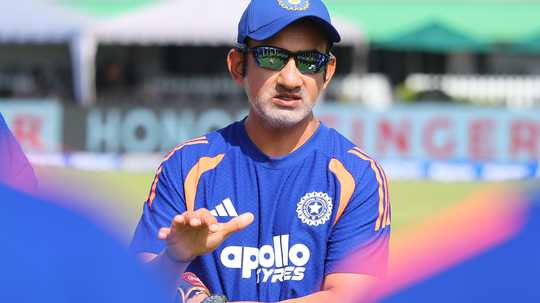

Gambhir Calls for a Fairer Bat-Ball Contest After India’s T20I Defeat
India coach Gautam Gambhir has renewed his call for conditions that give bowlers a stronger chance in T20 cricket after his side failed to defend 249 against West Indies in the second T20I in Ranchi. A flat pitch and heavy dew made life difficult for India’s attack, but Gambhir stressed that challenging conditions could not be the only explanation for the defeat.
West Indies chased down the target with remarkable authority, recording the second-highest successful run chase in men’s T20 internationals. Shai Hope again led the visitors’ response, while Sherfane Rutherford’s explosive innings turned a demanding pursuit into a memorable victory. The result levelled the series and gave both teams plenty to consider ahead of the third match.
Speaking after the game, Gambhir argued that cricket is most compelling when bat and ball are both able to influence the contest. He said teams should not have to choose between high-scoring entertainment and a genuinely competitive match, adding that bowlers deserve conditions in which their skills can make a difference.
Why Gambhir Wants More Balance in T20 Cricket
Gambhir’s comments reflect a wider discussion about the direction of the shortest format. Modern bats, aggressive tactics and increasingly powerful hitting have helped make T20 cricket a spectacle, but pitches that offer little assistance—combined with dew that makes the ball slippery—can leave bowlers with limited options. When batters can attack with minimal risk, even a large first-innings total may not feel secure.
The India coach also pointed to the personal stakes for bowlers. Players work hard to earn a place in the national dressing room, he said, and they should be able to compete on conditions that test both disciplines. A more even contest, in his view, would not diminish the entertainment; it could produce smarter tactics, tighter finishes and more varied cricket.
That perspective is especially relevant in a series featuring two powerful batting line-ups. India’s total of 249 would ordinarily be expected to put a team in a commanding position, yet West Indies showed how quickly momentum can shift when the surface remains true and the ball becomes difficult to grip. For fans following cricket prediction discussions, the match was a reminder that a big total does not automatically guarantee victory in a dew-heavy T20 game.
India Must Still Find Answers Under Difficult Conditions
Although Gambhir acknowledged the challenge posed by the Ranchi conditions, he did not use the pitch or dew to excuse the loss. He said India needed to examine the performance honestly, particularly because the team has high expectations after winning the T20 World Cup. In his view, improvement means confronting setbacks rather than explaining them away.
West Indies had made a poor start, losing two wickets in the opening over and three inside the first six. That early damage gave India an opportunity to take control of the chase. However, the visitors recovered, showing the depth and power in their batting order. Gambhir said India must learn how to contain opponents even when conditions favour stroke-play, especially after creating such an encouraging opening.
That challenge involves more than simply bowling faster. Captains and bowlers must adjust their plans to the pitch, the wet ball and the batters at the crease. Yorkers, changes of angle and well-protected boundary options can all matter, but execution becomes harder when the ball is slippery and the surface offers little movement. India will need a clearer plan for those moments as the series continues.
Rutherford’s Lifeline Changes the Course of the Chase
A key moment arrived on the final delivery of the 10th over, when Mayank Yadav dropped a catch at short fine leg. Rutherford was batting on 38 at the time and made India pay, going on to score 84 from 37 balls. His innings combined power with urgency, helping West Indies regain control after the early loss of wickets.
The missed chance was costly, but Gambhir refused to make it the sole explanation for the result. Dropped catches are part of cricket, he said, and players do not miss opportunities deliberately. His response suggested that India should focus on the wider performance rather than assign blame to one fielder or one moment.
Even so, the incident adds to a fielding concern for India. The team entered the series with a catching efficiency of 74.3% in T20 internationals in 2026, the second-lowest figure among full-member nations, according to the figures cited after the match. In a format where a single reprieve can produce a rapid change in scoring, improving fielding could be as important as refining the bowling plans.
Mayank’s Pace Gives India an Encouraging Sign
Mayank’s performance offered a positive note despite the dropped catch. He claimed three wickets and unsettled the West Indies top order with deliveries regularly reaching the 145 kph range. One ball to Rovman Powell was recorded at 149.5 kph, underlining the pace that makes the young quick a significant option for India.
Gambhir encouraged Mayank to trust that natural strength. The coach’s message was straightforward: a fast bowler capable of approaching 150 kph should not be afraid to use that speed. Mayank had mixed in slower deliveries in the opening match in Lucknow, but in Ranchi he attacked with greater pace and was rewarded with wickets.
That does not mean variation has no place in T20 cricket. Rather, Gambhir’s point was that a bowler’s plans should be built around his strongest weapon. For Mayank, pace can create hurried shots, force mistakes and make batters think twice before committing to an aggressive stroke—particularly when the fielding side is searching for a breakthrough.
Indore Offers India a Quick Chance to Respond
India have little time to dwell on the Ranchi defeat, with the third T20I scheduled for Sunday in Indore. The venue has a reputation for high scores, so another run-heavy match is a possibility. That makes the upcoming contest an important test of India’s ability to adapt, defend under pressure and convert early wickets into sustained control.
For supporters, the next match offers more than a simple series update. It will show whether India can sharpen their execution in challenging conditions and whether West Indies can carry their momentum forward. Any cricket prediction for the game will need to account for the venue, the likely influence of dew, the form of Hope and Rutherford, and the threat posed by Mayank’s pace.
Gambhir’s broader message remains clear: T20 cricket is at its best when both batters and bowlers have meaningful opportunities to shape the outcome. India’s defeat exposed the difficulty of defending a huge score, but it also highlighted areas the team can address—fielding, death bowling and decision-making under pressure—before the series moves on.