
Steven Smith Injury Concern Casts Shadow Over Australia’s Test in Durban
Australia’s first Test against South Africa took a worrying turn on Monday when Steven Smith was absent from the field during the hosts’ second innings at Kingsmead. The veteran batter had been struck on the helmet by a short-pitched delivery from Anrich Nortjé earlier in the day, prompting Cricket Australia to begin monitoring his condition for possible concussion.
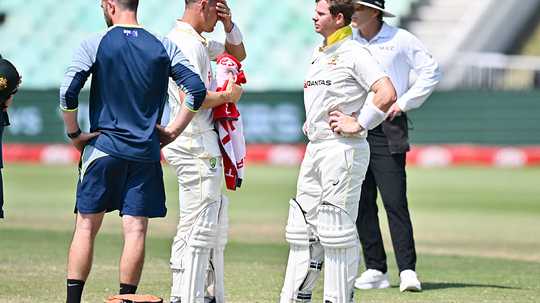
The incident occurred on the fourth day, during the 43rd over of Australia’s innings. Smith appeared to lose sight of Nortjé’s rising delivery and ducked into its path. The ball struck near the top of his helmet, seemingly after a slight glance. Play stopped while medical staff assessed him, and Smith changed helmets before continuing his innings.
Cricket Australia said Smith would be assessed and that a further update would be provided “later today or tomorrow.” His absence from the field during South Africa’s chase of a target of 421 made the situation more concerning, although it did not by itself confirm a concussion. Michael Neser took Smith’s place, leaving Australia without one of its most experienced close catchers at a crucial stage of the match.
Smith’s Response at the Crease Offered Some Reassurance
After the blow, Smith faced the next 10 deliveries from off-spinner Simon Harmer before Nortjé returned to the attack. The sequence that followed showed the familiar concentration and composure that have defined Smith’s batting career. He worked two deliveries from Nortjé into the leg side, though neither brought him a run, then produced a sharp burst of attacking strokes.
Smith struck three consecutive boundaries through gully, point and backward point, with a wide interrupting the sequence. The shots were controlled and decisive, offering a brief indication that he was able to continue. He went on to face another 22 balls before being caught in the deep off Harmer.
That innings, however, could not settle the medical question. Concussion symptoms may not be immediately obvious, and a player’s ability to bat after an impact does not necessarily mean they are clear to resume all duties. Australia’s medical staff will need to consider Smith’s symptoms and follow the relevant assessment protocols before deciding whether he can return to the field or be available for the next Test.
Australia Could Miss Smith’s Exceptional Work in the Slips
Smith’s value to Australia extends well beyond his runs. On Sunday, he took three outstanding catches in the slips, including two remarkable efforts off Nathan Lyon. Lyon later praised his long-time teammate, saying he had been fortunate to have Smith at first slip or leg slip for much of his career and was “extremely grateful” for his presence there.
The importance of that skill became apparent during South Africa’s second innings. About a dozen overs into the chase, Lyon drew Aiden Markram forward in defence. The ball took the outside edge, struck wicketkeeper Alex Carey’s elbow and flew towards the slip cordon. Marnus Labuschagne, wrong-footed by the deflection, could not reach it.
It was an exceptionally difficult chance, made more complicated by the ball’s change of direction. Smith’s quick reactions and anticipation have made him one of cricket’s most dependable close fielders, and it was easy to imagine him having a chance at a catch that few others might even attempt. The moment underlined how his absence could affect Australia’s fielding as the visitors tried to defend a substantial target.
A History of Head Injuries Makes the Assessment Crucial
The latest blow is particularly concerning because Smith has previously dealt with concussion and vertigo. Since August 2019, he has been concussed twice and experienced vertigo on three occasions, with the symptoms forcing him to miss two matches. That history does not determine the outcome of the current assessment, but it makes a cautious approach especially important.
For Australia, Smith’s health must take priority over the immediate demands of the Test. A player who has been struck on the helmet should not be rushed back simply because the team needs his experience or his ability in the slips. Medical staff will be watching for symptoms such as headache, dizziness, nausea, confusion or problems with balance and concentration, while also considering how he responds over time.
His absence could also influence Australia’s plans for the rest of the match. With South Africa pursuing 421, the visitors need sharp catching, disciplined bowling and clear communication in the field. Smith’s experience is valuable in each area, but the team will have to adjust if he is unavailable. Labuschagne, Carey and the other fielders may need to take on additional responsibility around the bat.
Second Test Availability Remains a Key Question
The timing adds another layer to the uncertainty. The second Test is scheduled to begin at St George’s Park on Sunday, giving Australia only a short window to assess Smith and prepare for the next match. If he is diagnosed with concussion, he will not be considered for selection, and the team may have to make changes to both its batting order and fielding setup.
That possibility is relevant to cricket prediction and analysis ahead of the next Test, but any forecast should remain cautious until Cricket Australia provides a medical update. Smith’s availability could affect Australia’s batting stability, the balance of the side and its close-catching strength. At the same time, South Africa’s position in the first Test and the conditions at St George’s Park will also shape expectations.
For now, the focus is on the assessment rather than speculation. Smith showed enough after the impact to continue batting and produce a fluent run of boundaries, but his later absence from the field makes clear that Australia is taking no chances. The coming update will determine whether the incident was a temporary precaution or a more serious setback—and whether one of the team’s most influential players can take part in the next chapter of the series.