
Wiaan Mulder Leads South Africa to Dramatic Test Victory Over Australia
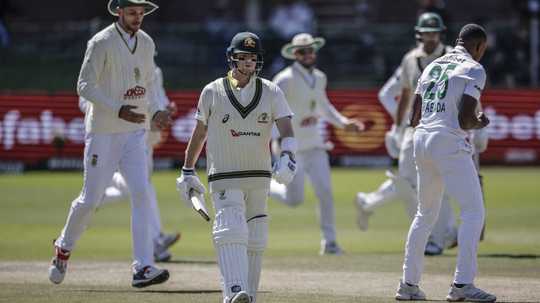
South Africa overcame rain, a stubborn Australian resistance and the pressure of a tense final day to secure a commanding victory at St George’s Park. Wiaan Mulder delivered the decisive spell, taking apart Australia’s lower order and ending Scott Boland’s remarkable fightback as the hosts won by an innings and 31 runs.
Boland, unexpectedly promoted from nightwatchman to one of Australia’s last hopes, batted for 166 balls. His innings ended when Mulder found movement back into the right-hander, slipping the ball past his defensive bat and into the stumps. The dismissal removed the final obstacle to South Africa’s win and capped a performance built on disciplined bowling, timely breakthroughs and patience in difficult conditions.
Rain delays Australia’s fight for survival
Australia began the final day under pressure after following on, with Travis Head and Boland at the crease. Boland had joined Head the previous evening as a nightwatchman, managing just two runs from 23 deliveries before stumps. What began as a short-term defensive assignment became a substantial Test innings when rain delayed play and forced Australia to spend much of the first session waiting to resume.
The weather had already disrupted the opening two days, and the lost time on the final morning added another complication for South Africa. It also delayed the arrival of the second new ball, giving Australia’s batters a little more time to settle. South Africa were without injured fast bowler Anrich Nortje, but Kagiso Rabada and Mulder still had enough control and variety to keep the pressure on.
Rabada repeatedly tested the outside edge with deliveries that passed close to Head’s bat. Off-spinner Simon Harmer also surrounded Boland with fielders, inviting him to take a risk. For a long stretch, Australia’s priority was simply to survive. Head, however, was not content to defend throughout: he moved past 100, reaching his second overseas Test century and his first in more than three years.
Travis Head’s century and Boland’s unexpected resistance
Head’s 121 was the innings that gave Australia’s last stand its shape. He combined measured defence with the ability to score when the bowlers offered room, keeping the visitors’ hopes alive well into the day. His century was especially valuable in a match where Australia had been forced to recover from a first-innings total of just 99.
Boland’s contribution was different but just as important to the contest’s final phase. He absorbed pressure, left carefully and made South Africa work for every chance. Yet his innings was not limited to defence. With slips waiting for an edge, he surprised Rabada with an ambitious ramp, and he also punished width by cutting and slicing the ball through the point region.
The knock became one of the longest innings by an Australian nightwatchman, underlining how dramatically Boland’s role had changed. He had entered as a temporary shield for a specialist batter; by the final session, he was a central figure in Australia’s attempt to resist defeat.
Mulder breaks through as South Africa seize control
Mulder’s accuracy ultimately proved more effective than Boland’s resilience. Bowling with the wicketkeeper close, he repeatedly attacked the stumps and used the movement available from the surface. The pitch offered seam for the quicks and occasional sharp turn for Harmer, making it difficult for Australia to settle into a reliable scoring rhythm.
After the drinks break, Mulder produced the breakthrough South Africa needed. Head tried to take on the bounce but chopped the ball onto his stumps, ending a determined century and shifting the balance of the innings. Mulder’s approach was simple but relentless: keep the ball threatening the stumps, make the batter play, and wait for an error.
The second new ball soon gave Rabada another opportunity to attack. Steve Smith, batting at No. 7 because of a neck issue, was dismissed in an unusual fashion. He chased a wide bouncer and sent a top edge into the air. Matthew Breetzke held the catch after a brief fumble, while captain Temba Bavuma watched anxiously from a distance, hoping the chance would not be spilled.
Boland then found a partner in Alex Carey, and together they helped Australia reach the final session. But the lower order could not turn that resistance into a serious threat. Mulder’s ball to Boland jagged back to hit the stumps; his delivery to Pat Cummins then beat the outside edge and clipped the top of off. The pair of wickets left Australia’s hopes fading quickly.
Rabada and Jansen finish the job
Dark clouds gathered over the ground as Australia’s tail tried to prolong the match, raising the prospect of another weather interruption. This time, however, the rain stayed away. Rabada returned to the attack and bowled Mitchell Starc with a full delivery, ending a brief stand with Carey.
Marco Jansen completed the victory when Josh Hazlewood slashed loosely at a delivery and sent the ball to the slips. The catch gave Jansen his only wicket of the innings and set off South Africa’s celebrations. The result was a significant landmark: South Africa had not beaten Australia after enforcing a follow-on since 1970. It was also only their fourth innings victory over the Australians.
The match offered a clear lesson in how a Test can turn on a combination of conditions and execution. Rain disrupted the schedule, Nortje’s absence reduced South Africa’s pace resources, and Head and Boland mounted a resistance that briefly made the finish uncertain. But Mulder’s sustained accuracy, supported by Rabada’s new-ball threat, ensured the hosts remained in control when the decisive moments arrived.
Match result and scorecard
South Africa 425/9 declared defeated Australia 99 and 295 (following on) by an innings and 31 runs. Travis Head scored 121, while Scott Boland made 40. Kagiso Rabada took 4-77 and Wiaan Mulder claimed 3-64.
For cricket fans following the series, the result is a reminder that a Test prediction can change quickly when a team’s lower order resists and a bowler finds a decisive spell. Australia showed grit through Head and Boland, but South Africa’s attack had the final word—and Mulder’s performance was the difference between a tense finish and a memorable home victory.