
Real Madrid vs Sevilla: Mourinho’s Refereeing Flashpoints Return to Focus
Real Madrid’s latest meeting with Sevilla brings more than the usual La Liga stakes. For José Mourinho, matches involving the Andalusian club are tied to two of the most memorable disputes of his career with referees: a heated confrontation after Roma lost the 2023 Europa League final and a dramatic Real Madrid press conference in 2010, when he presented a list of 13 decisions he believed had gone against his team.
Those episodes have resurfaced as debate over Real Madrid, Spanish refereeing and the football authorities intensifies. They also offer a revealing look at Mourinho’s approach to controversial calls: he has often challenged officials publicly, while arguing that clubs should not leave managers to defend their teams alone.
Roma’s Europa League final defeat to Sevilla
The latest flashpoint came in Budapest in May 2023, when Mourinho’s Roma faced Sevilla in the Europa League final. Roma were seeking a second consecutive European trophy after winning the Europa Conference League the previous season. Sevilla, meanwhile, were pursuing another title in a competition they have dominated for years.
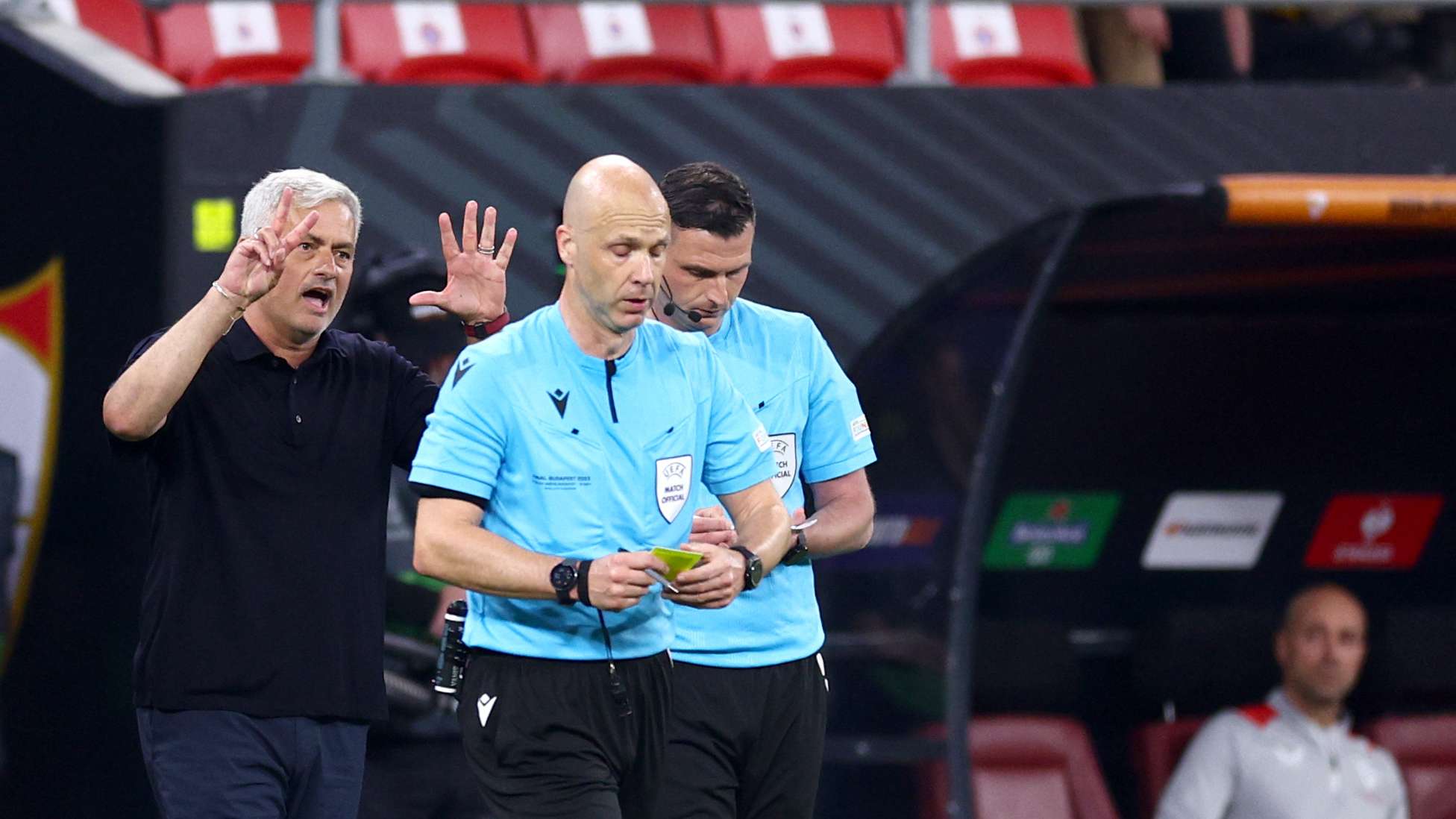
The final finished level after extra time, and Sevilla won the trophy on penalties to claim their seventh Europa League title. Mourinho was furious with several refereeing decisions and felt they had made Roma’s task more difficult. His frustration boiled over after the final whistle, when he confronted English referee Anthony Taylor and said: “You are a disgrace.”
UEFA later opened disciplinary proceedings and imposed a four-match suspension on the Roma coach. But the controversy was not confined to the pitch. At his post-match press conference, Mourinho criticised the number of yellow cards issued and argued that Sevilla forward Erik Lamela should have received a second caution. Lamela later scored in the penalty shootout.
“We go home feeling dead because of the injustice,” Mourinho said, while also acknowledging that it had been a major final. He questioned the consistency of the officiating and maintained that Roma had been treated unfairly despite their performance.
A dispute that continued after the final whistle
The confrontation carried on inside the Puskás Aréna car park. Mourinho reportedly showed footage of a penalty decision awarded to Sevilla before a video assistant referee review overturned it. Roberto Rosetti, UEFA’s refereeing chief, attempted to calm the coach, but Mourinho remained unconvinced. He argued that Rosetti had agreed with the officials and challenged Taylor’s handling of the incident.
The episode demonstrated how VAR can resolve a decision without necessarily ending the argument around it. Even when a review changes a call, coaches may still question the process, the original judgement or the wider consistency of decisions during a match.
Months later, Mourinho was asked again about Taylor. He avoided repeating his earlier criticism, saying that doing so could bring another lengthy suspension. The remark suggested that the final remained a source of frustration long after the trophy had been decided.
The 2010 Real Madrid-Sevilla match and the list of 13
Mourinho’s history of refereeing disputes connected to Sevilla stretches back to December 2010, during his first season in charge of Real Madrid. Madrid won the game 1-0, with Ángel Di María scoring the only goal, but the result was quickly overshadowed by Mourinho’s complaints about the officiating.
At the post-match press conference, he displayed a list of 13 incidents he considered serious errors by referee Clos Gómez. The complaints covered a range of situations, including offside decisions, fouls, possible bookings, a penalty appeal and the calculation of stoppage time.
Mourinho particularly objected to offside calls involving Mesut Özil, Karim Benzema and Di María, believing the Madrid players had been onside. He also pointed to a challenge on Esteban Granero in the 69th minute that he thought should have resulted in a penalty. Another source of frustration was Ricardo Carvalho avoiding a second yellow card after a clash with Álvaro Negredo.
He also questioned why Özil was booked for time-wasting while leaving the field, arguing that similar behaviour by Sevilla players had not been treated in the same way. Taken together, the incidents formed the basis of Mourinho’s case that the match had been officiated inconsistently.
Mourinho’s message to Real Madrid’s leadership
The list was more than a public criticism of the referee. Mourinho also used the moment to challenge Real Madrid’s leadership, saying he did not want to be the only person speaking up for the team. He called for a meeting with club president Florentino Pérez and expressed frustration that the responsibility for protesting seemed to fall on him alone.
“This team deserves someone to defend it,” Mourinho said, adding that the club had an administrative structure and that its officials should share that responsibility. He warned that if he personally acted on every list of alleged errors, the likely outcome would be another suspension for him.
His comments were also understood as a criticism of senior club figures, including general director Jorge Valdano and sporting director Miguel Pardeza. The dispute highlighted a familiar tension in elite football: managers may want institutional backing, while club executives often prefer to avoid turning individual refereeing decisions into a public confrontation.
Why the old controversies still matter
These episodes are relevant beyond Mourinho’s personal history. Refereeing decisions can shape the mood around a fixture, particularly when they involve high-profile clubs, major trophies or a sequence of disputed calls. Coaches use press conferences to explain their perspective, but public criticism can also bring disciplinary consequences and shift attention away from the players’ performance.
The two Sevilla-related disputes show different sides of the same issue. In Budapest, Mourinho’s anger followed a European final decided by a penalty shootout, with VAR and post-match review adding to the debate. In Madrid in 2010, he turned a domestic league victory into a wider argument about perceived errors and the club’s duty to stand behind its team.
As Real Madrid and Sevilla meet again, the history adds an extra layer to the occasion, though it does not determine what will happen on the pitch. Any football prediction for the match should rest on current form, team news, tactical choices and the quality of chances created—not on old disputes with referees. Still, Mourinho’s past makes clear why a contentious decision in this fixture can quickly become a story well beyond the final score.