
Manchester United’s Champions League Night Unravels in 2-0 Defeat to Atletico Madrid
Manchester United’s Champions League visit to the Riyadh Air Metropolitano ended in a damaging 2-0 defeat, as an early goal and a second-half red card undermined Michael Carrick’s side. Atletico Madrid seized control almost immediately, then used their defensive discipline and numerical advantage to protect their lead before Ademola Lookman struck late to settle the match.
The result will concern United not only because of the scoreline, but also because of how quickly their game plan came apart. Pablo Barrios scored inside the opening minute, leaving the visitors chasing the contest from the outset. Leny Yoro’s dismissal in the 74th minute made that task considerably harder, while Atletico’s compact shape restricted United’s ability to build sustained attacks.
Barrios Punishes United Within the First Minute
United arrived in Madrid needing a composed start against one of Europe’s most tactically disciplined teams. Instead, Atletico found a route through the visitors’ mid-block almost immediately. Barrios exploited space between the lines and finished to give the hosts an early advantage, setting the tone for a difficult evening for Carrick’s team.
Going behind so quickly changed the demands of the match. United had to find a way back against a side comfortable defending a lead, while also guarding against Atletico’s ability to counterattack into open space. The visitors’ defensive organisation looked unsettled in the opening exchanges, and the early goal allowed Diego Simeone’s team to settle into its preferred rhythm.
Atletico’s 4-4-2 structure proved difficult for United to play through. The hosts stayed compact, protected central areas and pressed selectively, making it hard for the visitors to move the ball into dangerous positions. United often had possession in areas where Atletico were comfortable allowing them to play, but struggled to turn that control into clear chances.
United Struggle to Find a Way Through
United finished with 42% possession and nine shots, figures that underline the difficulty they faced in taking control of the game. The number of attempts alone did not reflect the quality of their attacking threat: too many efforts came from low-probability positions, while Atletico limited the space available around the penalty area.
The central channel was particularly hard for United to access. With Atletico’s midfield line staying close to its defence, passing lanes into the forwards were often blocked or quickly closed down. United were left trying to advance through wider areas, where the home side could shift across as a unit and make crosses easier to defend.
That pattern also reduced the impact of United’s possession when they did manage to retain the ball. Moving it from side to side was not enough to unsettle Atletico’s shape, and the visitors needed quicker combinations, better movement between the lines and more precise final passes to create meaningful openings. Without those elements, the match increasingly suited the home side.
Yoro’s Red Card Changes the Contest
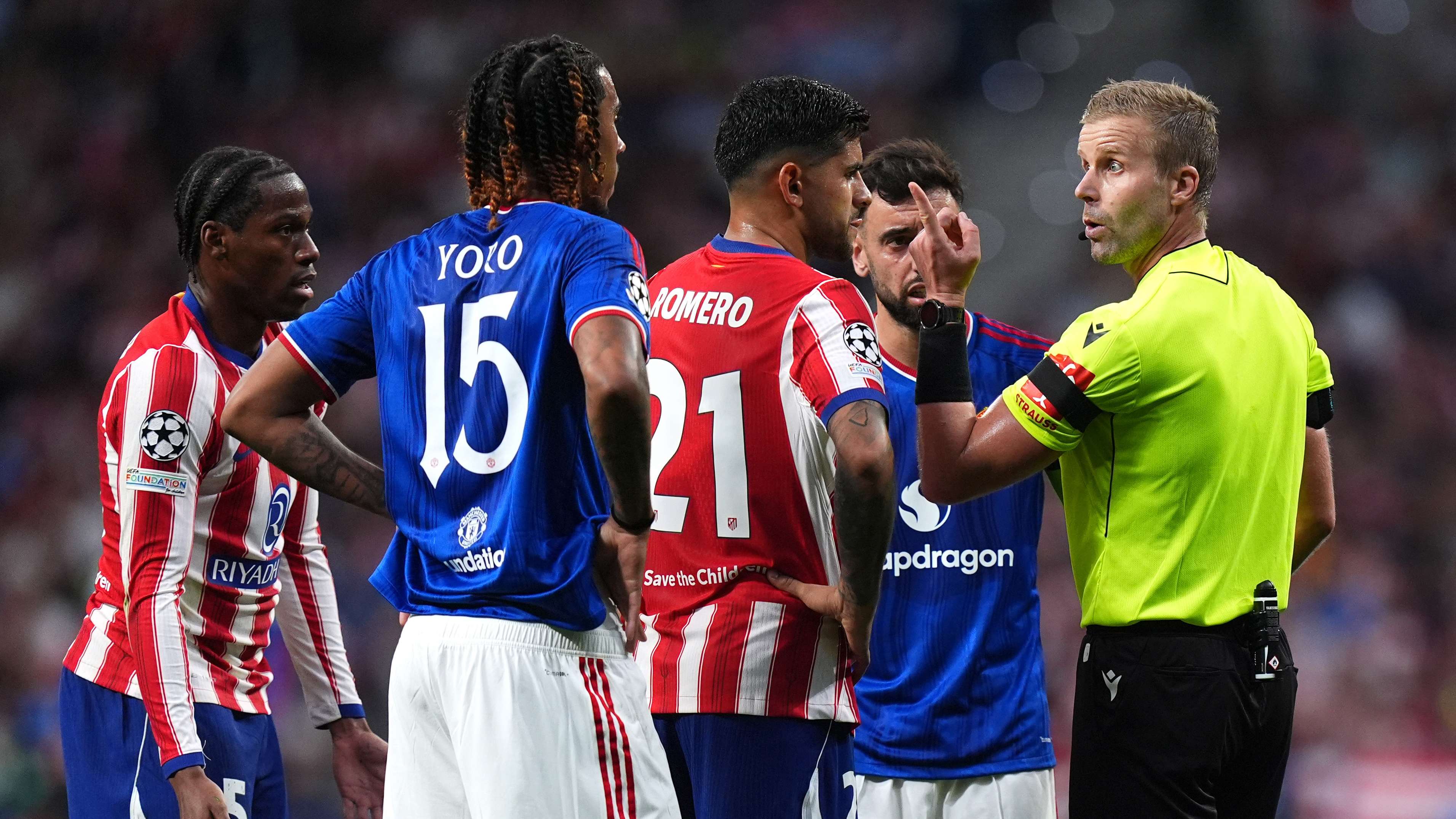
The second half offered United a chance to reset and build pressure, but the contest shifted decisively in the 74th minute when Yoro was sent off. Reduced to ten players, Carrick’s side had little choice but to retreat and protect its goal. The dismissal disrupted any remaining attacking plans and placed greater strain on a defence that had already spent much of the evening responding to Atletico’s movement.
Playing with a numerical advantage gave Atletico more room to circulate possession and stretch United’s defensive shape. The visitors had to cover more ground, close down passing options and remain alert to runners arriving in the box. Under those conditions, launching a comeback became increasingly unlikely.
The red card was a pivotal moment, but it did not explain the entire defeat. United had already struggled to impose themselves before Yoro’s dismissal, and the first-minute goal had forced them into a reactive position. The sending-off turned a difficult challenge into a far steeper one, while highlighting the importance of discipline in a high-pressure Champions League away match.
Lookman Seals Atletico’s Victory
Atletico made their advantage count late in the match, with Lookman doubling the lead. The goal confirmed the hosts’ control and removed any lingering possibility of a United comeback. For Simeone’s side, it was a reward for a performance built on defensive organisation, patience and an ability to take advantage of key moments.
United, meanwhile, left Madrid with more questions than answers. Their lack of central penetration limited their attacking options, while the early concession meant they were forced to pursue a game against an opponent adept at managing a lead. The growing injury list also added to the challenge, reducing Carrick’s flexibility as he looked for ways to change the contest.
What the Result Means for United’s Champions League Campaign
This 2-0 result gives Atletico a valuable advantage and leaves United needing a significant improvement in any subsequent meeting. A comeback would require greater control of the midfield, more purposeful movement in the final third and a much sharper start. United would also need to avoid the defensive lapses and disciplinary errors that allowed the game to slip away in Madrid.
For supporters assessing the next fixture prediction, the key question is whether United can create more high-quality chances without leaving themselves exposed at the back. Atletico have shown they can defend compactly and punish mistakes, so the Red Devils will need to balance attacking urgency with defensive discipline. Simply having more possession or taking additional shots may not be enough unless those efforts come from better positions.
Atletico’s performance offered a familiar lesson in Champions League football: a clear tactical structure can be decisive when paired with concentration and clinical finishing. United’s night was shaped by three defining moments—the opening goal, Yoro’s red card and Lookman’s late finish. Together, they turned a challenging away match into a comprehensive setback and left Carrick’s side with plenty to address before their next European test.