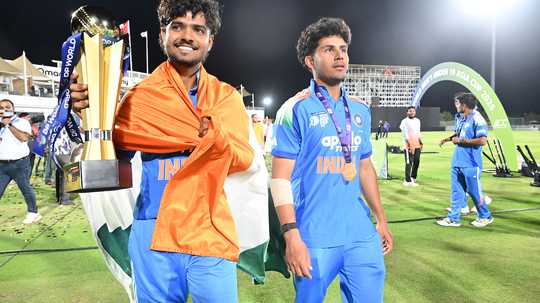

Mohit Ulva’s Last-Ball Heroics Turn an Under-19 Asia Cup Final Into a Career-Defining Moment
Mohit Ulva had around 2,000 followers on Instagram before the Under-19 Asia Cup final. One boundary later, the 18-year-old’s profile had surged past 40,000 followers—and the attention is still growing. Yet the young Saurashtra cricketer says he is trying to stay focused on the game rather than the sudden spotlight.
Ulva became the face of a dramatic finish in Muscat, striking the final ball for four to give India a thrilling one-wicket victory over Pakistan. The result secured the Asia Cup title and delivered a memorable moment in one of cricket’s most closely followed rivalries. Soon after the celebrations, he travelled from Muscat to Indore to join Saurashtra’s senior squad for the Syed Mushtaq Ali Trophy.
In a conversation with Cricbuzz, Ulva reflected on the pressure of the chase, the thinking behind his decisive shot and the support that helped him reach the India Under-19 team. His account offers a glimpse into the preparation and composure behind a finish that looked extraordinary from the stands.
How Ulva Read the Final Ball
India needed eight runs in the final over, with Ulva at the crease and the match hanging in the balance. He said he was waiting for an opportunity to find the boundary, believing that one well-timed four could bring the target within reach. The decisive delivery arrived on the final ball: short and outside off stump.
Ulva stepped out of his crease and created room, then struck the ball through the gap between extra cover and long-off. Rather than attempting an unnecessarily risky aerial shot, he focused on finding the open space in the field. The bowler had used a similar line earlier in the over, and Ulva felt he had identified a chance to score if the delivery came again.
“I just had to find that gap,” he explained. His confidence, he said, came from waiting for the right ball and backing a shot he had practised. The boundary completed a tense chase and instantly transformed the teenager into a national talking point.
A Famous Comparison He Had Not Heard
Fans and commentators compared the finish with Javed Miandad’s celebrated last-ball six against India in Sharjah in 1986. That shot, hit off Chetan Sharma, remains one of the most iconic moments in India-Pakistan cricket. Ulva, however, admitted he knew little about the historic match. Born in 2007, he had not yet entered the world when Miandad’s six changed the course of that contest.
The comparison reflects the emotional weight attached to last-ball finishes between the two countries, but Ulva’s own moment was shaped by a different generation, format and match situation. His focus during the chase was less on cricket history than on reading the bowler, assessing the field and staying present under pressure.
Trust in the No. 11 Batter Helped India Stay in the Chase
Ulva was not alone in the final-over drama. He had to manage the strike with No. 11 Chigurupati Venkata, and he said the team had confidence in its batting depth all the way down the order. Venkata, he noted, sometimes opens for his state side and was capable of contributing with the bat.
That trust was reinforced by a conversation between the pair. Venkata encouraged Ulva not to shoulder the entire responsibility, promising to look for a single and avoid wasting deliveries. The exchange helped Ulva remain calm and focus on keeping the chase alive rather than trying to finish the match on every ball.
Ulva and teammate Manal Chauhan also kept track of Pakistan’s bowling options. They knew several of the main bowlers had limited overs remaining and expected that a spinner or part-time bowler might have to deliver an over. When the final over came from a part-time option, the situation matched the possibility they had discussed.
Earlier, with India at 252 for eight in the 42nd over while chasing 338, the message between Ulva and Chauhan was straightforward: one of them needed to remain at the crease until the end. They avoided overcomplicating the task, concentrating on watching the ball, taking opportunities and extending the partnership.
Practice Built Around Pressure Situations
Ulva describes himself primarily as a bowling all-rounder, but he regularly prepares for demanding batting situations. Because he often bats in the lower order, he sets himself challenging practice targets—such as scoring 100 runs in 10 overs with only three wickets available. If he fails to meet the target, he treats the scenario as a lost match.
That kind of training is designed to make pressure familiar. Lower-order batters may have little time to settle, and they often need to score quickly while protecting the remaining wickets. By rehearsing those conditions, Ulva aims to build the decision-making and attacking confidence required to contribute late in an innings.
He had limited batting opportunities during the Asia Cup because India’s top order was strong. Before the final, his only other chance came against the United Arab Emirates, when he faced two balls at the end of an over and hit one for six. The final, therefore, became his longest innings of the tournament—and the most consequential.
From Surendranagar to the India Under-19 Team
Ulva comes from Surendranagar, with Lakhtar as his hometown. His father, who works with the Railway Protection Force, encouraged his cricket journey from the beginning, while his mother is a homemaker. The family later moved as his father’s work took him between Jamnagar and Rajkot, giving Ulva opportunities to develop within Saurashtra’s cricket system.
His route was competitive. At his first Rajkot district selection trials, he faced hundreds of players. He earned a place in the Under-16 side and made an early impression with an 86 off roughly 70 balls in a semi-final after arriving when his team was struggling at 52 for six. That performance helped him earn selection for Saurashtra Under-16.
Progress was not immediate or effortless. Ulva played only two matches in his first Vijay Merchant Trophy season and initially found the transition to white-ball cricket difficult. Saurashtra continued to back him, however, and he responded with strong performances in the Cooch Behar Trophy. He later attended National Cricket Academy camps, captained Rajkot at Under-16 level and earned selection for India Under-19, including a red-ball series against Australia.
Ulva credited his state association, selectors and Jaydev Shah for continuing to support him during quieter periods. That backing, he said, helped him keep improving and earn opportunities at higher levels.
Staying Grounded as Attention Grows
The surge in followers has brought messages from fans and praise from prominent cricket figures. Ulva said he appreciated the support, including a social media post from Yuvraj Singh and a post he saw from former Pakistan fast bowler Shoaib Akhtar. He is trying to reply to messages when his schedule allows, though his manager handles many calls and he avoids answering unknown numbers.
He also defended the team’s celebrations after the final, describing them as a natural response to a high-stakes India-Pakistan victory rather than anything intended to provoke. The team later held a cake-cutting celebration and dinner, while players also reviewed their performances across the tournament.
Next Goal: Establishing Himself in Senior Cricket
Although Ulva acknowledged that an IPL opportunity would be welcome, he is not treating it as an immediate expectation. His priority is to establish himself in Saurashtra’s senior side during the Syed Mushtaq Ali Trophy and make the most of every chance he receives.
For young players and cricket fans looking for a prediction about what comes next, one dramatic finish is not enough to define a career. Ulva’s progress will depend on consistency, adaptability and how he handles the step up from age-group cricket. His composure in Muscat has offered an encouraging early sign, but he knows the work continues.
“I want to perform consistently, move to a higher level and keep improving,” he said. The last-ball boundary may have introduced Mohit Ulva to a much wider audience. His next challenge is to turn that unforgettable moment into a foundation for sustained success.