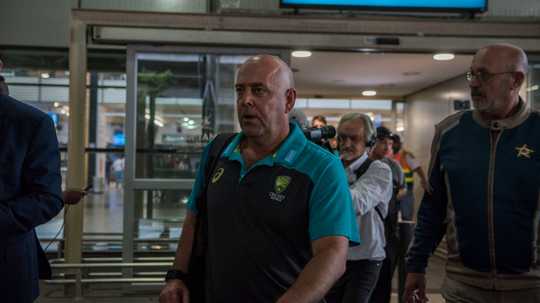

Darren Lehmann Repeats Sandpapergate Denial as Fresh Claims Renew Cricket Debate
Former Australia head coach Darren Lehmann has again denied knowing that sandpaper would be used during the 2018 ball-tampering scandal, as renewed accounts from people involved have brought one of cricket’s most damaging controversies back into the spotlight.
Speaking on ABC radio during the first T20I between Australia and England, Lehmann said his account of the events had not changed. He acknowledged that the team had made serious mistakes, but maintained that he was unaware of the specific plan to alter the ball with sandpaper.
“My version stays the same,” Lehmann said, reiterating that he “didn’t know” sandpaper would be used. He described the episode as a difficult period for everyone involved and said the people connected to it needed to find a way to move forward.
New accounts bring old questions back into focus
The renewed discussion follows a series of recent comments by former players, including a lengthy article by Cameron Bancroft published in The West Australian. Bancroft, who was caught on camera with sandpaper during the second Test against South Africa in Cape Town, offered further details about the events surrounding the plan.
In his account, Bancroft alleged that Lehmann and then bowling coach David Saker had agreed to the plot during the tea break on the second day of the match. The claim has added to longstanding questions about who knew what, and when, during the incident.
Asked about Bancroft’s description of the conversation, Lehmann said he could not recall it. He pointed to the time that had passed since the Test, which took place more than eight years ago, and said those involved should be asked directly about their recollections.
“I can’t remember that conversation,” he said. “I have my version and that’s where I stand.” Lehmann’s response leaves a clear difference between his account and Bancroft’s allegation, while offering no new detail to resolve the disagreement.
Why Sandpapergate remains a defining cricket controversy
The scandal erupted during Australia’s 2018 Test tour of South Africa, when television footage showed Bancroft attempting to use sandpaper to roughen one side of the ball. The aim was to influence its movement through the air, a practice that falls outside the laws of cricket and the sport’s expectations of fair play.
Captain Steve Smith and vice-captain David Warner were also implicated in the plan. Cricket Australia imposed lengthy suspensions on the players, while Bancroft received a ban of his own. Smith and Warner later returned to international cricket, but the episode left a lasting mark on the team’s reputation and prompted a wider review of its culture and conduct.
Lehmann was head coach at the time. He resigned in the aftermath, although he was not among the players sanctioned by Cricket Australia. The distinction between formal disciplinary findings and continuing public debate has helped keep the question of responsibility alive. For many supporters, the latest claims have reopened a chapter they believed had been settled; for others, they underline how difficult it can be to establish a complete account years after a high-pressure event.
Lehmann describes a prolonged personal toll
Lehmann also spoke about the effect the scandal had on his mental health. He said the period took him to what he described as a “really dark place” and that it took three or four years to regain a sense of normality.
He made clear that he did not want to return to that period, saying he was focused on moving forward rather than reliving the events. His comments offer a reminder that a major sporting controversy can have consequences well beyond suspensions, coaching changes and headlines. Players, coaches and their families may continue to face intense public scrutiny long after a match has ended.
Lehmann described the experience as traumatic and expressed concern about the tone of online discussion surrounding the renewed claims. He said social media had become vitriolic and that hurtful comments were affecting people connected to the scandal.
“There were mistakes,” he said, adding that those involved had apologised as best they could. He also accepted personal responsibility, saying he wished the team had acted differently and had not pushed boundaries to the point where the events reached such a serious stage.
What the latest comments mean for the debate
The latest exchange is unlikely to settle the competing accounts. Lehmann has restated his position, while Bancroft’s article has placed a more specific allegation into the public record. Without further corroboration, the claims remain disputed recollections rather than a newly established finding.
That uncertainty is part of why Sandpapergate continues to attract attention from cricket fans. The scandal was not simply about an attempt to change the condition of a ball; it raised questions about leadership, team culture and the pressure to gain an advantage in elite sport. It also prompted a broader conversation about how players are held accountable and how governing bodies respond when the spirit of the game is put at risk.
For fans looking ahead to Australia and England’s T20 series, the renewed controversy is a reminder of how quickly cricket’s on-field action can become entangled with its history. Any prediction about the teams’ performances should be based on current form, conditions and selection—not on assumptions drawn from past disputes. Yet the debate surrounding Lehmann’s comments shows that the legacy of 2018 still shapes how supporters assess Australian cricket and its leadership.
Lehmann’s appeal for the discussion to move forward reflects the strain the episode continues to place on those involved. But as long as accounts differ, interest in the scandal is likely to persist. The challenge for the cricket community is to examine the past honestly while avoiding personal attacks, recognising both the seriousness of the wrongdoing and the human cost of years of public scrutiny.