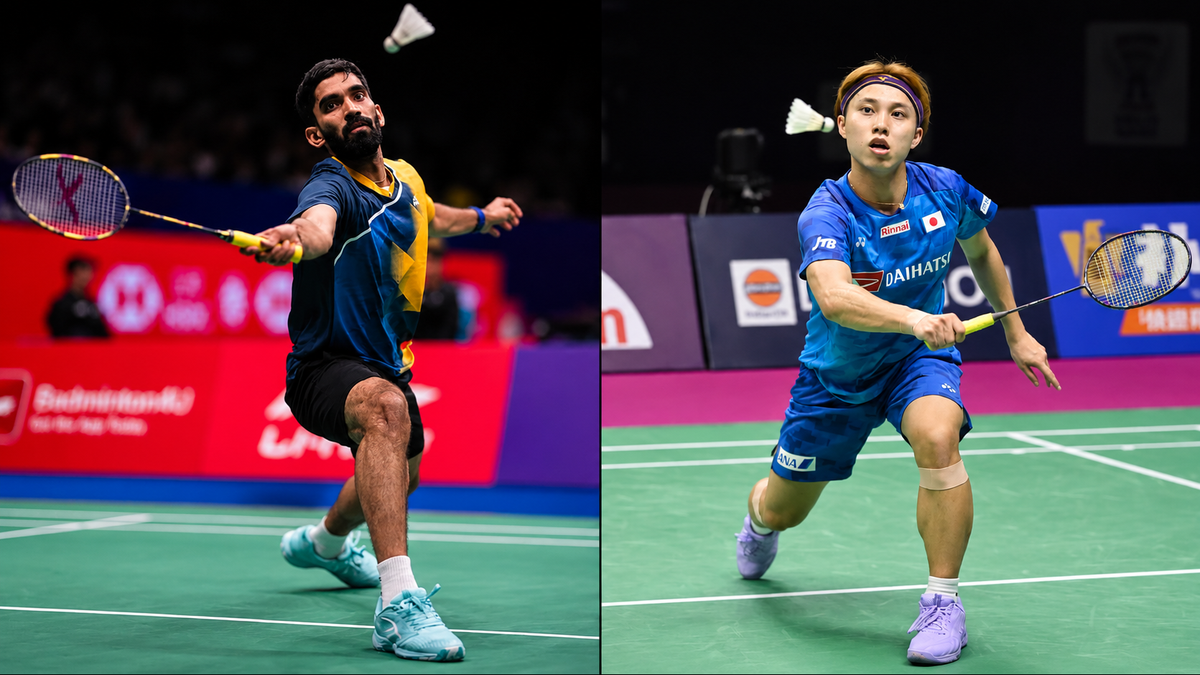

Kidambi Srikanth Stuns Kodai Naraoka to Reach Japan Masters Quarterfinals
India’s Kidambi Srikanth produced another composed, hard-fought performance at the Japan Masters, defeating home favourite Kodai Naraoka in three games to book a place in the men’s singles quarterfinals. The former world No. 1 won 21-15, 11-21, 21-18 on Thursday, ending a five-match losing streak against the Japanese shuttler.
The hour-long badminton contest tested Srikanth’s patience and defensive resolve. Naraoka, the tournament’s fifth seed, had the backing of the home crowd and responded strongly after losing the opening game. But Srikanth regained control in the decider, holding his nerve when the Japanese threatened to fight back.
Srikanth takes charge after a tight opening
The first game began as an even exchange, with both players working to control the rallies and find openings in their opponent’s defence. Srikanth carried a narrow 11-10 advantage into the interval, but Naraoka briefly shifted the momentum by moving ahead 14-12.
That lead did not last. Srikanth raised his intensity at a crucial point in the game, tightening his shot selection and applying pressure through a decisive run of points. He won nine of the next 10 rallies to turn the game around and close it out 21-15.
The burst was significant not only because it secured the opener, but because it showed Srikanth’s ability to respond when Naraoka appeared to be gaining control. Against a player known for his persistence in long rallies, the Indian needed to stay disciplined rather than rush for quick winners—and he did exactly that.
Naraoka forces a deciding game
Naraoka came out with greater urgency in the second game. He built an 11-5 lead by the interval and continued to dictate play after the restart, stretching the margin to 14-7. Srikanth managed to recover a few points, but the Japanese player kept the rallies on his terms and prevented a sustained comeback.
Naraoka took the game 21-11, setting up a decider and giving the home crowd reason to believe he could extend his unbeaten record against Srikanth. The contrast between the first two games also underlined the challenge facing the Indian: he would need to absorb Naraoka’s pressure while avoiding the run of errors that had allowed the second game to slip away.
Indian shuttler holds firm in the decider
The third game delivered the close finish the contest promised. Neither player found an easy route to control, and the score remained level at 7-7 before Srikanth created separation. He moved ahead with a timely run and took an 11-7 lead into the interval.
Naraoka did not give up. Backed by the Japanese spectators, he worked to reduce the deficit after the break, putting Srikanth under pressure and searching for a way back into the match. The Indian, however, stayed composed in the closing stages. He managed the rallies carefully, resisted the temptation to force the pace and held on to secure a 21-18 decider.
The result was a landmark win for Srikanth, who had failed to beat Naraoka in their previous four meetings. Ending that run at a major tournament—and doing so against the fifth seed on home soil—adds weight to the victory and sends the Indian into the last eight with renewed confidence.
Back-to-back three-game battles highlight Srikanth’s resilience
Srikanth’s win over Naraoka followed another demanding three-game match in the previous round. On Wednesday, he overcame Denmark’s Rasmus Gemke 18-21, 21-16, 24-22 in a contest lasting one hour and eight minutes.
That match featured a dramatic turnaround. Srikanth let an early five-point advantage in the opening game slip and eventually lost it, but responded by taking the second game to force a decider. In the final game, he trailed 19-15 and faced two match points. He saved both before winning the next two points to complete a remarkable escape.
Those successive matches have showcased a key strength in Srikanth’s Japan Masters campaign: his ability to keep competing when momentum swings against him. The Gemke match demanded a comeback from the brink, while the Naraoka encounter required him to recover after a one-sided second game. In both, he found ways to reset and make better decisions under pressure.
What the quarterfinal place means
Reaching the Japan Masters quarterfinals gives Srikanth an opportunity to build on a run that has combined physical endurance with mental toughness. Two long matches in quick succession can take a toll, making recovery and consistency especially important as the tournament progresses. His ability to control the pace, protect his energy and limit unforced errors will be closely tested in the next round.
The victory also offers a useful confidence boost against a high-ranked opponent. Naraoka’s style can make matches uncomfortable, particularly when he draws opponents into extended exchanges. Srikanth’s first-game surge and steady finish in the decider showed that he can disrupt that rhythm when he maintains pressure without losing patience.
For Indian badminton fans, the result is an encouraging sign from a player with extensive experience at the highest level. Srikanth has now followed a dramatic comeback over Gemke with a breakthrough win against Naraoka. He will next look to carry that momentum into the quarterfinals, where another demanding test awaits in his bid to advance further at the Japan Masters.