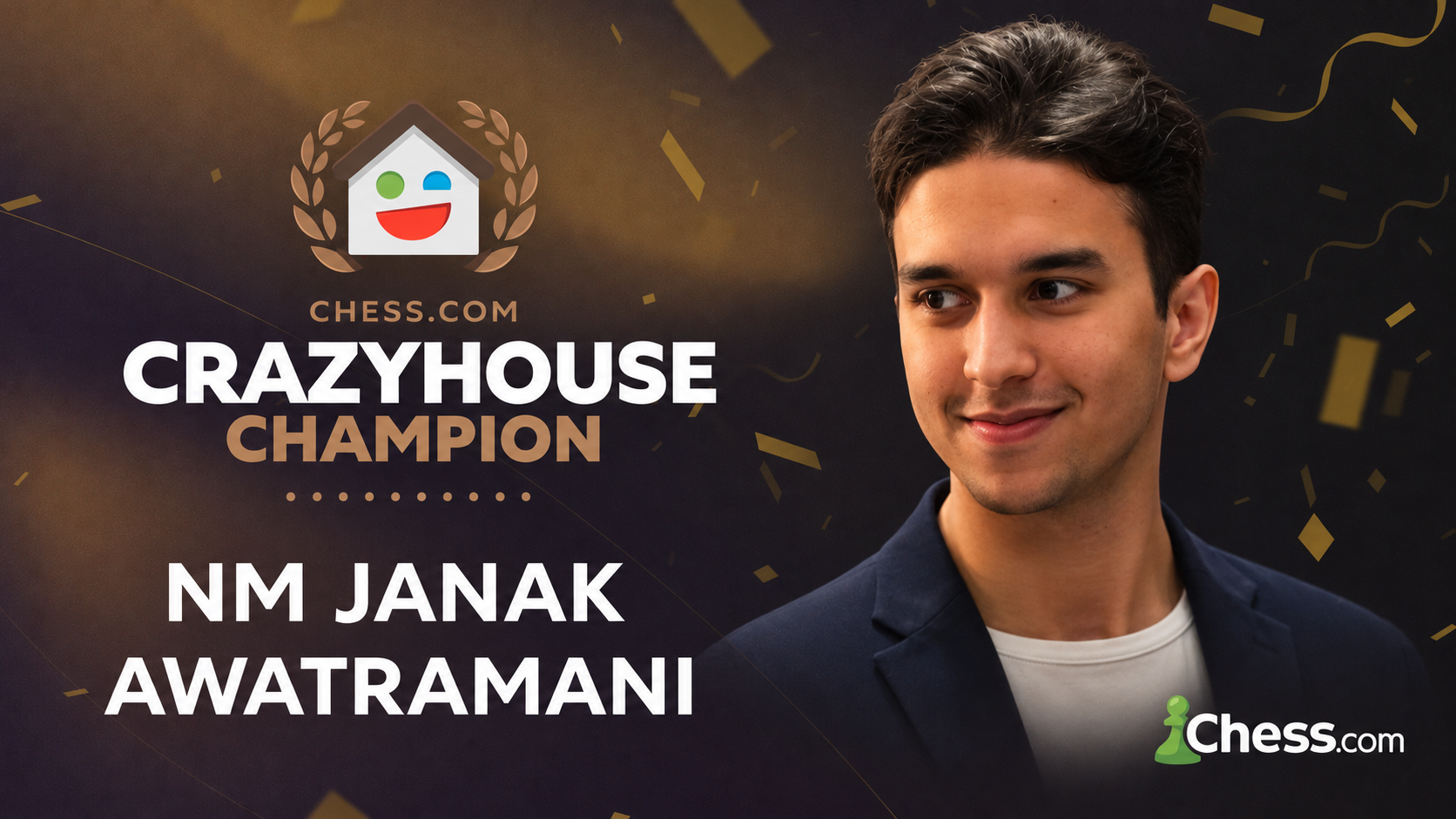

Janak Awatramani Wins the 2026 Chess.com Crazyhouse Championship
Canadian National Master Janak Awatramani captured the 2026 Chess.com Crazyhouse Championship with a commanding 3-0 victory over Grandmaster José Martínez in the Grand Final. The title capped a dominant run through the eight-player knockout and added another major online chess variant trophy to Awatramani’s résumé.
Awatramani’s success is especially fitting given his experience in Bughouse, a fast-paced team chess variant that shares Crazyhouse’s defining feature: captured pieces can return to play. Commentator GM Yasser Seirawan has described Crazyhouse as “Bughouse for one player.” Awatramani has won the last two Bughouse championships alongside National Master Isaac Chiu, but in this event he had to overcome his partner directly, defeating Chiu 3-1 in the Winners Final.
The championship was the 11th event in the 2026 Chess.com Community Championship series. Its eight-player final took place on November 6, following eight open online qualifiers. The total prize fund was $2,500, with Awatramani earning $750 for first place. The top three finishers also received custom 3D-printed Crazyhouse pieces designed to change color when flipped.
What Makes Crazyhouse Different From Standard Chess?
Crazyhouse uses a familiar chessboard and standard pieces, but captures have a dramatic second life. When a player takes an opponent’s piece, that piece enters the capturer’s reserve, or “pocket.” Instead of making a normal move on a later turn, the player may drop one of those captured pieces onto an unoccupied square.
The basic rules are simple, but their effects can be startling. Dropped pieces can give check or even deliver checkmate, while pawns cannot be placed on the first or eighth rank. Because a player can bring new material into the position at almost any moment, familiar chess ideas about safety, development and material advantage must be reconsidered.
A seemingly secure king can suddenly face a rook, knight or pawn arriving on an unexpected square. Even a large material lead may not guarantee victory: the opponent can use captured pieces to build a counterattack, block a threat or create a mating net. The result is a game where initiative is exceptionally valuable and positions can change in just one move.
Why Crazyhouse Produces So Much Action
In ordinary chess, exchanges gradually reduce the number of pieces on the board, often leading to an endgame. Crazyhouse works differently. Captured material can return, so positions may remain crowded and tactical throughout the game. Draws are uncommon, and players must constantly calculate not only the moves their opponent can make, but also the pieces they could drop after a capture.
That combination makes Crazyhouse a natural fit for online play and fast time controls. The 2026 final used 3+0 games, giving each player three minutes with no increment. Under those conditions, accurate calculation is difficult, and a single missed drop can reverse a winning position instantly.
Eight Qualifiers Set the Championship Field
The final bracket was filled through eight 75-minute arena qualifiers, each played at a 3+0 time control and open to players of all levels. The arenas produced a varied field that included established Crazyhouse specialists and strong over-the-board chess players. Three Canadians qualified for the final.
International Master Renato Terry posted the highest winning score, collecting 123 points in his arena and at one stage stringing together 19 consecutive wins. At the other end of the qualifying scores, JannLee advanced with 60 points. That qualification was a crowd-pleaser: JannLee is a longtime Crazyhouse standout, a former Chess.com championship winner and a player often credited as one of the game’s earliest champions.
Several well-known names narrowly missed the final. Grandmaster Awonder Liang finished second to Chiu in the first qualifier, while Seirawan placed fifth twice. Although Seirawan did not qualify as a player, viewers still saw him on the broadcast, where he joined another grandmaster in the commentary booth.
One late change affected the final lineup. Grandmaster Awonder Liang qualified by winning the fourth arena but was unable to compete. His place initially appeared likely to go to runner-up José Martínez, but Martínez won another qualifier, so the available spot went to the next eligible player instead.
Knockout Drama: Chiu Survives, Awatramani Advances
The quarterfinals opened with three 3-0 results, but the match between defending champion Isaac Chiu and Tan provided the round’s biggest comeback. Tan surged to a 2-0 lead, putting Chiu on the brink of elimination. The champion responded by winning the next two games and forcing a bullet decider.
One of Chiu’s comeback victories showcased the unforgiving nature of Crazyhouse. Tan dropped a pawn onto h2, but Chiu found the right response, seized control of the clock and finished with checkmate. Chiu then won the decider convincingly. Tan moved into the Losers Bracket, where he beat Cater 3-0 before falling 3-2 to FM Crazy_Eight. In the final bullet game, Tan was short of time but had a potential mate-in-two on the board—an opportunity that slipped away in the scramble.
Awatramani’s toughest test came against Aroesti in the Winners Semifinal. Awatramani lost the opening game from a position that had appeared winning, after choosing to capture a rook instead of making a defensive drop on f3. In Crazyhouse, that kind of decision can be decisive: the opponent may use a captured piece immediately to create a threat that ordinary chess players would not expect.
Awatramani recovered by winning the next two games. After another loss, he took the bullet decider with White and moved on to face Chiu in the Winners Final. There, Awatramani produced a 3-1 victory. Chiu’s lone win was memorable in its own right: despite having four rooks, he nearly let the position escape before a mistake allowed a smothered mate.
Martínez Reaches the Final, but Awatramani Takes the Title
Chiu’s route to a rematch with Awatramani ended in the Losers Bracket against Martínez. The match featured dramatic swings, with Martínez taking the lead twice. In one tense finish, Chiu had a forced mate-in-five but ran out of time with less than a second remaining. He fought back to level the match again, only to lose the bullet decider.
That set up the Grand Final between Martínez, the only grandmaster in the field, and Awatramani. The final proved far more one-sided than the earlier matches. Awatramani won the first game in just 19 moves, then controlled most of the second before finding a forced mate-in-four.
Martínez needed a victory in the final must-win game, and the position included several tactical turns. Awatramani nevertheless maintained the upper hand and converted the advantage to complete a 3-0 sweep. The result highlighted a key Crazyhouse lesson: the pieces visible on the board do not tell the whole story. A player’s reserve can transform the position, but Awatramani managed the threats and material balance more effectively throughout the decisive match.
How to Watch the Games and What’s Next
Fans can review the 2026 Chess.com Community Championship: Crazyhouse through the event’s Chess.com tournament and broadcast pages. The live coverage featured grandmaster commentary, offering viewers a closer look at the tactics, time scrambles and surprising piece drops that define the variant.
The next Community Championship is the 2026 Fog of War Championship, scheduled for December 17-18. Like the Crazyhouse qualifiers, the event is open to players of all levels. For chess fans looking to try a different format, Crazyhouse offers a particularly lively challenge: every capture can become a future attack, and no position is safe for long.