
Shafali Verma’s 24-Ball Fifty Powers India to Series-Winning T20I Victory
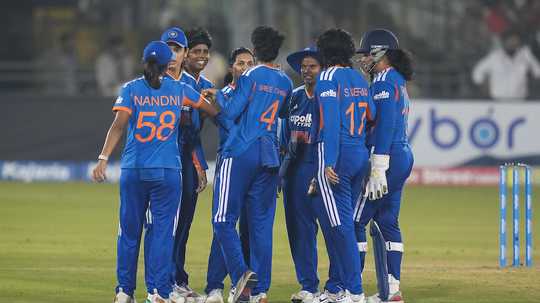
India Women produced a commanding all-round performance to defeat Zimbabwe by nine wickets in the second T20I, sealing the series with one match still to play. Shafali Verma’s explosive half-century set the tone for a remarkable chase, while captain Smriti Mandhana remained unbeaten as India reached their target in just 8.5 overs.
After restricting Zimbabwe to 102 for 8, India’s openers attacked from the outset, racing to 76 without loss in the Powerplay—the team’s second-highest score in that phase in women’s T20I cricket. India ultimately finished on 104 for 1, with 67 balls remaining, setting a record for the most deliveries left in a successful chase of a target above 100 in women’s T20Is.
Shafali Verma Sets the Pace with a Blistering Fifty
Verma needed only 24 balls to reach her half-century, striking six fours and four sixes in an innings that left Zimbabwe’s bowlers with few opportunities to settle. She opened her account with a boundary and followed it with a six in the same over, immediately signalling India’s intent.
Zimbabwe’s Nyasha Gwanzura came under sustained pressure. After Verma’s early attack, Mandhana joined in, finding the boundary and keeping the scoring rate high. Verma then took control in the fifth over, hitting five boundaries from Gwanzura’s bowling. The next over brought another burst of power: Verma struck Michelle Mavunga for two fours and a six as India’s run rate surged.
The assault continued even after Zimbabwe spread the field. Mandhana launched a six off Olinder Chare in the seventh over, while Verma brought up her fifty with another maximum in the eighth. She was dismissed on the next delivery, but by then the contest was effectively over. Mandhana finished the job six balls later, clearing the boundary to complete the victory.
The innings added to a standout year for Verma. Her half-century was her ninth score of 50 or more in 2026, the most by any player in a calendar year in women’s T20Is. It also extended the remarkable partnership record shared by Verma and Mandhana: the pair have now recorded nine stands of at least 50 runs in 2026, jointly the most by an opening combination in a calendar year in the format.
Mandhana Begins Full-Time Captaincy with a Series Win
The result gave Mandhana an ideal start to her tenure as India’s full-time captain. A series victory in her first assignment as permanent skipper offers an encouraging early sign, particularly with India’s batting lineup combining aggression and control so effectively.
Mandhana’s unbeaten 47 was an important part of the chase, even as Verma claimed most of the attention. She supported the early onslaught, rotated the strike when needed and ensured India maintained momentum after Verma’s dismissal. The pair’s ability to attack different bowlers and keep the required rate comfortably within reach made the target feel far smaller than it was.
For India, the performance also offered useful preparation for future T20I challenges. A fast start can put pressure on any opposition, but the innings showed more than power hitting: the openers read the conditions, targeted specific overs and kept scoring after Zimbabwe changed its field. That adaptability is valuable in cricket, where a successful approach must respond to both the pitch and the opposition’s plans.
India’s Bowlers Restrict Zimbabwe to 102
India’s dominance began with the ball. Zimbabwe struggled to build momentum on a slow start, reaching only 20 for 1 by the end of the Powerplay. Nandani Sharma made the early breakthrough, bowling Kelis Ndhlovu in the fourth over and disrupting Zimbabwe’s attempt to establish a platform.
The pressure intensified in the middle overs. Zimbabwe slipped to 20 for 2 and then 30 for 3 in the ninth over, leaving the innings in danger of collapsing before it had properly begun. Chipo Mugeri-Tiripano and captain Josephine Nkomo responded with a 45-run partnership, providing the most substantial resistance of the innings and helping their side move beyond the early trouble.
India, however, soon regained control. Niki Prasad made a memorable start to her career by taking wickets with the first two balls she bowled. That rare achievement placed her among only three players to claim two wickets in the first two deliveries of their career in the format across men’s and women’s cricket.
Zimbabwe were 75 for 5 after 14.2 overs, but the lower order could not produce the late acceleration needed to create a competitive total. Mugeri-Tiripano top-scored with 34, while Prasad returned figures of 2 for 7. Zimbabwe reached 102 for 8 after 20 overs, a total that left little margin for error against India’s aggressive top order.
Match Summary and What Comes Next
Zimbabwe Women: 102 for 8 in 20 overs (Chipo Mugeri-Tiripano 34; Niki Prasad 2 for 7).
India Women: 104 for 1 in 8.5 overs (Shafali Verma 55; Smriti Mandhana 47 not out). India won by nine wickets.
With the series already secured, the final match gives India an opportunity to test combinations and build further confidence, while Zimbabwe will look for a stronger start with both bat and ball. Any prediction for the last T20I will need to account for India’s current form: their bowlers have kept Zimbabwe to a modest total, and their openers have shown they can turn a chase into a one-sided contest within a few overs.
For supporters following the series, the second match was a clear demonstration of India’s depth and intent. Verma’s record-setting form, Mandhana’s assured leadership and Prasad’s immediate impact all provided talking points. More broadly, the result underlined how quickly a T20I can shift when a team combines disciplined bowling with fearless batting—a formula India executed almost perfectly.