
India Edge New Zealand by Four Runs in Rain-Interrupted Cricket Thriller
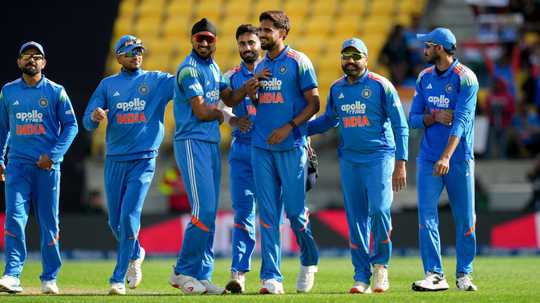
India moved 2-0 ahead in their five-match cricket series against New Zealand after claiming a tense four-run victory under the Duckworth-Lewis-Stern (DLS) method in Wellington. A rain-delayed start, a challenging two-paced pitch and repeated interruptions turned the second ODI into a low-scoring contest in which every run mattered.
New Zealand were bowled out for 134 in 41 overs after India’s seamers made the most of the movement on offer. Gurnoor Brar led the attack with an impressive four wickets for 30 runs, while Anshul Kamboj took two. India’s reply also faltered against disciplined bowling, but Shreyas Iyer and KL Rahul helped keep the chase alive. When another spell of rain halted play, India were 113 for seven in 26 overs—four runs ahead of the DLS par score. The match was eventually abandoned, confirming a narrow Indian win.
Rain and a Difficult Pitch Shape the Contest
Persistent rain delayed the toss and left the outfield too wet for an on-time start at Hnry Stadium. Once conditions improved, the match was reduced to 47 overs per side. The surface offered uneven pace and assistance for the bowlers, making it difficult for batters to trust their shots and build momentum.
That context is important when assessing the result. This was not a straightforward chase on a flat batting surface: both teams had to adjust to a pitch that rewarded patience, accurate lengths and careful shot selection. The changing weather also meant that the DLS calculation remained central to the finish, with India’s slim advantage ultimately proving decisive.
India’s Pacers Put New Zealand Under Pressure
New Zealand’s innings began poorly as India’s fast bowlers exploited the helpful conditions. Auqib Nabi struck first, removing Tim Seifert after the ball stopped on the opener, who could only send it towards mid-on. Nabi then drew Will Young into a push outside off stump, with Rahul completing a sharp catch behind the wickets.
Daryl Mitchell briefly countered with a series of confident strokes, including boundaries and a six, but New Zealand lost another wicket when Henry Nicholls inside-edged Anshul Kamboj’s delivery onto his stumps. At 23 for three, the hosts were already in need of a substantial partnership.
Mitchell and captain Tom Latham responded with a cautious stand. Their 30-run partnership came from 64 deliveries, reflecting how challenging it was to score freely. Brar broke through in the 20th over, first dismissing Latham with a top-edged pull and then removing Glenn Phillips, who also fell attempting a pull shot. New Zealand had slipped to 53 for five.
Mitchell had earlier been dropped by Shubman Gill, a reprieve that proved costly. The right-hander made the most of it, reaching 55 and recording his seventh score of 50 or more in his last nine ODIs against India. He found support from Mitchell Santner, whose 31 helped New Zealand pass 100 and gave the innings some late stability.
India’s spinners and seamers then closed in. Axar Patel ended Mitchell’s innings as he attempted to attack, before Brar removed Santner, who edged behind after striking a six. Axar bowled Kyle Jamieson, and Kamboj and Brar finished the job by dismissing Nathan Smith and Blair Tickner. New Zealand were all out in the 41st over, with Brar’s four-wicket haul the standout contribution.
Early Wickets Make India’s Chase a Test of Nerve
India’s pursuit of 135 began with a burst of boundaries but quickly became a battle for survival. Gill lasted just one delivery, edging Jacob Duffy to second slip. Rohit Sharma opened his account with an uppish four and later pulled Jamieson for another boundary, while Virat Kohli produced a classic cover drive.
However, Duffy struck again when Kohli attempted another drive and sent a catch to cover. Rohit and Iyer responded aggressively: Iyer lofted Duffy over backward point for six, and Rohit launched two maximums off Jamieson with forceful shots through the leg side. Jamieson had the final say, though, as Rohit edged a drive to second slip. India were 39 for three in the eighth over.
Axar Patel survived a difficult moment against a short delivery and briefly found a boundary with a ramp attempt. A similar effort against Matt Fisher, who had replaced Tickner as a concussion substitute, ended his innings. At 47 for four, India needed a partnership—and Iyer and Rahul supplied one.
Iyer and Rahul Rebuild Before New Zealand Strike Again
Iyer played with intent, collecting boundaries off Fisher, while Rahul used the pull shot effectively against Smith, including a six. Rahul also survived a New Zealand review for a possible caught-behind dismissal. The pair added 39 runs for the fifth wicket, restoring some order to a chase that had threatened to unravel.
Jamieson broke the stand when Iyer was caught in an awkward position attempting to deal with a short ball. Iyer’s 30 was a valuable contribution on a pitch where clean timing was difficult. Naman Dhir then escaped a possible run-out before finding a boundary over point, while Rahul continued to score when opportunities appeared.
Rahul’s top-edged six off Duffy took India beyond 100 in the 23rd over. Dhir added a pulled boundary but was caught in the deep while trying to clear the boundary again. A third umpire review confirmed that Seifert completed the catch without touching the rope. Jamieson then dismissed Anshul Kamboj, leaving India at 113 for seven and 22 runs short of the original target.
DLS Decision Delivers a Narrow Indian Victory
Rain returned with India four runs ahead of the DLS par score. Officials initially prepared for a possible 37-over match, with India’s revised target set at 133. But the weather worsened, the covers came back on, and play could not resume. India were therefore declared four-run winners under the DLS method.
The result gives India a 2-0 lead, but the scoreline reflects how closely contested the match was. New Zealand’s bowlers—particularly Jamieson and Duffy, who claimed three wickets apiece—made the chase far more difficult than India would have wanted. Rahul’s unbeaten 26 and Iyer’s 30 were crucial in keeping the visitors just ahead when the rain arrived.
What the Result Means for the Series
India will take confidence from a win built on pace bowling, composure under pressure and a timely middle-order partnership. New Zealand, meanwhile, can point to Mitchell’s resilient half-century and the impact of their seamers, but will regret losing wickets in clusters during both innings.
Any cricket prediction for the next match should account for the conditions as much as the teams’ form. Wellington’s surface showed how quickly a contest can shift when the ball moves and the weather interrupts play. With India leading 2-0, New Zealand must find a way to convert promising spells into a complete performance if they are to keep the series alive.
Brief scores: New Zealand 134 all out in 41 overs (Daryl Mitchell 55, Mitchell Santner 31; Gurnoor Brar 4-30, Anshul Kamboj 2-25) lost to India 113-7 in 26 overs (Shreyas Iyer 30, KL Rahul 26 not out; Kyle Jamieson 3-35, Jacob Duffy 3-35) by four runs under the DLS method.