
Mikel Merino’s extraordinary journey from Dortmund bombing to football’s biggest stages
Arsenal and Spain midfielder Mikel Merino has experienced the kind of highs and hardships that can reshape a person’s outlook on life. A terrifying attack on Borussia Dortmund’s team bus, a rare injury that threatened his World Cup ambitions, and the pressure of returning to elite football have all become part of a career defined by perseverance.
In a personal letter published by The Players’ Tribune, Merino reflected on the moments that tested him most. His account offers more than a behind-the-scenes look at professional football: it is a story about chance, family, recovery and the determination to keep believing when the odds appear overwhelming.
The Dortmund attack that changed his perspective
Merino was 20 and playing for Borussia Dortmund when three bombs exploded beside the team bus as it travelled to a Champions League match. The blast shook the vehicle and left the young midfielder surrounded by smoke, confusion and the sound of people crying out.
“I’m lucky to still be alive,” Merino recalled. He described hearing a huge explosion and feeling the bus nearly tip over. When he looked behind him, he saw blood and smoke. His team-mate Marc Bartra had been injured in the attack and was taken to hospital, where Merino spent the night waiting for news.
The shock deepened the following day, when the players learned that a large piece of shrapnel had lodged in the headrest of the seat beside Bartra’s. It was the seat Merino would usually have occupied. On that journey, however, he had chosen another place because his legs felt heavy and there was more room in front of him.
That small, ordinary decision could have had life-changing consequences. The experience left Merino with a lasting awareness of how quickly circumstances can change—and how fragile the boundary between a routine trip and a tragedy can be. For a young footballer focused on training and competition, the attack brought an entirely different kind of fear into his life.
A rare injury put his World Cup dream at risk
Years later, Merino faced another difficult challenge, this time on the pitch. A serious foot injury in February threatened to derail his season and, potentially, his chance to represent Spain at the World Cup. With the tournament only four months away, the timing could hardly have been worse.
Merino remembered sitting through what he called the most depressing medical presentation of his life. The injury was unusual, and specialists had to consider carefully how to treat it and what recovery might involve. The estimate was daunting: he could need around six months before returning to play.
One doctor delivered the assessment bluntly: “Mikel, I’m sorry, this is impossible.” The words captured the scale of the challenge, but they did not end Merino’s hopes. Instead, he began a demanding programme of treatment and rehabilitation, working through the uncertainty one day at a time.
His family became central to that process. Merino singled out his wife, Lola, who supported him while pregnant. He admitted that needing help with everyday tasks sometimes made him feel embarrassed, but her presence helped him manage the physical and emotional strain of recovery. The episode is a reminder that a footballer’s comeback is rarely a solo effort: medical teams, family members and personal resolve all contribute.
From rehabilitation to Arsenal and Spain celebrations
Merino’s recovery demanded patience, but he continued to believe he could return to a level that would convince Spain coach Luis de la Fuente. While sidelined, he kept the coaching staff informed, sending video clips and graphics that tracked his progress. It was a practical way to show that his ambition was matched by evidence of improvement.
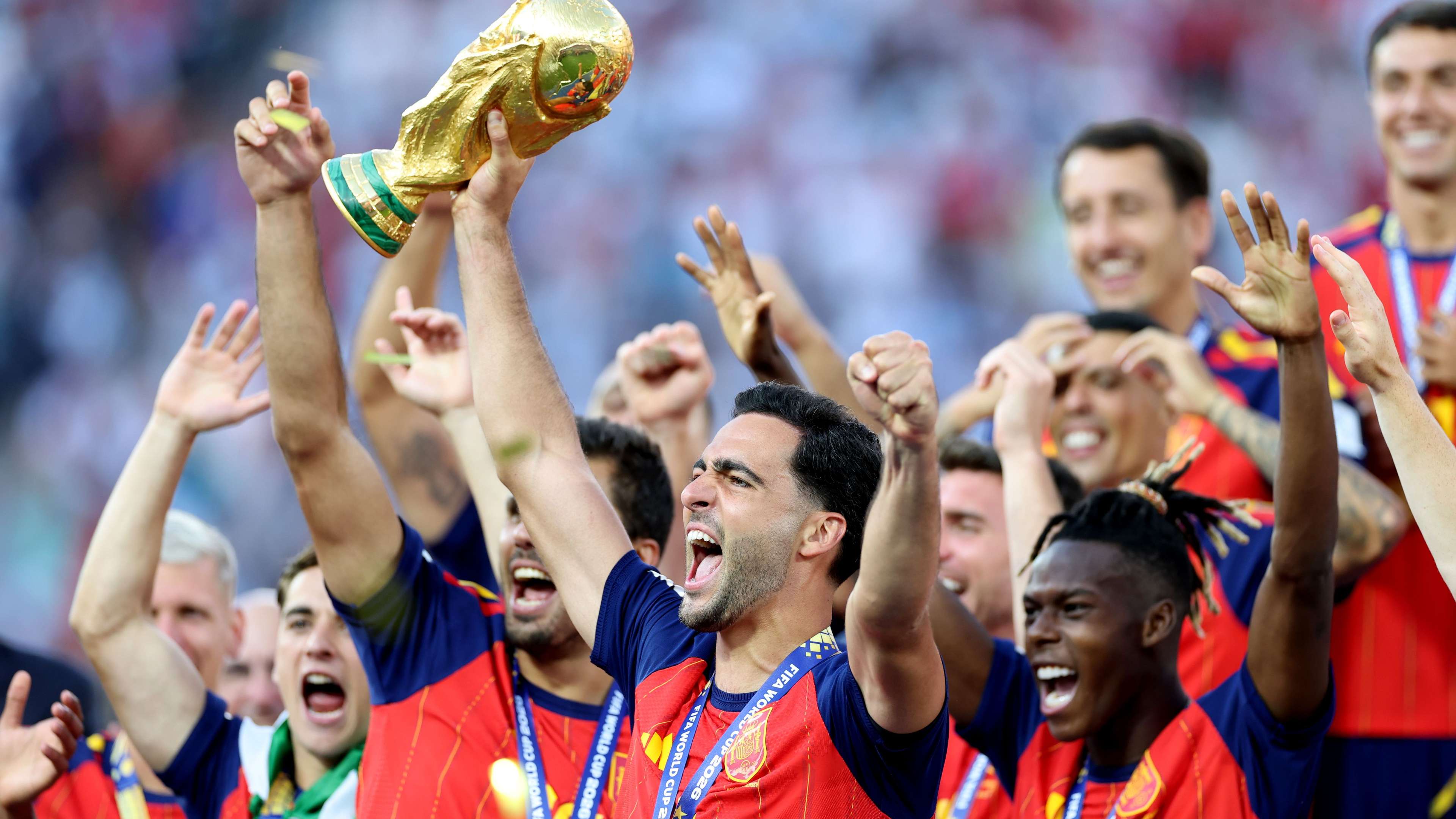
His return brought a series of moments that once seemed out of reach. Merino was able to take part in Arsenal’s Premier League title celebrations and later earned a place in Spain’s World Cup squad. The selection transformed months of anxiety into joy. When the news arrived, he embraced Lola and kissed their son, Marco, who had been born just ten days before a decisive point in Merino’s season.
Becoming a father gave the midfielder fresh motivation during his rehabilitation. His son’s arrival did not erase the pressure or the pain, but it helped give the struggle a new perspective. For Merino, the call-up was not simply a professional achievement; it was the culmination of a recovery shared with the people closest to him.
Spain’s collective strength and defining matches
Merino also reflected on the matches that best represented Spain’s identity. He recalled a decisive attacking move against Portugal, when he recognised space in the centre of the defence and made a run to exploit it. A well-timed pass found him and helped create a scoring opportunity—a reminder of how awareness and movement can be as important as individual skill.
He praised Spain’s possession-based approach, explaining that the team’s ability to keep the ball makes it difficult for opponents to regain control. Against France, a side filled with talented players, Spain relied on its collective structure and composure to influence the tempo. Merino’s comments highlight a familiar truth in football: tactical quality matters, but it is the shared understanding between team-mates that allows a system to work under pressure.
The Lionel Messi shot he will never forget
Another memory came from facing Argentina and Lionel Messi. Merino saw the forward prepare to shoot from outside the penalty area and stepped in to block the effort. The ball struck him directly in the face with such force that he fell to the ground.
“I said to myself: no, not him,” Merino recalled. “I came forward to block it, but he struck the ball hard, straight into my face.” For the remainder of the match, he temporarily lost sight in one eye. The incident frightened him, though relief followed when he realised the problem had passed by the final whistle.
It was a startling reminder of the physical risks players accept in elite football. Even a routine defensive action can become a frightening moment when the ball is struck with the power of one of the sport’s greatest players.
A career shaped by resilience—and the people behind it
Merino’s story spans football’s most dramatic contrasts: the fear of the Dortmund attack, the isolation of injury rehabilitation, the exhilaration of trophies and the pride of representing Spain. His experiences also offer a wider lesson for supporters weighing a player’s form or making a football prediction: performance is shaped not only by talent and tactics, but by health, confidence and the support available away from the pitch.
In closing his letter, Merino thanked the family members who stood beside him through the hardest chapters and celebrated the milestones that followed. His journey is not simply a tale of sporting success. It is a testament to the power of hope, the value of patience and the strength people can draw from those closest to them.
After everything he has lived through, Merino’s final sentiment was simple: “Even today, I still can’t believe it’s all over. All I can say is: thank you.”