
Shai Hope’s Century and Keemo Paul’s Five-Wicket Haul Set Up T20I Decider
West Indies produced a landmark win in Hyderabad, defending a huge total against India for the first time in a men’s T20I on Indian soil. Shai Hope’s unbeaten century powered the visitors to 247 for 3, before Keemo Paul’s cleverly varied pace disrupted India’s chase and secured a 24-run victory. The result levels the series and sends the teams to Bengaluru for a winner-takes-all decider.
On a fresh, high-scoring surface, India’s pursuit began at a blistering pace. Sanju Samson struck freely in the Powerplay, while West Indies’ bowlers later found ways to make the pitch work for them. Gudakesh Motie’s economical spell tightened the middle overs, and Paul’s five-wicket haul finished the job. For fans considering a cricket prediction ahead of the final match, Hyderabad offered a useful reminder: a big total can still be defended when bowlers vary their pace and execute their plans under pressure.
Hope Leads West Indies to a Towering Total
Asked to bat first, West Indies made the most of the conditions from the opening over. Jewel Andrew, returning from injury, joined Hope at the crease and immediately showed attacking intent, launching Arshdeep Singh for six. The early boundaries set the tone for a first six overs in which West Indies raced to 79 for 1—their highest Powerplay score against India in T20Is.
Hope was the steady force behind the surge. In outstanding form throughout the tour, he punished deliveries that strayed too full and used his timing and wristwork to find the leg-side boundary. He also struck cleanly through the ‘V’, ensuring India could not rely on one area of the field to contain him. His fourth century of the tour was another demonstration of how effectively he can combine composure with power.
India did find a breakthrough when Axar Patel came into the attack during the Powerplay, but the wicket did little to slow the scoring. Shimron Hetmyer quickly settled in, taking advantage of loose deliveries from Arshdeep, while Hope continued to dictate the innings. Naman Dhir, who had enjoyed success earlier in the series, struggled to contain the in-form captain and conceded 19 runs in his only over.
West Indies’ middle order then ensured the momentum never disappeared. Prince Yadav used a well-directed bouncer to dismiss Hetmyer, but Rovman Powell responded with a forceful burst, helping take 22 runs from an Axar over. Sherfane Rutherford added another late assault, striking 22 runs from Mayank Yadav’s final spell as the visitors surged beyond 200.
Hope reached his century from the final delivery of the innings, benefiting from a difficult chance that India could not hold. Mayank missed an opportunity to complete a catch, and Tilak Varma also struggled to judge a straight hit. Those missed chances proved costly: Hope finished unbeaten on 102, while Rutherford’s 49 helped West Indies post 247 for 3.
Samson’s Fast Start Gives India Early Hope
India began the chase with the urgency the target demanded. Samson took charge in the opening overs, striking a straight six off Roston Chase and making the most of a Powerplay in which Abhishek Sharma had limited access to the strike. Chase’s second over cost 25 runs, and India had already reached 50 without loss by the third over.
That explosive start made the chase look possible, but the conditions soon shifted the contest. The surface was dry and offered no significant dew, giving West Indies’ seamers an opportunity to use pace changes and challenge the Indian batters’ timing. Rather than feeding the initial hitting zone, they mixed shorter deliveries with slower balls and used their field placements to create pressure.
Paul made an immediate impact. A short ball, backed by a carefully positioned fielder, brought the first breakthrough. Three deliveries later, Ishan Kishan fell while attempting another big hit. India’s early momentum had been checked, and the middle order was forced to rebuild rather than simply continue the Powerplay assault.
Motie and Paul Turn the Match
Abhishek struggled to find rhythm after receiving little of the strike early on, eventually making 29 from 24 balls. Shreyas Iyer contributed 16 from 11, but neither innings developed into the sustained partnership India needed. Dhir was dismissed for a first-ball duck, leaving the hosts with a growing gap between the required rate and their scoring pace.
West Indies also learned from India’s opening burst. Their use of the short ball was more effective than India’s, while the visitors’ bowlers varied their pace to take away easy timing. India managed only 32 runs from 31 short deliveries, a telling contrast to the damage West Indies had caused with their own attacking approach. Iyer and Hope later noted that the pitch held up at times and offered occasional uneven bounce, making clean hitting less straightforward as the innings progressed.
Tilak Varma and Nitish Reddy briefly revived India’s hopes with a 70-run partnership in just 5.2 overs. Tilak combined placement with controlled aggression, while Reddy supported the late charge. Their stand brought the required rate back into view, but West Indies struck at the critical moment, removing both batters and exposing the lower order to an increasingly difficult finish.
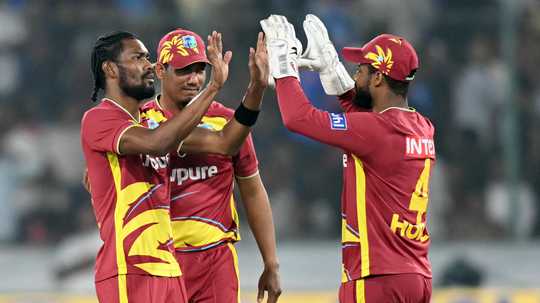
Motie’s disciplined spell helped keep the pressure on, while Paul delivered the decisive blows at the back end. His variations made it difficult for India’s batters to predict pace and length, and his five wickets turned a high-scoring match into a controlled West Indies victory. India were eventually dismissed for 223 in 19.3 overs, 24 runs short.
What the Result Means for the Series Decider
The win carries historical significance: West Indies had failed to defend a total against India in India in six previous T20I attempts. This time, Hope’s exceptional innings gave the bowlers a substantial cushion, and Paul and Motie used the conditions intelligently to protect it.
The deciding match in Bengaluru now presents a fresh challenge for both sides. India will look to improve its middle-overs response and convert strong starts into a complete chase. West Indies, meanwhile, will take confidence from their ability to adapt after a rapid Powerplay. Any cricket prediction for the decider should account for more than batting power alone: pitch behaviour, bowling variations and the handling of pressure could prove just as important as the toss or the headline total.
Match Summary
West Indies: 247/3 in 20 overs (Shai Hope 102 not out, Sherfane Rutherford 49; Prince Yadav 1/36, Axar Patel 1/45).
India: 223/9 in 19.3 overs (Sanju Samson 56, Tilak Varma 43; Keemo Paul 5/41, Gudakesh Motie 2/13).
Result: West Indies won by 24 runs, levelling the series and forcing a decider in Bengaluru.