
Vinícius Júnior Faces Possible Ban After Real Madrid Red Card
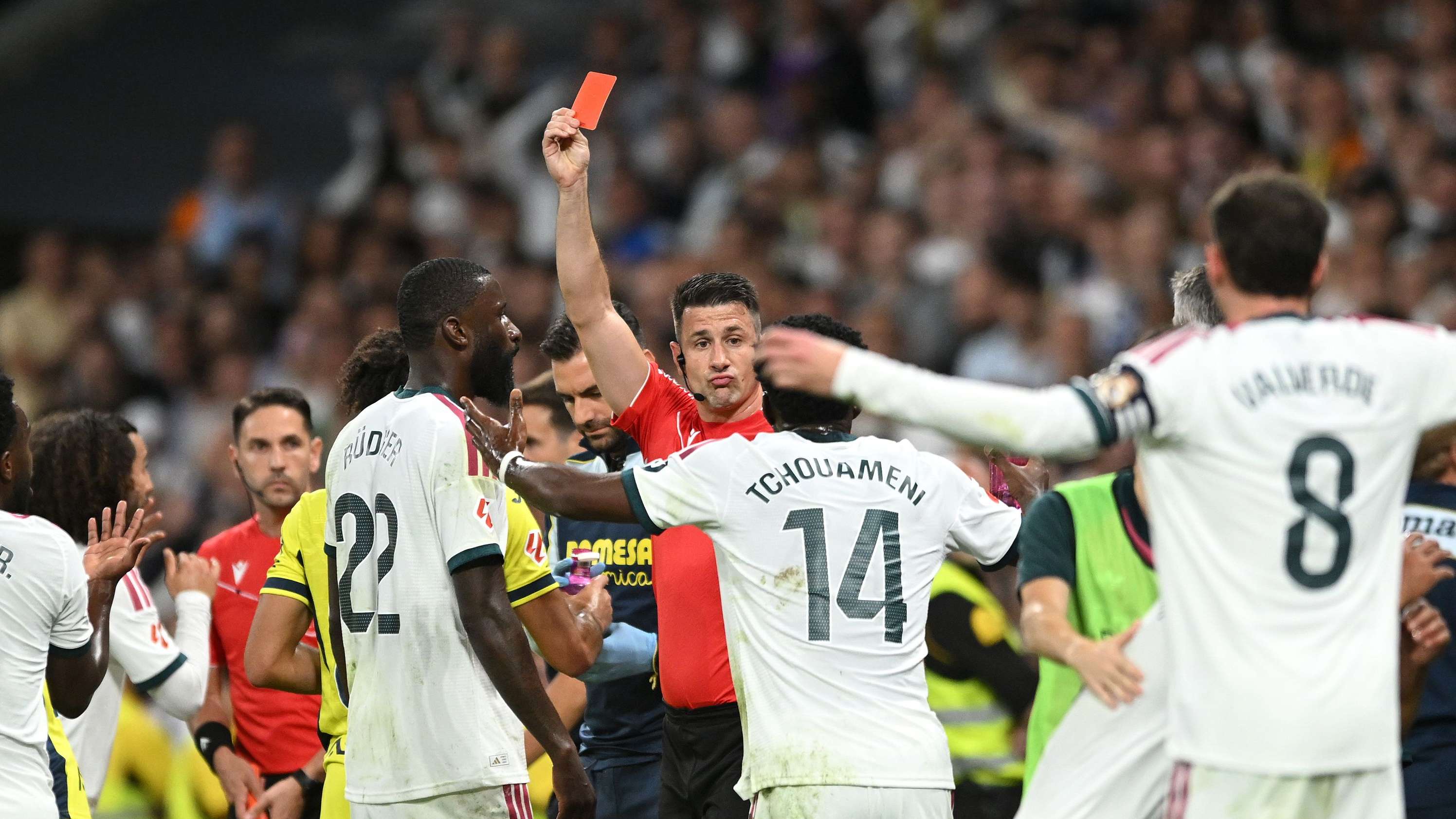
Vinícius Júnior could miss Real Madrid’s upcoming Clasico against Barcelona after being sent off against Villarreal. The referee’s report describes the Brazilian forward pulling an opponent’s hair and then protesting angrily after seeing a red card, leaving Spain’s disciplinary committee to determine how many matches he will be suspended for.
The decision could have a significant impact on Real Madrid’s plans for the high-profile fixture, scheduled for the 25th at Spotify Camp Nou. Depending on how the incident and the player’s reaction are classified, Vinícius may receive a ban of two to four matches. The case has also prompted debate about how football’s disciplinary rules distinguish between violent conduct during play, actions away from the ball and protests against officials.
What the referee’s report says
According to Spanish newspaper Mundo Deportivo, referee Isidro Díaz de Mera submitted his report in the early hours after Real Madrid’s match against Villarreal. It records that Vinícius was dismissed in the 71st minute for pulling the hair of Villarreal defender Saliba.
The referee did not show a red card immediately. After receiving an alert from assistant referee Alejandro Muñiz Ruiz, he reviewed the incident using video assistant referee technology. The VAR officials reportedly described the action as “violent conduct” during their communication with the referee on the pitch.
Díaz de Mera’s written account says Vinícius pulled an opponent’s hair “with the ball in play, without the ball being in contention between them”. That distinction may prove crucial. The ball was still in play, but the report indicates the two players were not directly competing for it when the contact occurred.
Why the length of the suspension is uncertain
The disciplinary committee is expected to consider the incident under Article 130 of Spain’s football disciplinary code, which covers violent conduct. The wording of the article allows for different penalties depending on the circumstances and where the action took place.
Under the first paragraph, violent conduct during play that creates danger but causes no injury can be punished with a suspension of one to three matches, or a ban of up to one month. If the committee decides Vinícius’s action falls into this category, a one-match suspension is possible.
However, the report’s note that the ball was not being contested between the players could support a more serious interpretation. The second paragraph of Article 130 applies when an act occurs outside the framework of play, when a player is not in a position to challenge for the ball, or during a stoppage. It provides for a suspension of two to three matches.
The committee’s central task will be to interpret the referee’s description: the ball was in play, but the players were not competing for it. That subtle distinction may determine whether the hair-pulling incident brings a one-match ban or a suspension of at least two matches.
Vinícius’s reaction could bring an additional penalty
The report also describes Vinícius’s response after he was sent off. Díaz de Mera wrote that the player continued to protest loudly while still on the pitch, moved towards the referee in an aggressive manner and had to be restrained by teammates. The referee said he could not identify any specific words directed at him.
That detail may influence the committee’s decision. If the reaction is treated as minor conduct contrary to sporting regulations, the rules allow for a suspension of up to four matches or a fine of up to €602. In that scenario, the committee could impose the minimum penalty.
A more severe ruling could classify the conduct as protesting against match officials under Article 127. That provision carries a suspension of two to three matches, or a ban of up to one month. Article 124 is another possibility: it covers words or behaviour showing disdain or disrespect towards referees, officials or sporting authorities, and also allows for a two-to-three-match suspension.
Because the report does not quote a particular insult or phrase, the committee will have to assess the described behaviour and the referee’s account when choosing the appropriate category. The distinction matters: a protest treated as a minor offence could add less to the punishment than conduct deemed disrespectful under Articles 124 or 127.
Possible outcomes and the Clasico prediction
The potential overall suspension ranges from two to four matches, based on the scenarios outlined in the report. A two-match ban would combine a one-match punishment for the sending-off incident with one match for his reaction. A three-match suspension could result from one match for the hair-pulling and two for protesting, or two matches for the on-field offence and one for his conduct afterwards.
The harshest likely outcome would be four matches: two for violent conduct considered outside the framework of play, plus two for the reaction to the red card. The disciplinary committee’s ruling, rather than the referee’s report alone, will determine the final penalty.
For Real Madrid, the immediate concern is the Clasico. Whatever the committee decides, the report has created serious uncertainty over Vinícius’s availability for the Barcelona match. If the minimum combined suspension is imposed, he would still be at risk of missing the fixture; a longer ban would rule him out more clearly and could affect Madrid’s attacking options across several games.
Any football prediction for the Clasico will need to account for the disciplinary outcome. Vinícius is a major part of Real Madrid’s forward threat, and his absence could require a tactical adjustment, a different choice on the left flank or a greater attacking role for another player. Barcelona’s preparations may also change depending on whether Madrid can call on one of their most influential attackers.
The committee’s ruling is expected on Wednesday. Until then, the key question is how it interprets the referee’s precise wording—and whether Vinícius’s reaction is treated as a separate offence. The answer will shape both the suspension and the build-up to one of Spanish football’s most anticipated fixtures.