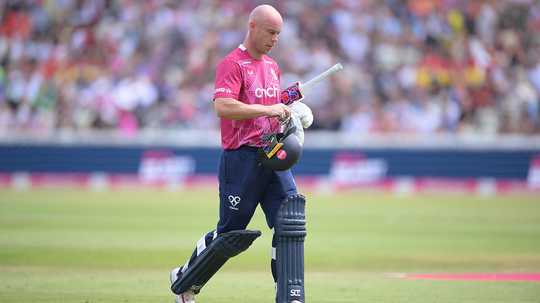

Chris Lynn handed one-month suspension after cocaine test during T20 Blast finals day
Former Australia batter Chris Lynn has received a one-month suspension from the England and Wales Cricket Board’s Cricket Regulator after a drug test detected a cocaine metabolite. The sample was collected on July 18, when Lynn was representing Northamptonshire during the T20 Blast finals day.
Lynn accepted the sanction after acknowledging that he had used cocaine on July 15 and 16. The regulator accepted evidence that the use took place outside competition and was not connected to his performance on the field. His case highlights how anti-doping rules distinguish between substances taken in competition and conduct that occurs outside it, while still treating prohibited substances seriously.
What the drug test found
According to the Cricket Regulator’s report, Lynn’s urine sample was analysed at a World Anti-Doping Agency-accredited laboratory in France. The test returned an adverse analytical finding for benzoylecgonine, a metabolite of cocaine.
Cocaine is listed as a stimulant under the 2026 WADA Prohibited List. It is prohibited in competition and classified as a “Substance of Abuse” under the rules. That classification is relevant to how a case may be assessed, but it does not make the substance permissible for a player to use around a tournament or match.
The timing of a sample is central to anti-doping proceedings. A positive result establishes that a prohibited substance or its metabolite was detected; the surrounding evidence helps regulators determine whether the relevant violation occurred in competition, how the rules apply and what sanction is appropriate. In Lynn’s case, the regulator accepted that the cocaine use occurred several days before the July 18 sample and outside the period treated as competition for the charge.
How the case unfolded
The Cricket Regulator notified Lynn of the test result on July 31 and informed him that he had been provisionally suspended. On August 20, Lynn responded to the allegation, confirmed his cocaine use on July 15 and 16, and argued that the matter should be treated as an out-of-competition anti-doping violation unrelated to sporting performance.
He also supplied evidence to support his account of when the substance had been taken. On September 23, the regulator issued a formal charge notice and confirmed that it accepted his explanation that the violation had occurred outside competition.
Lynn was initially charged under two articles of the ECB’s anti-doping rules. One charge was later withdrawn after the concentration of the substance in his sample was found to be below the minimum level required for a charge under WADA rules. The remaining proceedings resulted in the one-month suspension.
Why the suspension was reduced
The regulator had initially sought a three-month suspension. However, the proposed sanction was reduced after Lynn provided confirmation that he had completed a substance-of-abuse treatment programme. The programme formed part of the circumstances considered when determining the final penalty.
The one-month period was counted from the start of Lynn’s provisional suspension. As a result, the sanction was deemed to have been completed on August 30. The decision therefore did not extend his suspension beyond that date, even though the formal charge notice was issued later.
In anti-doping cases involving substances classified as drugs of abuse, treatment and other evidence may influence the outcome under the applicable regulations. That does not remove the underlying violation, but it can be relevant to the sanction. The distinction is important: the regulator accepted that Lynn’s use was outside competition, yet still imposed a penalty under the sport’s rules.
What the decision means for cricket
The case is a reminder that professional cricket’s anti-doping framework applies beyond the moment a player walks onto the field. Players are responsible for understanding which substances are prohibited, when restrictions apply and how a test result may be assessed. A substance that is prohibited only in competition can still lead to a formal case if it is detected and the circumstances require investigation.
It also shows why regulators examine more than a laboratory result. The test provides scientific evidence, while a player’s response, supporting documentation, the timing of use and any relevant treatment can all shape the final decision. In Lynn’s case, the accepted out-of-competition explanation and completion of a treatment programme were both reflected in the outcome.
For Northamptonshire and the wider T20 Blast, the news arrives in a format where squad availability and player discipline can attract close attention. Lynn is an experienced T20 batter, and any suspension involving a prominent player naturally prompts questions from supporters about eligibility and future participation. Because his one-month suspension was treated as completed on August 30, the sanction itself had already run its course by the time the formal process concluded.
Cricket prediction and the wider discussion
From a cricket prediction perspective, the case is not, by itself, a reliable indicator of how Lynn or Northamptonshire will perform in future matches. Predictions should be based on current availability, form, team selection, opposition and conditions—not simply on a disciplinary headline. The suspension had a defined end date, and the regulator’s decision focused on the circumstances of the anti-doping violation rather than on match results or sporting performance.
For fans following cricket news, the key facts are clear: Lynn accepted that he used cocaine before the sample was collected; the regulator accepted that the use occurred out of competition; one of the original charges was dropped because the concentration fell below the relevant threshold; and the final one-month suspension was treated as completed on August 30 after Lynn confirmed he had undertaken treatment.
The ruling underscores the balance anti-doping authorities must strike between enforcing consistent rules and considering the details of an individual case. It also reinforces a practical lesson for players at every level: seek guidance about prohibited substances, take testing obligations seriously and address health or substance-use concerns through appropriate support. In professional cricket, accountability and player welfare remain closely connected.