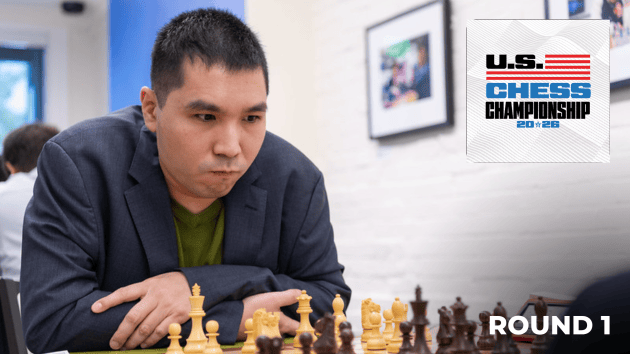

2026 U.S. Chess Championships Open in St. Louis With Dramatic First-Round Wins
The 2026 U.S. Chess Championship and U.S. Women’s Chess Championship began in St. Louis on Friday, October 9, with a ceremonial opening bell and a first round packed with decisive games, missed chances, and tense endgames. Dr. Jeanne Cairns Sinquefield officially launched the two-week event at the Saint Louis Chess Club, where 24 of the country’s leading players have gathered to compete for national titles.
In the Open section, three-time U.S. champion Wesley So marked his 33rd birthday with a hard-fought victory over Sam Shankland. Awonder Liang and Jeffery Xiong also opened with wins, defeating Hans Niemann and Sam Sevian, respectively. The remaining Open games ended in draws.
The Women’s Championship produced four decisive results. Among the biggest surprises was a costly queen blunder by Irina Krush, who had held a clearly favorable position against newcomer Alice Li. Li seized the opportunity to claim an important first-round win. International Master Anna Zatonskih and FIDE Masters Jennifer Yu and Zoey Tang also started the tournament with victories.
Wesley So’s Birthday Win Headlines the Open Section
So’s game against Shankland became the day’s longest and most dramatic contest. So emerged from the opening with a promising position, having sacrificed a pawn to gain activity and long-term pressure. But the game was far from straightforward: both players had opportunities as the position shifted repeatedly through the middlegame and endgame.
After 80 moves, So finally converted his advantage into a win. The result gave the three-time national champion an ideal start to his title campaign—and a memorable way to celebrate his birthday. So later thanked his mother and supporters, sharing a birthday message alongside a photograph of his celebration.
Shankland had made clear before the event that he was eager to challenge the younger generation. The opening-round pairing delivered on that promise, with both grandmasters producing a determined fight. So’s patience and ability to keep pressing proved decisive in a game that demanded sustained concentration.
Liang Takes Advantage of Niemann’s Risky Approach
Liang scored the first Open-section win of the day against Niemann. The game was not without errors, and Liang was notably self-critical afterward, describing it as a poor-quality contest in which both players missed important possibilities. One major opportunity came when Liang could have trapped Black’s queen with the precise move 30.Bc5!, potentially ending the game quickly.
Even so, the encounter offered a useful illustration of the tension between practical ambition and positional safety. Niemann, playing Black from a slightly inferior position, continued to seek counterplay and accepted weaknesses around his king. That approach created chances but also gave Liang opportunities to increase the pressure. Liang ultimately converted the advantage and earned a valuable full point in a field where every result can shape the standings.
Xiong Wins a Technical Pawn Endgame
Xiong’s victory over Sevian came in a complex pawn endgame, where a single miscalculation proved costly. The position featured the endgame concept known as related squares—a technique in which the king’s route and the key squares around the pawns must be calculated precisely. Finding the correct plan can be difficult even with ample time.
Sevian was short of time during the final phase and could not identify the necessary continuation. Xiong took advantage, demonstrating the value of accurate calculation and king activity in seemingly simplified positions. The win gave Xiong an early boost in a championship where endgame technique may be just as important as opening preparation.
Women’s Championship: Upsets and a Top-Seed Draw
The Women’s section also began with plenty of action, including difficult results for members of the U.S. squad that recently competed at the Olympiad in Samarkand. Krush appeared to be in control against Li before overlooking a tactical detail and dropping her queen. The sudden reversal allowed Li, making her championship debut, to secure a notable win.
Another Olympiad teammate, Abrahamyan, had held the better position against Jennifer Yu but failed to maintain control. With less than three minutes remaining, Abrahamyan allowed Yu to build a dangerous attack, and the game slipped away. International Master Tatev Abrahamyan’s defeat added to a challenging opening day for several players arriving from recent team competition.
IM Gulrukhbegim Tokhirjonova also lost after being gradually outplayed by IM Nazi Paikidze. The result reflected how quickly pressure can accumulate in a long round-robin tournament: even without a single dramatic blunder, a player can lose control as an opponent steadily improves their position.
The marquee Women’s matchup featured defending champion and top seed Carissa Yip against second seed Alice Lee. Their game lived up to expectations, with both players gaining promising chances at different stages. However, time pressure became a major factor for Yip, and neither side managed to secure the decisive advantage. The encounter ended in a draw, leaving both contenders with half a point after an energetic opening-round battle.
Tournament Format, Schedule, and Prize Funds
Both championships are 12-player single round-robin tournaments taking place in St. Louis from October 9 to 22. Players face every opponent once, making consistency essential across the full schedule. The time control is 90 minutes for the first 40 moves, followed by 30 minutes for the remainder of the game, with a 30-second increment beginning on move one.
The Open Championship offers a base prize fund of $250,000, including $55,000 for first place. The Women’s Championship has a $152,000 prize fund, with $35,000 awarded to the winner. Both events also feature bonus prizes tied to achievements such as finishing outright first, winning consecutive games, and ending the tournament strongly.
The Open Championship also serves as an official event for the U.S. FIDE zone and a qualification tournament for the next World Cup. Compared with the previous year’s lineup, Jeffery Xiong is the only change in the Open field. The Women’s roster includes Alice Li in place of WGM Katerina Nemcova.
What to Watch in Round 2
Round 1 has already shown why the U.S. chess championships are difficult to predict. Strong positions can disappear through a single tactical oversight, while technical endgames and clock management can decide games long after the opening is forgotten. The early wins for So, Liang, Xiong, Li, Yu, and Paikidze set the pace, but the round-robin format leaves plenty of time for the standings to change.
Round 2 is scheduled for Saturday, October 10, at 1 p.m. Eastern Time (19:00 CEST; 10:30 p.m. IST). Fans can follow the games through the Saint Louis Chess Club’s live coverage and review completed games through the event’s online platforms. With two weeks of elite chess ahead, the opening round has offered an early reminder: preparation matters, but resilience and precision under pressure may matter even more.