
Real Madrid’s Mbappé and Vinícius Dilemma Puts the Club’s Project to the Test
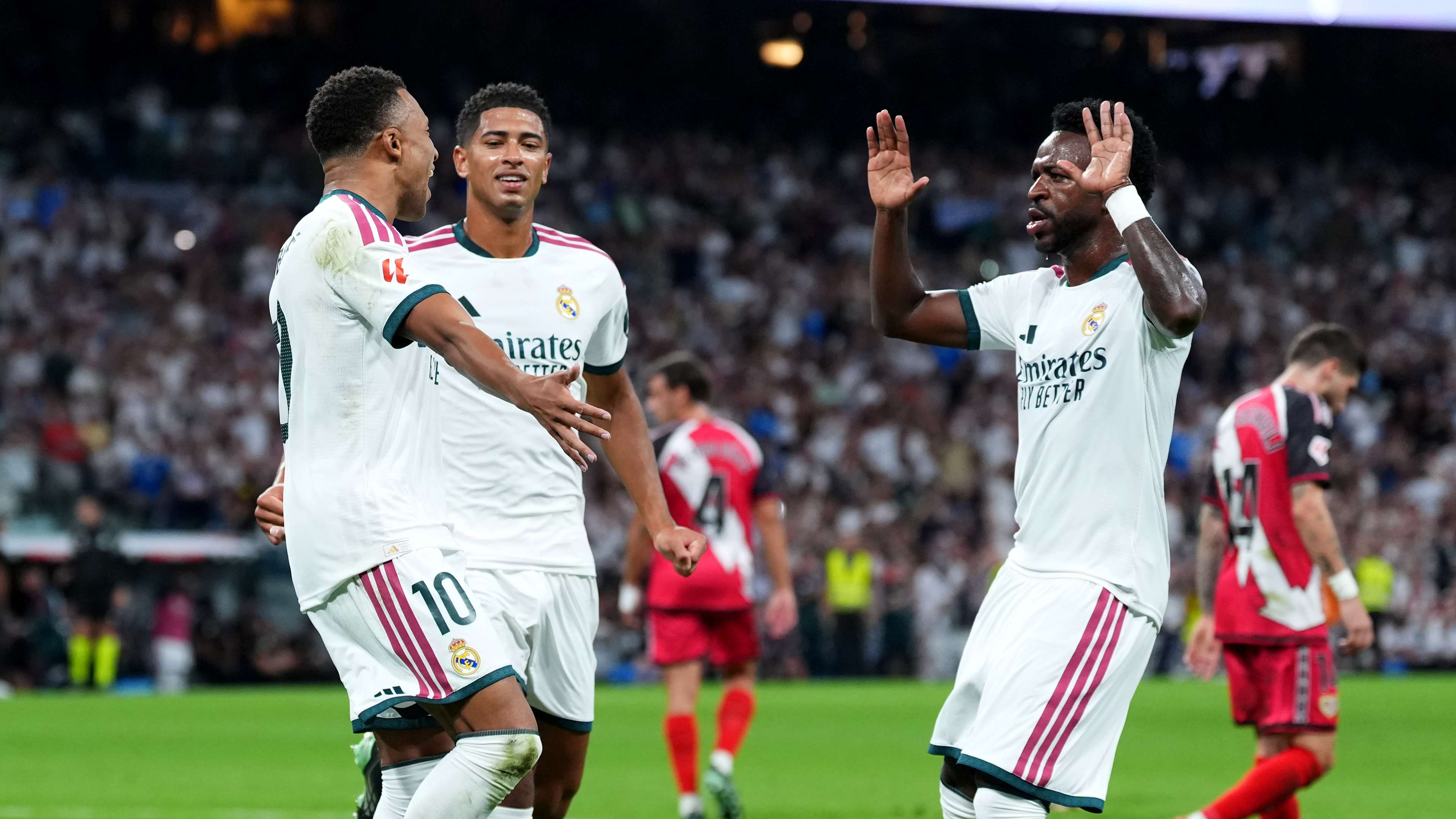
Real Madrid’s latest collection of football superstars was supposed to make the club even harder to stop. Instead, the partnership between Kylian Mbappé and Vinícius Júnior has become one of the biggest questions facing the team: can two elite forwards who favour the same spaces thrive together without weakening the side’s balance?
The challenge is now confronting José Mourinho, who has inherited a dressing room still recovering from a turbulent period. With Barcelona six points ahead in La Liga and the first Clásico of the season scheduled for October 25, the pressure is building. The outcome could influence not only Real Madrid’s immediate results, but also the direction of a project built around assembling some of football’s most recognisable names.
From a Champions League high to a difficult rebuild
A little more than two years ago, Real Madrid appeared to be at the summit of European football. The club had won a record-extending 15th UEFA Champions League title and finally secured Mbappé on a free transfer from Paris Saint-Germain after years of pursuit. The French forward’s arrival seemed to add another decisive weapon to an already formidable team.
Vinícius was also at the height of his reputation, having emerged as a leading contender for the Ballon d’Or before Manchester City’s Rodri received the award. Jude Bellingham, meanwhile, made an extraordinary first-season impact, scoring 23 goals after becoming one of the most expensive signings in the club’s history.
Those achievements fuelled expectations that Florentino Pérez’s star-focused strategy would deliver sustained dominance. But the following seasons did not match the promise. Real Madrid went without a major trophy, several coaches took charge in succession, and the club faced criticism over its performances and internal direction.
Refereeing decisions became a frequent subject of debate, but concerns inside the club extended beyond officiating. The departures of midfield leaders Toni Kroos and Luka Modrić left questions about creativity and control, while observers pointed to inconsistent intensity and a lack of cohesion among the team’s attacking stars.
The tactical problem behind the headlines
At the centre of the debate is a straightforward footballing issue: Mbappé and Vinícius both prefer to attack from the left. Their movement can make them dangerous individually, but when they drift into the same zones, they risk limiting each other’s influence and narrowing Real Madrid’s options in possession.
Analysis of their positioning during the recent Madrid derby against Atlético showed the forwards repeatedly occupying similar areas. The overlap can complicate attacking patterns, particularly during counter-attacks, when Real Madrid need players to stretch the opposition across the pitch rather than converge on one channel.
It can also affect the team’s defensive structure. One former member of a coaching staff told The Athletic that the issue was “first and foremost a footballing problem,” while another suggested that lasting progress may require a major structural change—or, in the most dramatic scenario, the departure of one of the two forwards.
That does not mean the pair cannot succeed together. It does mean their roles need to be clearly defined. Mbappé can threaten the space behind a defence, while Vinícius can isolate full-backs and create chances through his dribbling. To make those strengths complementary, Real Madrid must encourage one player to hold width or move centrally while the other attacks the left channel.
Numbers underline the contrasting starts
The early-season statistics have highlighted a difference in form. Mbappé has recorded eight goals and two assists in Real Madrid’s first eight matches, making him a major source of attacking production. He failed to score in the team’s two defeats and missed a penalty in another loss, but his overall output remains strong.
Vinícius, by contrast, has registered one goal and three assists across the same number of games. That return has prompted concern because the Brazilian has often been one of Real Madrid’s most reliable sources of goals and creative momentum. People close to Mourinho have reportedly said the coach has not seriously considered dropping him, despite speculation in the Spanish media.
Online theories about Vinícius’s dip have included unsupported claims linking it to cosmetic surgery. There is no evidence for that suggestion, and it risks distracting from more relevant questions about form, positioning and the team’s changing tactical demands.
Both forwards were kept quiet in the derby defeat to Atlético. For Mourinho, the priority is not simply to choose which star gets the ball more often, but to create a system in which their movement opens opportunities for Bellingham, Rodrygo and the midfielders as well.
Mourinho’s approach: balance without draining the forwards
Real Madrid have traditionally used a 4-4-2 shape that could leave the front players exposed when the team lost possession. Mourinho has instead worked with a compact 4-2-3-1, asking the forwards to protect spaces and maintain the team’s shape rather than undertake constant, energy-sapping defensive runs.
The intention is to improve defensive organisation while preserving the sharpness of Mbappé and Vinícius in the final third. That balance is difficult to achieve. If the forwards contribute too little without the ball, Real Madrid can be left with too few players defending. If they are asked to track back excessively, the team may lose the explosiveness that makes them so dangerous on the break.
Mourinho has reportedly focused during the international break on improving both defensive solidity and attacking efficiency. Sources familiar with the dressing room have rejected reports of a renewed internal crisis following the Atlético defeat, saying relations are better than they were last season, although poor results could quickly increase tension.
Good relationship, unresolved competition
People close to the players have described Mbappé and Vinícius as being on good terms away from the pitch. Their difficulty appears to be less about personal hostility than competition and on-field habits. One source said they compare themselves with each other, adding that if one does not defend, the other may be reluctant to do so either.
There has also been speculation that Vinícius feels the club is giving Mbappé more support in his pursuit of individual awards. Such perceptions can become significant in a squad where status, playing time and recognition matter. Still, no public evidence establishes that this is the decisive cause of their tactical problems.
Mbappé has also faced criticism over his activities while recovering from a knee injury, including a bicycle ride during a holiday in Switzerland. Mourinho dismissed the controversy as “ridiculous,” defended the activity as safe and confirmed that the forward would start against Villarreal. The episode nevertheless reflects how closely the behaviour of high-profile players is scrutinised.
A defining test for Real Madrid
Previous coaches, including Carlo Ancelotti, Xabi Alonso and Álvaro Arbeloa, tried different approaches to accommodate the club’s attacking talent, with varying results. Ancelotti managed a forward line packed with stars, while Alonso’s project reportedly created friction with key players. Arbeloa sought to rebuild trust with Vinícius and Bellingham but faced challenges elsewhere in the squad.
Mourinho’s task is to avoid treating the dilemma as a simple choice between two exceptional players. Real Madrid need a repeatable tactical plan: clearer spacing, coordinated pressing, better support from midfield and a willingness to vary the speed of attacks. If those adjustments work, Mbappé and Vinícius could become complementary threats rather than competing ones.
For supporters following the La Liga title race, the next stretch of football offers an important test. Real Madrid’s results, the forwards’ positioning and Mourinho’s selection decisions will all shape the conversation. The club’s ambition remains immense, but its success may depend on a less glamorous quality than star power: getting its best players to function as one team.