
Facundo Bernal’s Red Card Sparks Debate Over Football’s Uneven Outrage
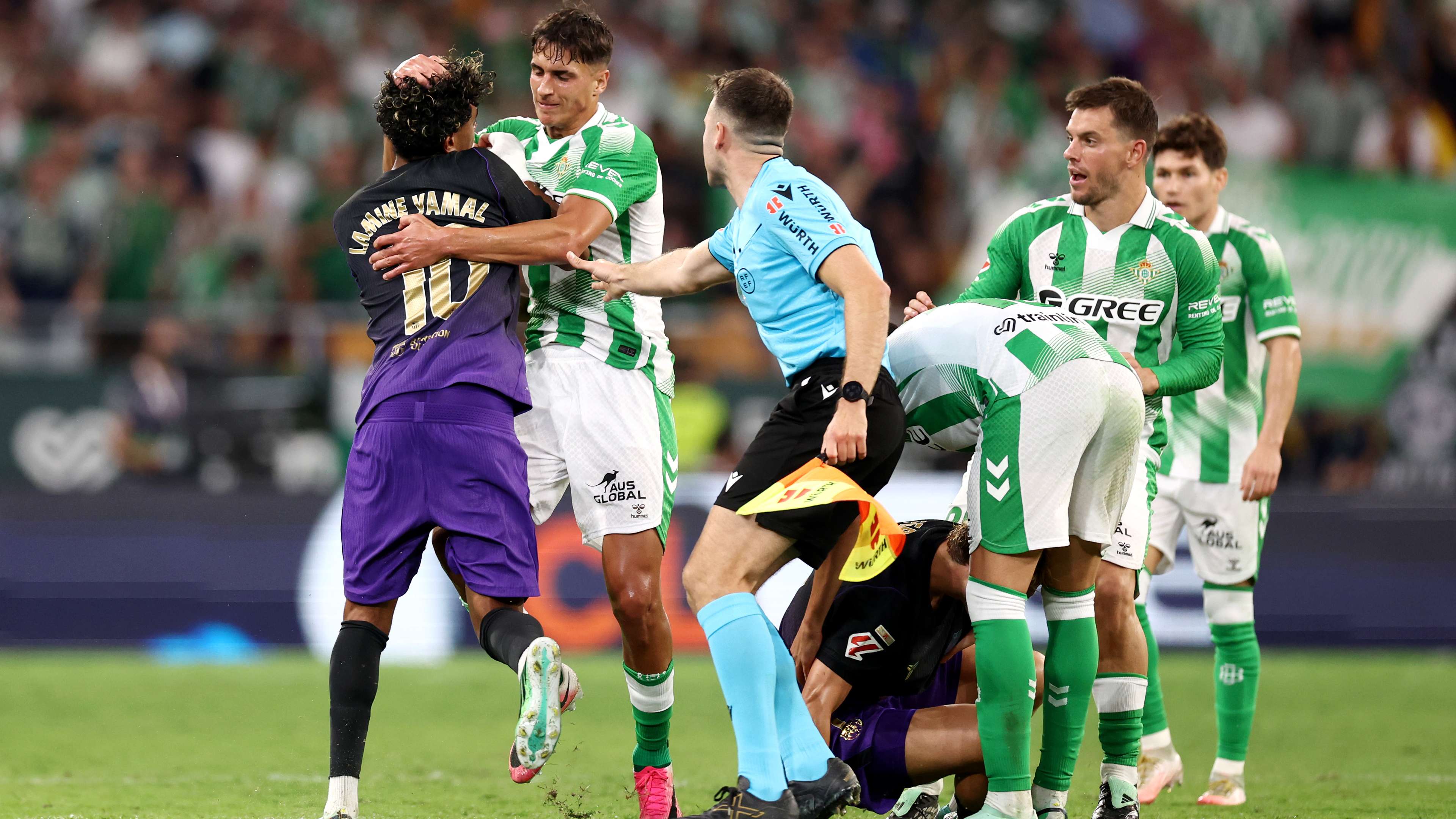
Facundo Bernal’s dismissal after a confrontation with Lamine Yamal during Barcelona’s meeting with Real Betis became one of Spain’s most talked-about football controversies. The decision prompted protests from Betis supporters, criticism from manager Manuel Pellegrini and close scrutiny from commentators linked to Real Madrid. Yet a remarkably similar incident in the Premier League attracted far less attention, raising a broader question: do comparable refereeing decisions receive the same treatment across football?
The two episodes followed a familiar pattern. A player appeared to lead with his head during a heated exchange, the referee showed a red card to that player, and the opponent received a yellow. Despite those similarities, the reaction to Bernal’s dismissal was considerably louder than the response to Tottenham midfielder Rodrigo Bentancur’s sending-off after a clash with Manchester United defender Luke Shaw.
What Happened Between Bernal and Yamal?
The Barcelona-Betis match turned contentious when Bernal was sent off following a confrontation with Yamal. The referee judged the midfielder’s movement towards the Barcelona forward to be serious enough to warrant a straight red card. Yamal remained involved in the exchange, prompting debate over the sequence of events and whether the referee had fully accounted for both players’ actions.
Betis supporters objected to the decision, while Pellegrini publicly questioned the call. The incident also became a talking point among commentators and figures associated with Real Madrid, some of whom examined whether Yamal had contributed to the confrontation. That scrutiny helped keep the episode in the headlines well beyond the final whistle.
In football, a red card can reshape a match in an instant. A team forced to play with ten men may have to abandon its original plan, protect space more carefully and rely on counterattacks rather than sustained pressure. That impact often makes a dismissal feel especially significant to supporters, particularly when they believe the decision was harsh or inconsistent.
The Premier League Comparison: Bentancur and Shaw
A similar flashpoint occurred at Old Trafford when Tottenham faced Manchester United. Shaw forcefully shoved Bentancur during a confrontation, and the Spurs midfielder responded by directing his head towards the defender. The referee dismissed Bentancur for violent conduct and booked Shaw for his role in the incident.
Shaw’s involvement attracted some criticism, but the decision did not generate anything like the same level of sustained argument as the Bernal-Yamal clash. The Premier League’s official explanation supported Bentancur’s red card, describing the dismissal as the correct outcome for violent conduct. That endorsement gave the decision a clear institutional defence, even if some viewers felt Shaw’s shove deserved greater consideration.
The comparison is not proof that the incidents were identical in every detail. Referees assess the force, intent and context of each confrontation, and small differences can matter. Still, the broad similarity is difficult to ignore: in both cases, the player who appeared to make a head-first gesture was sent off, while the opponent received a caution.
Why Did One Decision Create a Bigger Storm?
The contrast may have less to do with the basic mechanics of the refereeing decisions than with the setting around them. Barcelona and Real Madrid are among the most scrutinised clubs in world football, and any controversial moment involving either side can quickly become part of a wider rivalry. Yamal’s profile adds another layer: as one of Barcelona’s most prominent young players, his involvement naturally draws attention from fans and media.
Comments from managers and former players can also extend the life of a controversy. Pellegrini’s criticism gave Betis supporters a prominent voice, while commentary connected to Real Madrid ensured that the incident was discussed through the lens of Spain’s intense club competition. Once a decision becomes a point of debate between rival fan bases, the conversation can move beyond the referee’s interpretation and become a question of perceived fairness.
The Bentancur-Shaw incident, by contrast, received an official explanation that may have helped settle the immediate debate. That does not mean everyone agreed with the call, or that the Premier League is free from controversy. Rather, it suggests that the volume of discussion can depend on more than the decision itself. Club identity, player reputation, media attention and the availability of clear explanations all influence how a refereeing moment is received.
Consistency, Context and Football’s Refereeing Debate
Comparisons between incidents can be useful, but they should not replace a close examination of the footage. A referee must judge what happened in real time, often amid players’ reactions and a rapidly changing situation. Video review may provide additional angles, yet it can also intensify disagreement when supporters interpret the same images differently.
For fans, the central concern is consistency. If a head-first gesture is judged as violent conduct in one match, supporters will naturally ask whether a similar action in another game should lead to the same punishment. That question is especially important in a sport where a sending-off can influence the result, affect a team’s position and potentially shape the wider narrative around a season.
At the same time, consistency does not necessarily mean treating every incident as identical. The force of a shove, the movement that follows and the players’ actions before the confrontation all matter. A fair assessment should consider the complete sequence rather than isolating a single frame or judging the decision solely by which club benefited.
Prediction: The Debate Is Likely to Continue
The most reasonable prediction is that the Bernal-Yamal incident will remain part of Spain’s broader discussion about refereeing standards, particularly whenever Barcelona, Betis or Real Madrid are involved in another controversial decision. The Bentancur-Shaw comparison is likely to resurface as fans and analysts look for examples of how similar conduct is handled in different competitions.
Ultimately, the contrast reveals how football controversies are shaped both by the referee’s whistle and by everything that follows it. Bernal’s red card and Bentancur’s dismissal shared important similarities, but the surrounding reactions were markedly different. That gap invites questions about media attention, club rivalries and public perceptions of fairness—and reinforces why transparent explanations matter whenever a major decision changes the course of a match.