
VAR Controversy in Barcelona vs Real Betis Revives Debate Over Disallowed Goals
A disputed decision in Barcelona’s La Liga meeting with Real Betis has renewed questions about how far back video assistant referees can review an attacking move. Referee Ricardo de Burgos Bengoetxea ruled out a powerful goal by Giovani Lo Celso after consulting the pitchside monitor, prompting an angry response from Betis players and coach Manuel Pellegrini.
The decision also drew comparisons with a controversial moment involving Egypt at the 2026 World Cup. In both cases, a goal was cancelled because officials identified an infringement earlier in the same attacking sequence. The key issue was not simply whether a foul or handball had occurred, but whether the attack had continued without a change of possession.
Why Lo Celso’s Goal Was Disallowed
Barcelona travelled to the Benito Villamarín to face Real Betis in the ninth round of La Liga fixtures. The match was already tense when Lo Celso appeared to give the hosts another breakthrough in the 43rd minute. The Argentine midfielder struck the ball from outside the penalty area, sending a fierce effort towards goal that goalkeeper Joan García could not stop.
Betis supporters celebrated what looked like a spectacular goal. However, De Burgos was advised to review the build-up on the VAR monitor. After watching the footage, he decided that the ball had struck the hand of a Betis player in midfield earlier in the move. The goal was therefore disallowed.
The decision sparked immediate protests. Betis players surrounded the referee, while Pellegrini made his frustration clear from the touchline. The Chilean coach and his team were particularly unhappy because the handball had occurred some distance from the penalty area and before Lo Celso received the ball.
For Betis, the goal felt like a separate moment: the ball had travelled on, Lo Celso had taken responsibility, and his finish was a piece of individual quality. Under VAR’s interpretation, however, the important question was whether the handball occurred during the same uninterrupted phase of possession.
How VAR Defines One Attacking Phase
The refereeing analysis platform Archivo VAR has since addressed the debate. Its explanation focused on the continuity of the move: if the attacking team retains possession, the sequence can still be considered part of the same phase of play, even when several passes or actions take place between the original infringement and the goal.
That distinction matters. A goal may be reviewed if an offence occurs during the build-up, but the review is not necessarily limited to the final pass or the immediate action before the shot. If possession has not changed hands, officials may consider the earlier incident relevant. In the Betis case, the handball was judged to have taken place before the ball reached Lo Celso, but the attacking move had continued without a clear change of possession.
In practical terms, VAR is not simply checking whether the final shot was legal. It can examine the build-up for specific offences that directly affect the attacking phase. The system is intended to correct clear errors, although decisions involving the length and continuity of a move can still feel subjective to players and fans.
Egypt’s World Cup Experience Offers a Close Comparison
The ruling brought back memories of Egypt’s round-of-16 match against Argentina at the 2026 World Cup in the United States, Canada and Mexico. Argentina eventually won the contest 3-2, but an incident involving a disallowed Egypt goal became one of the game’s most contentious talking points.
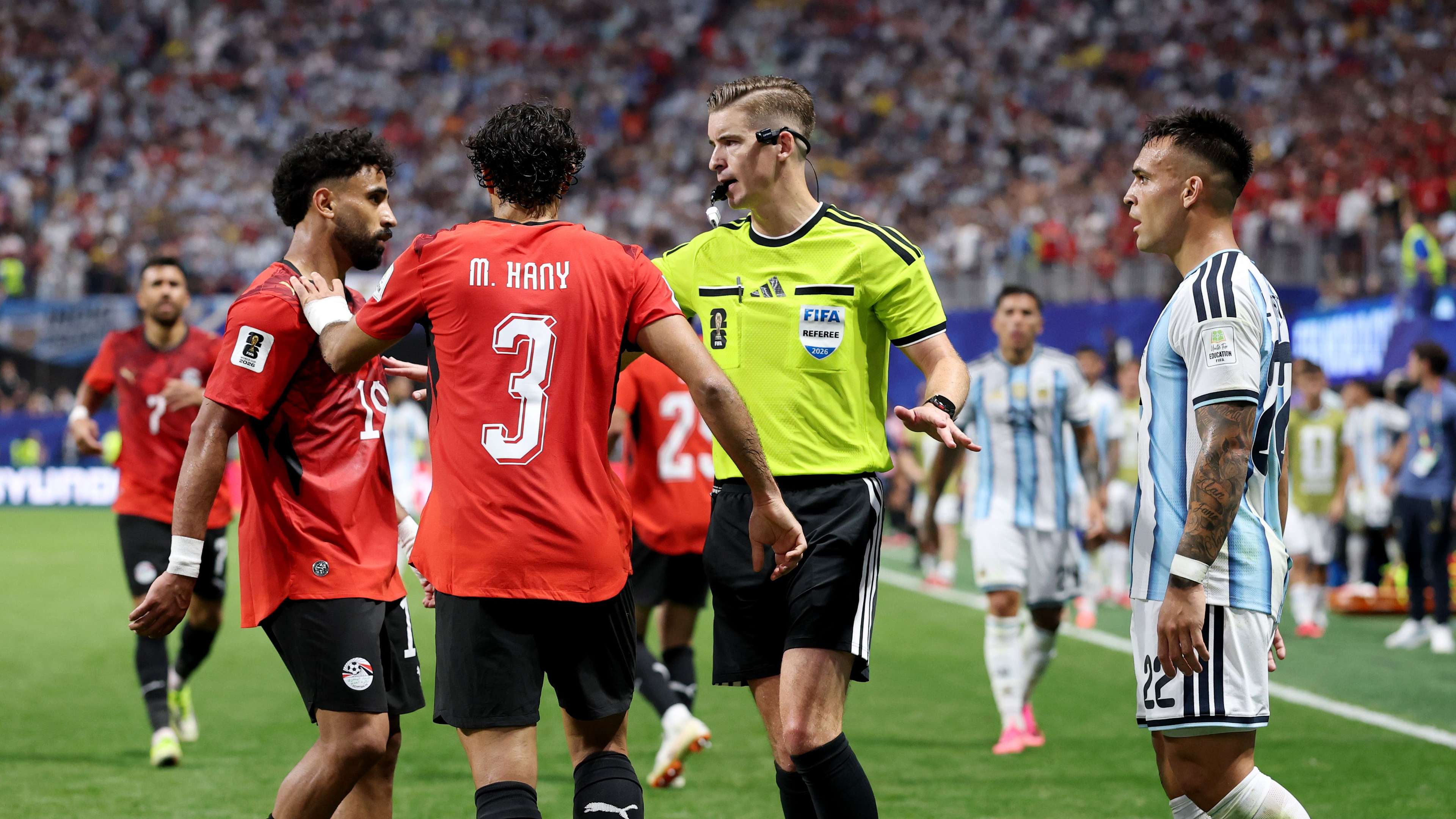
Egypt were leading when Mostafa Zico appeared to score a second goal after receiving a pass from Mohamed Salah. French referee François Letexier reviewed the sequence and ruled the goal out, citing a foul on Egypt midfielder Marwan Attia at the beginning of the move.
Egypt’s players and head coach Hossam Hassan objected strongly. Their argument was that the contact involving Attia happened too early in the sequence to justify cancelling a goal scored after the attack had developed. From their perspective, the team had continued to play and produced a valid finish. The officials, by contrast, treated the earlier foul as part of the same phase.
The comparison with Betis is striking because both incidents involved a goal being overturned for an offence that took place well before the final shot. In each case, the aggrieved side believed that the attack had progressed beyond the point where the original incident should matter. Archivo VAR’s explanation suggests that the decisive factor is whether possession changed hands—not simply how much time passed or how many actions followed.
Why These Decisions Continue to Divide Football Fans
VAR has made it possible to identify handballs and fouls that might previously have gone unnoticed. That can improve accuracy, especially when a clear infringement directly leads to a goal. Yet the technology also creates difficult questions about where an attacking move begins and ends.
Supporters often expect a clear break between an earlier incident and a later goal. They may view a long sequence of passes as a fresh phase, particularly if the player who scores has to create the chance independently. Referees and VAR officials, however, apply the laws by assessing possession and whether the ball has moved into a new phase of play.
That difference in perspective can make a technically correct decision feel harsh. It also explains why coaches and players frequently react with disbelief when a goal is ruled out for an offence far from the penalty area. The longer the gap between the infringement and the finish, the harder it can be for viewers to see the connection.
What the Decision Could Mean for La Liga
The Betis incident is another reminder that VAR decisions can shape the emotional and tactical direction of a football match. A disallowed goal may affect a team’s confidence, change how it approaches the remainder of the game and become a major talking point long after the final whistle.
For fans following La Liga, the episode offers a useful guide to future reviews: an infringement does not automatically become irrelevant just because play continues. If the same team keeps possession, officials may still judge that the attack remains active. A clear change of possession, by contrast, can help establish that a new phase has begun.
As football continues to adapt to video technology, debates over consistency are likely to persist. The broader prediction is that similar controversies will arise whenever an early handball or foul is linked to a goal several actions later. Until the boundaries of an attacking phase are easier for everyone to understand, VAR may correct decisions while still leaving players, coaches and supporters divided over whether the outcome feels fair.