
Roncero Questions VAR After Real Madrid’s 3-0 Win Over Racing Santander
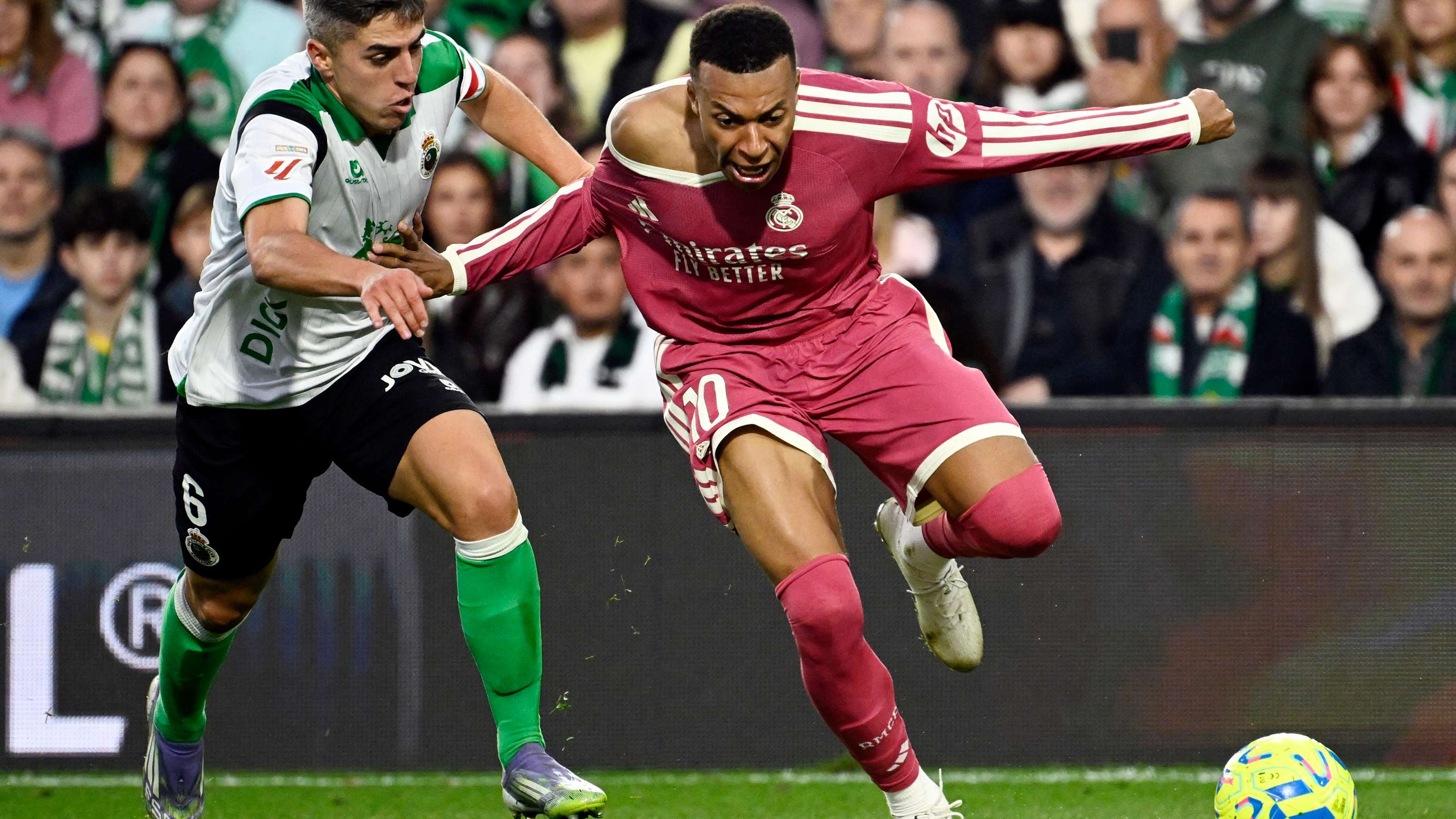
Real Madrid left El Sardinero with a convincing 3-0 victory over Racing Santander, but the result was followed by a debate over two key penalty-area incidents. Spanish journalist Tomás Roncero, editor-in-chief of the Madrid-supporting newspaper AS, criticised the officiating by José Luis Munuera Montero and VAR—while acknowledging that Kylian Mbappé’s early penalty should not have been awarded.
Roncero’s remarks focused on two moments: the decision to give Real Madrid a spot-kick after contact involving Mbappé, and a separate challenge on Madrid player Diomande that the journalist believed should also have resulted in a penalty. In his view, the handling of the incidents exposed an inconsistency in how the referee and video officials assessed contact inside the box.
Roncero says Mbappé penalty was too soft
Mbappé’s penalty came around 10 minutes into the match, giving Real Madrid an early opportunity to take control. Although the referee pointed to the spot, Roncero argued that the contact from the Racing defender was not enough to justify the decision.
“The referee denied Diomande a very clear penalty, while Mbappé’s penalty, for me, is not a penalty,” Roncero said.
He did not dispute that the defender made contact with the France forward. His objection was that contact alone should not automatically lead to a foul. In Roncero’s assessment, the incident lacked the force or clear impact needed for a penalty, making the award a questionable call rather than an obvious error in Real Madrid’s favour.
The distinction matters in football, where physical contact is common and officials must judge whether a player has been unfairly impeded. A defender placing an arm on an attacker may be legal, careless or foul play depending on the circumstances. The referee’s interpretation can therefore have a major effect on a match, particularly when the decision comes early and gives one side a chance to score from the spot.
Diomande challenge becomes the bigger controversy
While Roncero admitted that Mbappé’s penalty was undeserved, he was more forceful in his criticism of the challenge on Diomande. He believed the incident warranted a referee’s intervention and questioned why VAR did not recommend an on-field review.
“I don’t understand why the VAR room did not ask the referee to review the challenge on Diomande,” he said. Roncero added that he thought the contact was worthy of a yellow card. In his reasoning, if the challenge merited a booking, it should also have been treated as a foul and brought to the referee’s attention.
That argument highlights a recurring source of frustration for supporters: the perception that VAR is applied differently from one incident to another. Video officials are not expected to review every minor collision. Their role is generally to intervene when there may have been a clear and obvious error in a major decision, such as a penalty, a red card or a goal. But when one incident is reviewed and another potentially similar moment is not, fans and commentators often ask what standard was used.
Roncero’s criticism centred on that contrast. VAR was involved in the decision that led to Mbappé’s penalty, yet, according to the journalist, it did not prompt a review of the challenge on Diomande. He described the two moments as comparable situations that received different treatment.
Roncero says his view is not about the players involved
Roncero also sought to head off claims that his assessment was shaped by club allegiance. He said he would have made the same argument if a player from another team—such as Barcelona forward Lamine Yamal—had been involved in a similar challenge that went unpunished.
That point is significant in a rivalry as intense as Real Madrid and Barcelona’s, where refereeing decisions are often discussed through the lens of club loyalties. By referring to Yamal, Roncero presented his position as one based on the nature of the incidents rather than the identity of the players who benefited or lost out.
Still, the debate is unlikely to end with one journalist’s interpretation. Penalty decisions often depend on details such as the defender’s movement, the attacker’s balance, the intensity of contact and whether the action affects a player’s ability to continue. Slow-motion replay can help clarify what happened, but it can also make ordinary contact appear more dramatic than it looked at full speed.
Real Madrid’s performance remains central to the result
Despite his concerns about the officiating, Roncero insisted that the refereeing controversy should not overshadow Real Madrid’s overall performance. The visitors won 3-0 and, in his view, were clearly the stronger side throughout the match. He argued that the result would have been the same even if Mbappé had not received the penalty.
Roncero pointed to the difference in attacking threat as evidence of Madrid’s control. Real Madrid created enough opportunities to score more than three goals, while goalkeeper Thibaut Courtois was reportedly called into serious action only once. That contrast, he suggested, showed that the visitors’ victory was built on their play rather than on a single decision.
For Racing Santander, the match offered a difficult test against one of Spain’s most powerful teams. A penalty conceded early can disrupt a side’s plan, especially when playing at home, but the remainder of the scoreline also reflects Real Madrid’s ability to manage the contest and create further chances. The final result therefore presents two separate questions: whether the key calls were correct, and whether Madrid deserved to win on the balance of play.
Prediction: refereeing debate may continue after the final whistle
The 3-0 scoreline gives Real Madrid a clear result to take from El Sardinero, but the two penalty-area incidents have ensured that the match will also be remembered for its officiating. Roncero’s position is unusual in that he criticised both sides of the decision-making: he rejected the penalty awarded to Mbappé while arguing that Diomande should have received one.
That balanced criticism does not settle the debate, but it explains why the VAR response has become a talking point. If officials are to maintain confidence in the system, consistency and clear explanations are essential—especially when a review appears to favour one incident while leaving another untouched.
Roncero ended with a pointed response to anyone who reduced Real Madrid’s win to the referee’s decisions. He argued that doing so ignored the football played on the pitch. His broader prediction is that the discussion around officiating will persist, but he believes Madrid’s performance should remain the main takeaway: a dominant victory, a clean sheet and a result he considers deserved regardless of the controversial penalty.