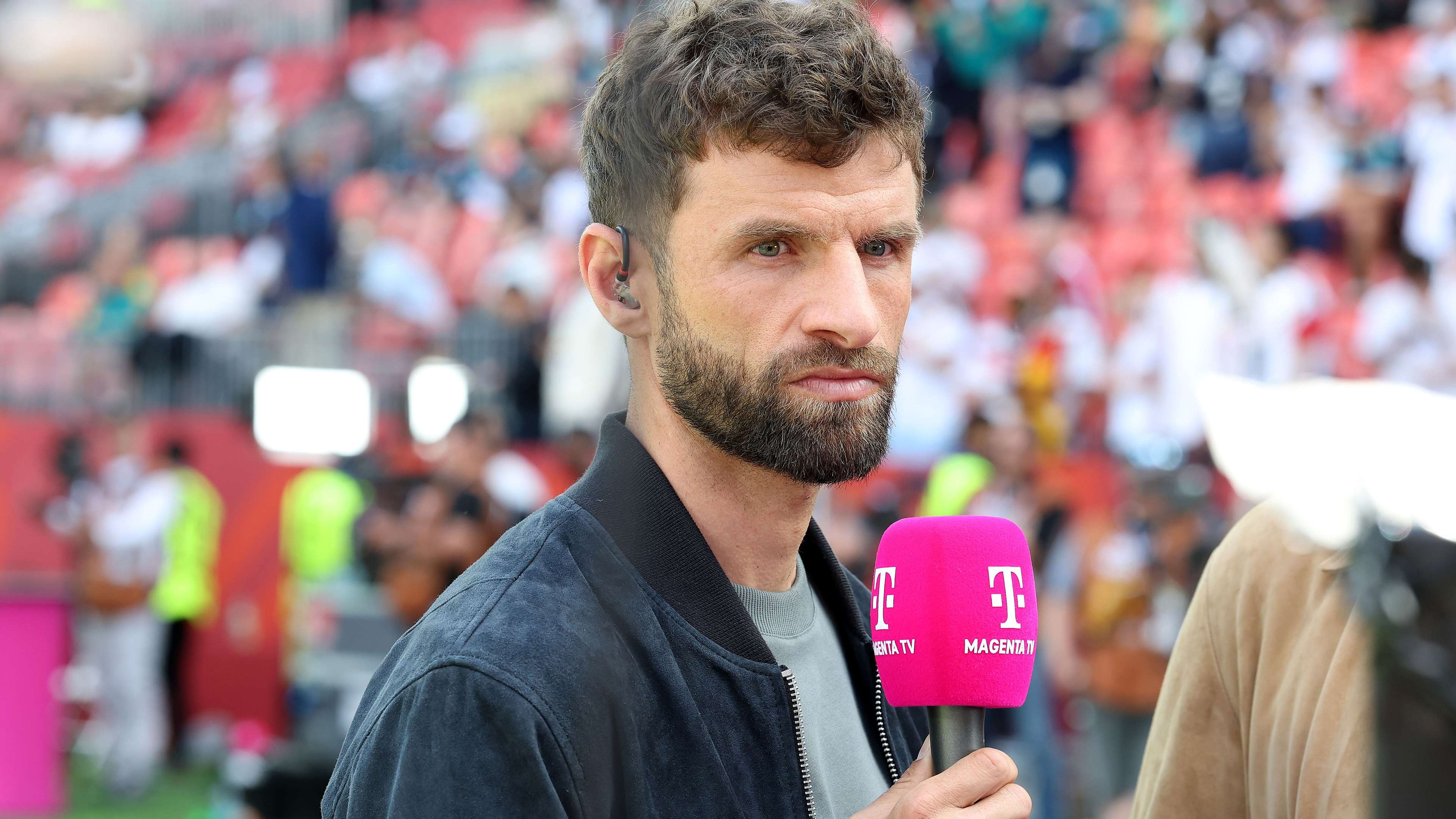

German Star Thomas Müller Sparks Controversy with Comments on Lionel Messi
The football world was once again abuzz with controversy as German star Thomas Müller hinted at the influence of Lionel Messi on referees during a recent discussion. Müller’s comments have reignited a debate surrounding the Argentine captain’s presence on the pitch and how it may affect officiating decisions.
Müller’s Controversial Remarks
In a video that quickly spread across social media platforms, Müller recalled a specific moment involving Messi during a match against Argentina. He recounted a situation where the ball accidentally hit his hand while playing against Argentina, leading to a yellow card being shown to him. Müller suggested that the referee’s decision was influenced by Messi’s proximity to the incident.
“We were already leading against Argentina, and Lionel Messi was standing right next to me. The ball bounced off the ground and then struck my hand, which was in this position (next to his body),” Müller explained in the video. “The referee immediately showed me a yellow card, and I think the reason is simply that Messi was standing beside me.”
He further added, “I felt that Messi looked at him as if to say, we’re behind (2-0), please help us a little.”
Revisiting the 2010 World Cup Quarter-Final
The incident Müller referred to took place during Germany’s quarter-final match against Argentina in the 2010 World Cup, a game that ended in a 4-0 victory for the Germans. His comments have brought back memories of the contentious refereeing decisions that surrounded Argentina during the 2026 World Cup.
Throughout the tournament, fans and media alike scrutinized numerous calls that seemed to favor the Albiceleste. The allegations of biased officiating became a hot topic of discussion, with critics arguing that Argentina benefited from controversial decisions that smoothed their path to the final. On the other hand, some defended the referees’ calls, citing the subjective nature of interpreting the rules of the game.
Impact of Müller’s Comments
Müller’s remarks have stirred up a fresh wave of debate within the football community, with fans and experts weighing in on the topic. The discussion around the influence of star players like Messi on referees’ decisions has sparked conversations about fair play and sportsmanship in the game.
As the controversy continues to unfold, it serves as a reminder of the complex dynamics at play in football matches, where the actions and presence of key players can sometimes extend beyond their on-field performance.
Stay tuned as the football world grapples with the aftermath of Müller’s comments and the larger implications they raise for the sport.
Thomas Müller’s Reputation and Influence
Thomas Müller’s comments about Lionel Messi and the influence of star players on referees come at a time when both players have established themselves as key figures in international football. Müller, known for his versatility and intelligence on the pitch, has been a vital player for both Bayern Munich and the German national team. His outspoken nature and candid remarks have earned him a reputation for being unafraid to speak his mind, even if it means stirring up controversy.
On the other hand, Lionel Messi, often regarded as one of the greatest footballers of all time, has consistently attracted attention both for his extraordinary skills and his interactions with officials during matches. As a player who commands respect and admiration worldwide, Messi’s actions and demeanor on the field can undoubtedly have an impact on referees’ decisions, whether intentional or not.
The Psychology of Refereeing Decisions
Müller’s anecdote sheds light on the psychological aspects that can influence referees during high-stakes matches. Research in sports psychology has shown that referees, like any other human beings, can be susceptible to various biases, including those related to star players or crowd pressure. The presence of a player of Messi’s caliber near an incident could subconsciously sway a referee’s judgment, leading to decisions that may not always be entirely impartial.
Understanding these psychological factors is crucial in evaluating the fairness and integrity of officiating in football. While referees undergo rigorous training and are expected to make split-second decisions in the heat of the moment, external influences, such as the presence of star players, can complicate the task at hand.
The Ethics of Fair Play in Football
The debate sparked by Müller’s comments raises important questions about the principles of fair play and sportsmanship in football. While gamesmanship and strategic behavior are inherent parts of the sport, there is a fine line between seeking an advantage within the rules and engaging in behavior that may be perceived as unethical or unsporting.
Players like Messi, with their exceptional talent and status, carry a certain responsibility to uphold the values of fair play and respect for the game. Their actions, both on and off the field, set an example for fans, young players, and the broader football community. As such, it is essential for players to be mindful of how their behavior and interactions with officials may be perceived and the potential impact they can have on the integrity of the sport.
Conclusion
As the football world grapples with the fallout from Thomas Müller’s comments on Lionel Messi and refereeing decisions, it is clear that the conversation extends beyond individual players and specific incidents. The broader themes of fairness, integrity, and the psychological dynamics of officiating in football merit ongoing reflection and discussion.
Ultimately, the controversy surrounding Müller’s remarks serves as a reminder of the complexities inherent in the beautiful game and the constant need to uphold its core values. As fans, players, and officials alike navigate the intricacies of football, maintaining a balance between competitive spirit and ethical conduct remains paramount in preserving the essence of the sport we all love.