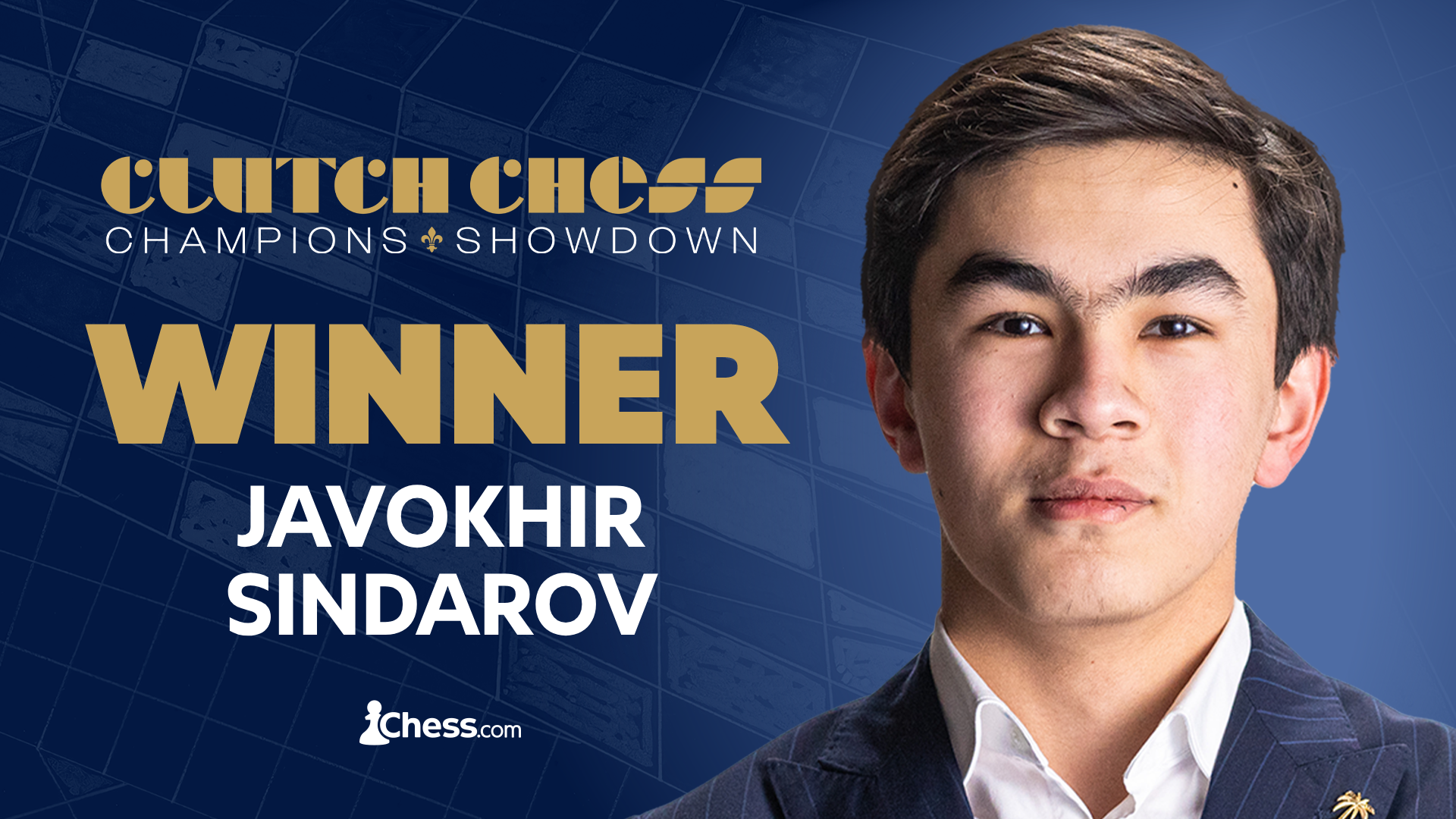

Sindarov Wins Clutch Chess: Champions Showdown 2026 After Dramatic Final Day
Javokhir Sindarov captured the title at Clutch Chess: Champions Showdown 2026, finishing with 20.5 points after three days of rapid chess at the Saint Louis Chess Club. The Uzbek grandmaster earned $168,000, including performance bonuses, and delivered one of the tournament’s most memorable games in a spectacular attack against Hikaru Nakamura.
Fabiano Caruana finished second, R. Praggnanandhaa took third, and Nakamura placed fourth. Sindarov’s victory was especially notable because the event was his final tournament before his upcoming World Championship match. His performance offered a timely demonstration of his tactical sharpness, resilience, and ability to thrive under pressure.
A 2.5-Point Deficit Turned Into a Title
The final day began with Sindarov and Caruana trailing Praggnanandhaa by 2.5 points. In a format where each win was worth three points and $3,000, the gap was significant—but far from insurmountable. With two-game mini-matches still to play, one decisive result could quickly change the standings.
Sindarov later joked that he had checked social media that morning and discovered that grandmasters had selected him as their commentators’ pick. He said the vote gave him extra motivation, though his comeback ultimately depended on both his own strong play and Praggnanandhaa’s late slowdown.
The tournament used a fast 10+5 time control, meaning players had ten minutes for the game and received five seconds after each move. That format rewards quick calculation and practical decision-making, but it can also turn a promising position into a crisis in a single time scramble.
Sindarov Takes Control Against Praggnanandhaa
Sindarov’s first mini-match of the day was against Praggnanandhaa, the player he needed to catch. Their opening game ended in a draw, leaving the tournament leader with a chance to protect his advantage. In the second game, however, Sindarov found the decisive opportunity and won.
The critical moment came after Praggnanandhaa sacrificed a piece for two central pawns. He needed the counterintuitive move 21…Qc5 to recover the material. Instead, he played 21…Qb8, apparently aiming for the same idea, but Sindarov spotted a tactical resource that left White in trouble. The result transformed the title race and gave Sindarov valuable momentum.
He then defeated Caruana in a rook endgame after a tense time scramble, emerging two pawns ahead. Their next game looked as if it might produce another Sindarov win. In a sharp King’s Indian Defense, he created serious attacking chances, but Caruana defended resourcefully and escaped. Sindarov admitted he was disappointed not to recognize how strong his position had become.
A Stunning King’s Indian Attack Against Nakamura
Sindarov’s most celebrated performance came in his match against Nakamura. The Uzbek grandmaster launched an ambitious attack in the King’s Indian Defense, beginning with a bishop sacrifice and later giving up two exchanges to keep the initiative alive.
Rather than settle for a routine conversion, Sindarov chose to finish the game in striking style. He explained that many moves appeared winning, but once he had begun playing beautifully, he wanted to complete the attack the same way. The game stood out as a leading candidate for the tournament’s best and drew attention for its combination of calculation, imagination, and confidence.
“When I played with Hikaru, the game was one of the best King’s Indian games I’ve ever played in my life,” Sindarov said. “Even in the short time control, I played very well.”
The final game of their mini-match ended in a solid draw in the Berlin Defense. That half-point was enough to secure the championship, capping a remarkable final-day surge.
Nakamura and Praggnanandhaa Reflect on Missed Chances
Nakamura had led the standings after the first day but lost ground as the event continued. Despite finishing fourth, he said he was generally satisfied with the quality of his chess. His main frustration was failing to maintain that level during time scrambles.
He noted that playing with a five-second increment presents a different challenge from formats with no increment or a larger one. In his view, the short addition falls between familiar time-control categories, and he has not felt as comfortable in that middle ground recently. The distinction matters in rapid chess: a player may understand a position well but still struggle to find accurate moves when the clock is low and every decision carries immediate consequences.
Praggnanandhaa remained in contention until the final game. He described the result as disappointing because he had chances against Caruana and had also blundered in his loss to Sindarov. At the same time, he acknowledged that fortune had helped him earlier, including a win over Nakamura from a position that had looked lost.
That Nakamura game turned on a late mistake. After losing control in the scramble, Nakamura played 43.Ree5??, only to discover that he could not stop Black’s passed pawn from promoting after 43…d2. Praggnanandhaa later added another win against Nakamura, converting an exchange advantage with convincing technique.
Caruana’s Defense Decides the Final Match
Praggnanandhaa’s last mini-match was against Caruana, and it became the decisive test of his title hopes. In the first game, Praggnanandhaa pressed for a long time from a position with an extra pawn and winning chances. Caruana held firm, however, and the game ended in a draw after exactly 100 moves.
That left Praggnanandhaa needing a win with Black in the final game to claim the tournament. He adopted a Stonewall setup and generated attacking prospects, but Caruana’s preparation and tactical awareness proved decisive. Praggnanandhaa allowed an elegant queen trap with 33…Rg7??, and Caruana responded with 34.Ng4!, a resource he had anticipated well in advance.
Praggnanandhaa said that finishing second in such a strong field was a respectable result, but admitted that being so close to the title made the outcome hard to accept. Caruana’s defense across the mini-match was a reminder that in elite chess, surviving a difficult position can be as consequential as winning one.
What Comes Next for the Players?
Caruana and Praggnanandhaa are set to travel to Budapest for their next event, where they will compete in a field that includes world number-one Magnus Carlsen. Sindarov will turn his attention to preparation for the World Championship match, while Nakamura said his upcoming classical schedule includes the American Cup and the Total Chess World Championship in 2027.
Sindarov also thanked the Saint Louis Chess Club, the organizers, and the broadcast team. Reflecting on his final tournament before the title match, he praised the city and, especially, its people. The 2026 edition ran from October 27 to 29, brought together four leading grandmasters, and featured a $425,000 prize fund.
For fans, the event offered a compelling mix of tactical brilliance, long defensive battles, and rapid-fire drama. Sindarov leaves St. Louis with the trophy—and with a major confidence boost before the biggest chess challenge of his career.