
Neymar handed two-match ban under Brazil’s “Vinicius law”
Brazilian football star Neymar has been suspended for two matches after a disciplinary panel ruled that he breached a competition rule by covering his mouth during a heated exchange with an opponent. The decision follows an incident in Santos’ 1-1 draw with Bahia and has reopened debate about how football authorities should interpret gestures made during on-field confrontations.
The second disciplinary committee of Brazil’s Superior Court of Sporting Justice found Neymar guilty under a regulation commonly known as the “Vinicius law.” The rule applies across Brazilian competitions and is intended to discourage players from concealing their words during disputes, supporting transparency and helping officials investigate potentially abusive or discriminatory language.
According to Spanish newspaper Marca, committee members considered a suspension of up to four matches before a majority settled on a two-game ban. Neymar can appeal the ruling before the court’s full bench, meaning the punishment could still be reviewed.
How the Santos-Bahia incident unfolded
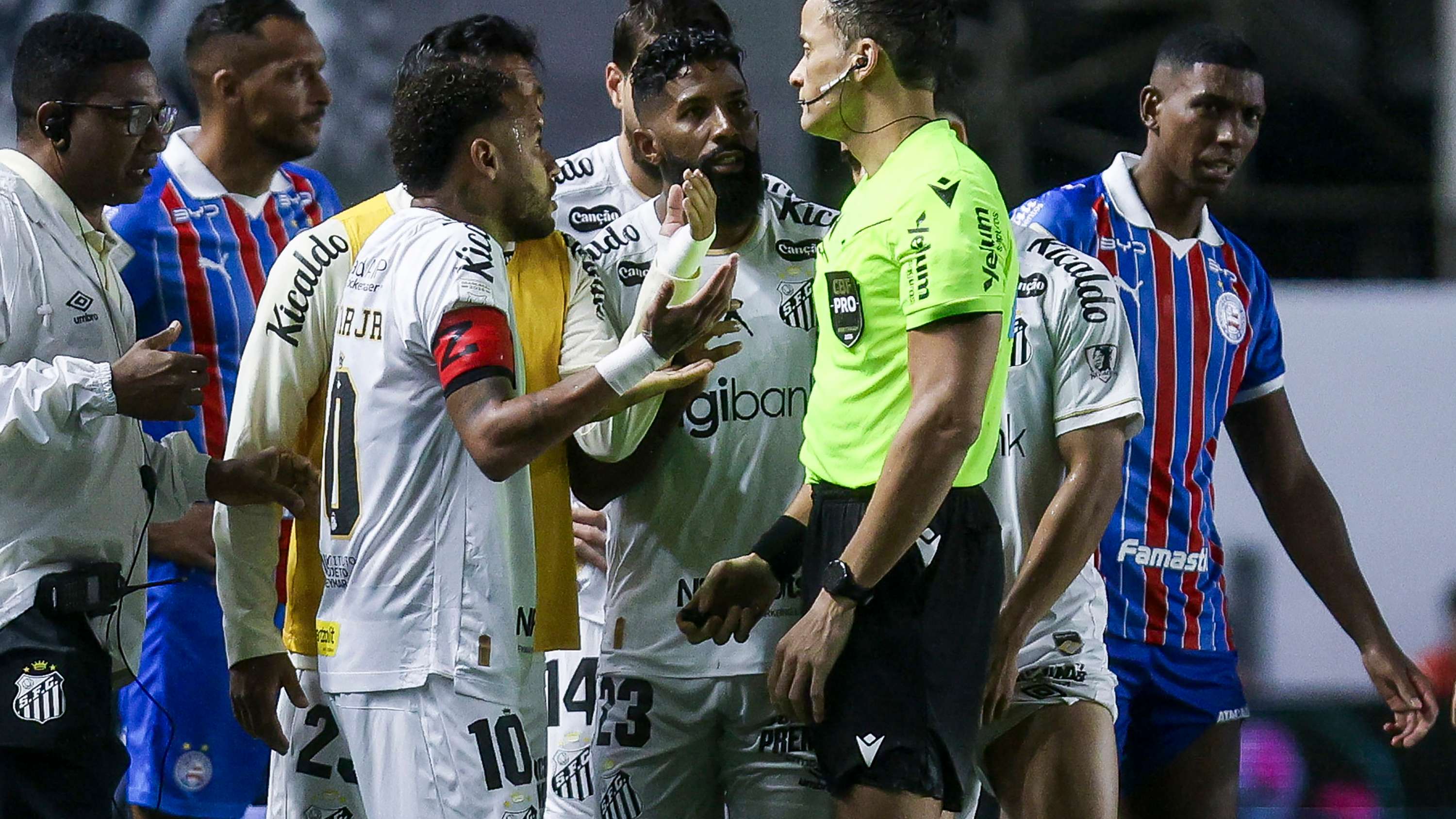
The dispute took place at Santos’ Vila Belmiro stadium during last Saturday’s Brazilian league match against Bahia. The teams finished level at 1-1, but the result was overshadowed by Neymar’s confrontation with Bahia midfielder Rodrigo Nestor.
The players had already clashed during the first half. Their disagreement intensified before the restart, when Neymar and Nestor squared up near the pitch. As the argument continued, Neymar raised a hand to cover his mouth while speaking to his opponent.
Nestor immediately approached the referee to report what had happened. The official later acknowledged that he had not witnessed the gesture directly. After receiving an alert from the video assistant referee (VAR), however, he issued Neymar a straight red card.
The dismissal was only part of the controversy. The referee’s report stated that Neymar moved towards Bahia’s substitutes’ bench after being sent off, apparently attempting to reach Nestor. Santos teammates intervened and held him back. That account added to the disciplinary scrutiny surrounding the incident, although the committee’s ruling focused on Neymar’s covered-mouth gesture.
Why the rule is known as the “Vinicius law”
The regulation has become widely associated with efforts to address discrimination and improve accountability in Brazilian football. A player who covers their mouth while speaking may make it harder for referees, opponents, broadcasters and investigators to establish what was said. The rule is designed to discourage that concealment, particularly during confrontations where offensive language may be alleged.
Its informal name references Vinicius Junior, the Brazilian forward who has repeatedly spoken out about racism in football. The rule reflects a broader push to ensure that claims of discriminatory abuse can be investigated effectively. It also raises a difficult practical question: a covered mouth may be relevant evidence, but the gesture alone does not necessarily reveal what a player said or why they chose to cover their face.
That distinction is likely to be central to Neymar’s appeal. Any review could examine the context of the exchange, the referee’s use of VAR, the wording of the competition regulations and whether the available evidence supports the committee’s interpretation.
Disciplinary panel says gesture undermined transparency
Delmiro Campos, the official responsible for investigating the case, argued that Neymar’s action was an attempt to conceal his words during a confrontation. In Campos’ view, the gesture conflicted with the principles of transparency and sporting ethics that underpin the rule.
“Objectively, the gesture of covering the mouth in the context of a confrontation directed at an opponent, with awareness of the illegitimacy of this act, are two things that cannot be called into question,” Campos said, as reported during the proceedings.
Neymar’s legal team disputed that assessment. His lawyers argued that the exchange was not hostile and should be understood as a verbal disagreement in a light-hearted atmosphere. They also maintained that not every instance of a player covering their mouth should automatically fall under the regulation.
Lawyer Marcelo Mendez told the hearing that Neymar’s movement was instinctive. “Not every gesture of covering the mouth is covered by the Vinicius law, and the player put his hand over his mouth instinctively,” he argued.
What the suspension could mean for Santos
If the two-match suspension remains in place, Santos will have to manage the loss of one of its most prominent players during the ban. Neymar’s influence extends beyond his attacking contributions: his experience, creativity and ability to draw defenders can shape how Santos builds attacks and creates space for teammates.
The exact impact will depend on the timing of the appeal and the club’s upcoming schedule. Santos may seek to have the decision overturned or reduced, while the coaching staff will need to prepare for the possibility that Neymar is unavailable. Supporters will also be watching closely to see whether the ruling affects the team’s momentum in a competitive stage of the season.
For football fans, the case is significant beyond the immediate result. It tests how consistently Brazilian authorities apply a rule intended to protect transparency and sporting integrity. A clear ruling may help players and clubs understand where the boundary lies, but the appeal could also prompt further discussion about whether context should influence disciplinary decisions.
Appeal could shape future interpretations
Neymar’s case highlights the challenge of balancing fair process with the need to address conduct that may be difficult to assess from the pitch. VAR can alert officials to an incident they did not see, but video footage may not establish the words exchanged or the intention behind a gesture. That leaves disciplinary panels to weigh the circumstances and apply the competition’s rules.
The full court’s review, if Neymar appeals, could therefore have consequences beyond this single match. Its decision may influence how similar incidents are handled in Brazilian football and clarify whether an instinctive gesture, a heated argument or the presence of an opponent is enough to trigger punishment.
For now, the two-match ban stands unless it is changed on appeal. The episode has turned a draw between Santos and Bahia into a wider conversation about player conduct, video review and accountability. Any prediction about the final outcome remains uncertain, but the ruling has already placed the “Vinicius law” firmly in the spotlight—and ensured that Neymar’s next steps will be followed as closely as his performances on the pitch.