
Hertha BSC’s Perfect Start Raises a Big Promotion Question
Before the 2026/27 campaign began, Hertha BSC were one of the great unknowns in the 2. Bundesliga. The Berlin club had lost several of its most recognisable players, had spent the summer under financial pressure and had not completed a new signing until shortly before the opening match. Many observers expected a difficult rebuilding season. Instead, Hertha have made a remarkable start—and their early form has transformed the promotion conversation.
After six league games, Stefan Leitl’s side have won all six and sit at the top of the table. Their perfect record has given them an early cushion over the chasing pack, including recently relegated Wolfsburg. It is still far too soon to declare Hertha promotion favourites, but the opening weeks have offered a compelling prediction: the club may be stronger as a collective than it was when it relied on a handful of high-profile names.
Why Hertha BSC Let Their Star Players Go
The comparison with Paris Saint-Germain is tempting, though it has clear limits. PSG’s celebrated stars left as part of a sporting reset before the club finally won the Champions League. Hertha’s summer departures were driven less by a grand footballing plan and more by financial necessity. The capital club needed to reduce costs, generate transfer income and begin addressing a substantial debt burden.
Fabian Reese moved to VfL Wolfsburg, goalkeeper Tjark Ernst joined Feyenoord Rotterdam and Michael Cuisance signed for RC Lens. Their transfers brought Hertha a combined €16.5 million. The club also moved on from Michal Karbownik, who joined Basaksehir on a free transfer, while Diego Demme retired, removing another significant salary from the books.
Hertha also sold promising homegrown players Kennet Eichhorn to Bayer Leverkusen and Marten Winkler to Anderlecht. Those deals helped push the club’s summer transfer income close to €30 million, but they also raised concerns about how much quality would remain on the pitch. A year earlier, Hertha had been widely discussed as a leading promotion candidate. After losing so much experience and attacking talent, the outlook appeared far less certain.
A New Style of Football Under Stefan Leitl
Rather than trying to recreate the old team, Leitl has reshaped Hertha’s approach around the players who stayed. The coach describes it as a new way of playing, built on intensity, aggressive pressing and close, often man-to-man defending across the pitch. When Hertha win possession, they aim to move forward quickly and attack before the opposition can reorganise.
The result is a more direct and adventurous brand of football. Hertha press higher, accept the risks of leaving space behind and ask players to cover ground at speed. Leitl has said the approach is better suited to his current squad, while the players’ early performances suggest they have embraced the demands.
Centre-back Niklas Kolbe, who has formed an effective partnership with academy graduate Linus Gechter, has spoken positively about the open one-on-one situations created by the system. The defensive line must be ready to sprint back after joining attacks, but Kolbe sees that as an opportunity to use his pace and ability to defend balls played into space. That confidence is important: Hertha’s high-risk football depends on defenders who are comfortable protecting large areas.
New Arrivals Add Energy and End Product
Hertha’s limited recruitment has nevertheless delivered useful options. Oluwaseun Adewumi, a 21-year-old forward on loan from Burnley, has made an immediate impression. He has scored three times in six league appearances and brought pace and unpredictability to the attack—qualities that suit a side looking to turn possession wins into quick chances.
Left-back Mads Pedersen has also settled quickly after arriving from Augsburg for a reported €150,000. He has already supplied two assists and appears well suited to Leitl’s demand for energetic forward runs. Pedersen has described Hertha’s approach as bold and high-risk, adding that he enjoys the freedom to push on. His early contribution shows how a modestly priced signing can have a major effect when the role is clear.
Farid Alfa-Ruprecht, on loan from Bayer Leverkusen, has offered a useful option from the bench and scored late in the 3-1 win at Osnabrück. Centre-forward Gustaf Nilsson, borrowed from Club Brugge, is still waiting to make a bigger impact. His adjustment will be worth watching, particularly as Hertha face tougher defensive tests and need alternative ways to score.
Breakout Performers and the Importance of Hertha’s Academy
The departures have created opportunities for players who previously struggled to secure regular minutes. Midfielder Kevin Sessa and attacking player Jon Dagur Thorsteinsson have become more influential, demonstrating how a change in squad hierarchy can revive careers. Thorsteinsson, who spent part of 2026 on loan at Norway’s Brann Bergen, has returned to the picture with a decisive role. His two long-range goals helped inspire Hertha’s comeback in Dresden, earning him a playful comparison to an “Icelandic Messi” from teammate Pedersen.
Hertha’s academy is also becoming more visible in the first team. Gechter and Julian Eitschberger are regular starters, while Pascal Klemens and Marton Dardai contribute important depth. Younger players including Soufian Gouram, Boris Mamuzah Lum, Selim Telib and Jerome Diallo are also pushing for opportunities. Their involvement gives the squad a stronger connection to Berlin and helps preserve a recognisable Hertha identity during a period of major change.
That blend of academy graduates, newly important squad players and carefully chosen loanees may prove more sustainable than a team built around expensive individual reputations. It also gives supporters a clearer sense of what the side represents: local development, collective effort and a willingness to compete aggressively.
Resilience Is an Early Sign of Promotion Potential
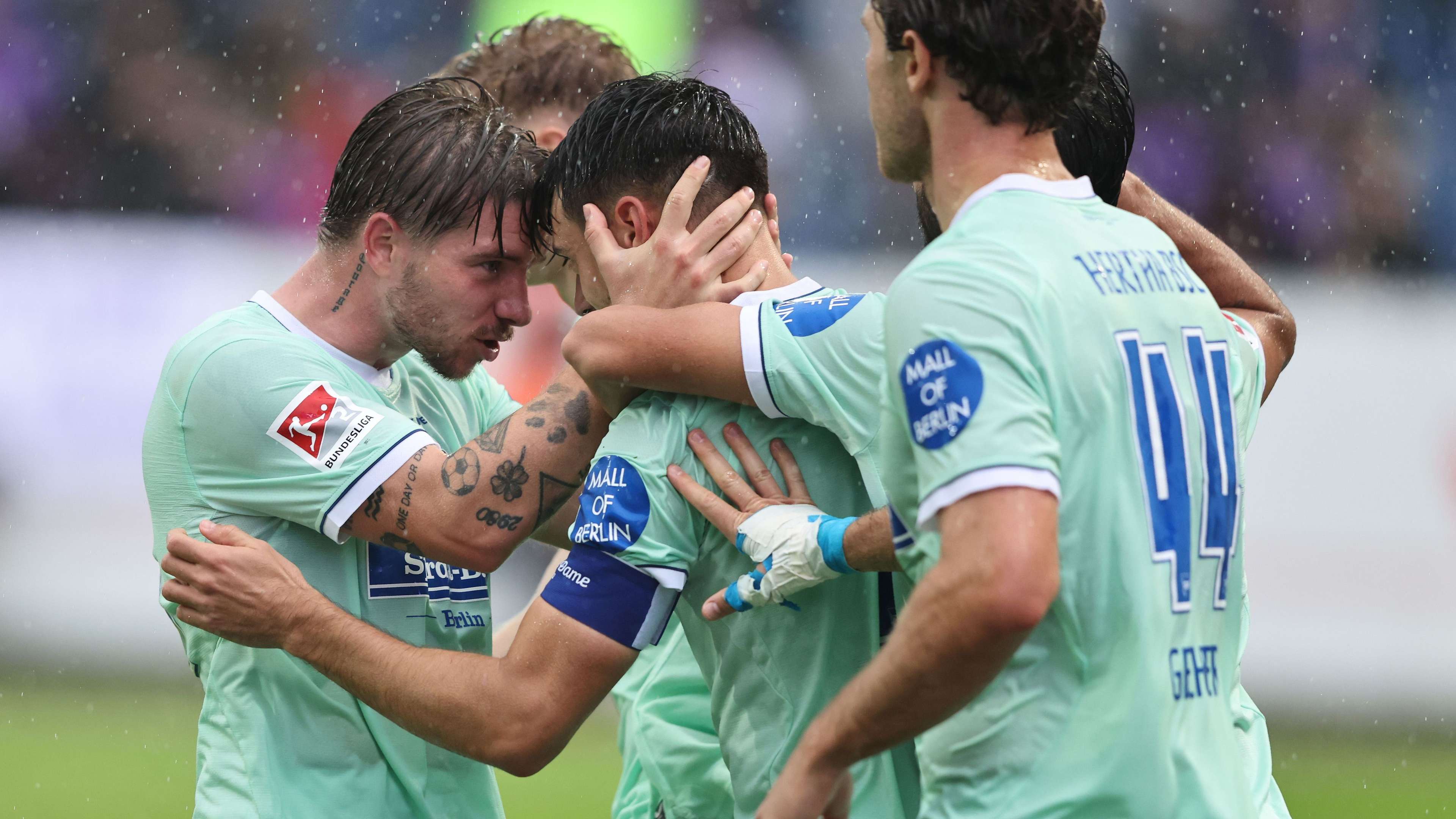
Hertha’s record is not only about winning; it is also about how they have responded when matches became difficult. They came back from two goals down to beat Braunschweig 5-3 and overturned an early deficit in Dresden. Against Magdeburg, they protected a 2-1 lead even after Paul Seguin was sent off for a second yellow card. Those results have strengthened the team’s confidence and provided evidence of a group capable of adapting under pressure.
There are, of course, reasons for caution. Six matches represent only a small portion of a demanding 2. Bundesliga season. The intensity of Hertha’s pressing could become harder to maintain, injuries may test their depth and opponents will study the space behind the defensive line. The club must also show that its attack can remain productive when Adewumi or other key performers are unavailable.
Still, the early prediction is difficult to ignore: Hertha have the structure, momentum and team spirit to remain in the promotion race. Their summer clear-out was not a glamorous sporting choice, but it has helped create a more balanced and unified side. If Leitl’s players can sustain their energy and manage the inevitable setbacks, a return to the Bundesliga in 2027 is a realistic ambition—not merely a hopeful slogan.
There is a wider prize, too. Hertha’s strong start has arrived while city rivals Union Berlin have struggled in the division above. That contrast does not decide which club is Berlin’s leading force, but it adds another layer of interest to Hertha’s campaign. For now, the capital’s traditional club are giving their supporters a reason to believe again: not because of a collection of famous names, but because a new team is beginning to play as one.