
Australia A’s Resilient Century Sparks Dominant Victory Over India A in First Unofficial ODI
On a brisk Tuesday afternoon in Puducherry, cricket enthusiasts witnessed a compelling display of skill, strategy, and resilience as Australia A showcased their prowess with a commanding victory over India A in the inaugural unofficial One Day International (ODI) of the series. The match not only highlighted individual brilliance but also underlined the importance of tactical cricket prediction and understanding player performances in shaping the outcome of such competitive fixtures.
Match Overview: A Tale of Strategic Batting and Precise Bowling
Opting to bat first, Australia A set the tone early with an aggressive approach. The opening over saw Mitchell Owen unleashing a powerful six and a boundary, instantly putting India A on the back foot. Sam Konstas followed suit with a couple of crisp boundaries, signaling Australia’s intent to dominate from the outset. However, the hosts quickly regrouped, and their bowling attack responded with disciplined precision. Owen’s gamble failed when he mis-hit a pull shot, falling for 10, and Konstas was dismissed in the second over, both wickets courtesy of Yash Thakur’s sharp bowling.
Australia A’s innings hit turbulence when Arshad Khan struck thrice in quick succession, reducing the visitors to 30/3 by the fifth over. With their top order collapsing, the onus fell on Liam Scott and Nathan McSweeney to stabilize the innings. Their partnership proved crucial, but Nishant Sindhu’s tight bowling kept India A firmly in control. Shortly after, Nikhil Chaudhary claimed two quick wickets, leaving Australia A in dire straits with half their side back in the pavilion.
McSweeney and Sutherland: The Architects of Australia’s Resurgence
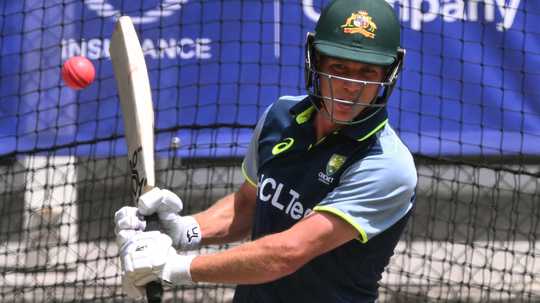
Despite the setback, captain Will Sutherland and Nathan McSweeney stepped up to rescue the innings. Demonstrating remarkable resilience and tactical acumen, the duo adopted a patient yet aggressive approach, ensuring they batted deep into the innings. McSweeney, benefitting from a reprieve, accelerated to reach his maiden century, anchoring the innings with a powerful display of stroke play. Meanwhile, Sutherland built a solid foundation, eventually unleashing his aggressive instincts.
Sutherland’s fireworks began when he dispatched Anukul Roy for a six, followed by a rapid fifty. He then targeted Roy in the subsequent over, smashing three consecutive sixes—an impressive display of cricket prediction and shot selection that put India A under immense pressure. The partnership, characterized by calculated risk-taking, helped Australia A post a formidable total of 274 runs in 48.2 overs. Suryansh Shedge’s impressive four-wicket haul (4-40) was not enough to contain the Australian batting onslaught.
India A’s Challenging Chase Ends in Collapse
Chasing a competitive 275, India A’s batting line-up faced early setbacks. Sai Sudharsan’s attempt to anchor the innings was short-lived as he gloved Mahli Beardman’s delivery to the keeper for just 1. The middle order also faltered, with Devdutt Padikkal and Prabhsimran Singh falling in quick succession in the same over, leaving India A in a precarious 24/3 situation.
Ruturaj Gaikwad attempted to steady the innings, supported by Rajat Patidar’s timely boundaries, providing a glimmer of hope. However, the introduction of Spencer Johnson into the attack proved decisive. Johnson’s second spell saw him dismiss Gaikwad, dealing a significant blow to the chase. Despite some resistance from Nishant Sindhu—who showcased his potential with some boundary shots—the Indian innings unraveled further as Mahli Beardman claimed his fourth wicket, dismissing Shedge, and Patidar perished after a commendable half-century. Their efforts were not enough, and the innings folded in the 32nd over, with India A crumbling to 149 all out.
Key Player Performances and Cricket Prediction Insights
This match underscored the critical role of individual performances in cricket prediction. Nathan McSweeney’s century was a masterclass in resilience and shot selection, reinforcing the importance of a calculated approach when batting under pressure. His ability to seize the moment and accelerate at the right juncture exemplifies the evolving nature of cricket strategy, emphasizing that predictions often hinge on such pivotal player contributions.
Will Sutherland’s aggressive batting, particularly his sequence of big hits against Anukul Roy, highlights the significance of understanding player strengths and predicting their impact in match situations. His foresight to target specific bowlers at the right time proved instrumental in Australia’s total, demonstrating how cricket prediction and tactical awareness are intertwined.
On the bowling front, Mahli Beardman’s impressive figures of 4-23 played a crucial role in restricting India A’s chase. Such performances reinforce the value of bowlers who can adapt to different pitch conditions and pressure scenarios, which are often key factors in match predictions and analysis.
Broader Context: What This Match Means for Future Cricket Predictions
This victory for Australia A not only boosts their confidence ahead of upcoming fixtures but also offers valuable insights into player form and team strategies. For cricket enthusiasts and analysts, such matches serve as vital data points for refining predictive models, especially in unofficial or tour matches where player development and team dynamics are under close observation.
Moreover, the series underscores the importance of resilience and tactical execution—elements that are central to making accurate cricket predictions. As teams continue to adapt to evolving game strategies, understanding individual performances like McSweeney’s century or Sutherland’s aggressive cameo becomes essential for stakeholders involved in betting, commentary, and fan engagement.
Conclusion: A Match to Remember in the Cricket Prediction Arena
The first unofficial ODI between Australia A and India A in Puducherry proved to be a thrilling encounter filled with strategic batting, disciplined bowling, and decisive moments. Nathan McSweeney’s masterful century was the highlight, shaping the outcome in Australia’s favor and providing a textbook example of how individual brilliance can influence team results.
For cricket fans and prediction analysts alike, this match offered a wealth of insights—reminding us that understanding player form, assessing pitch conditions, and anticipating tactical moves are crucial in forecasting cricket outcomes accurately. As both teams look forward to future encounters, the lessons learned here will undoubtedly influence predictions and strategies in upcoming series and tournaments.
In the ever-evolving world of cricket, such matches reaffirm the sport’s unpredictability and the enduring importance of meticulous prediction, backed by comprehensive analysis of player performances and match dynamics.