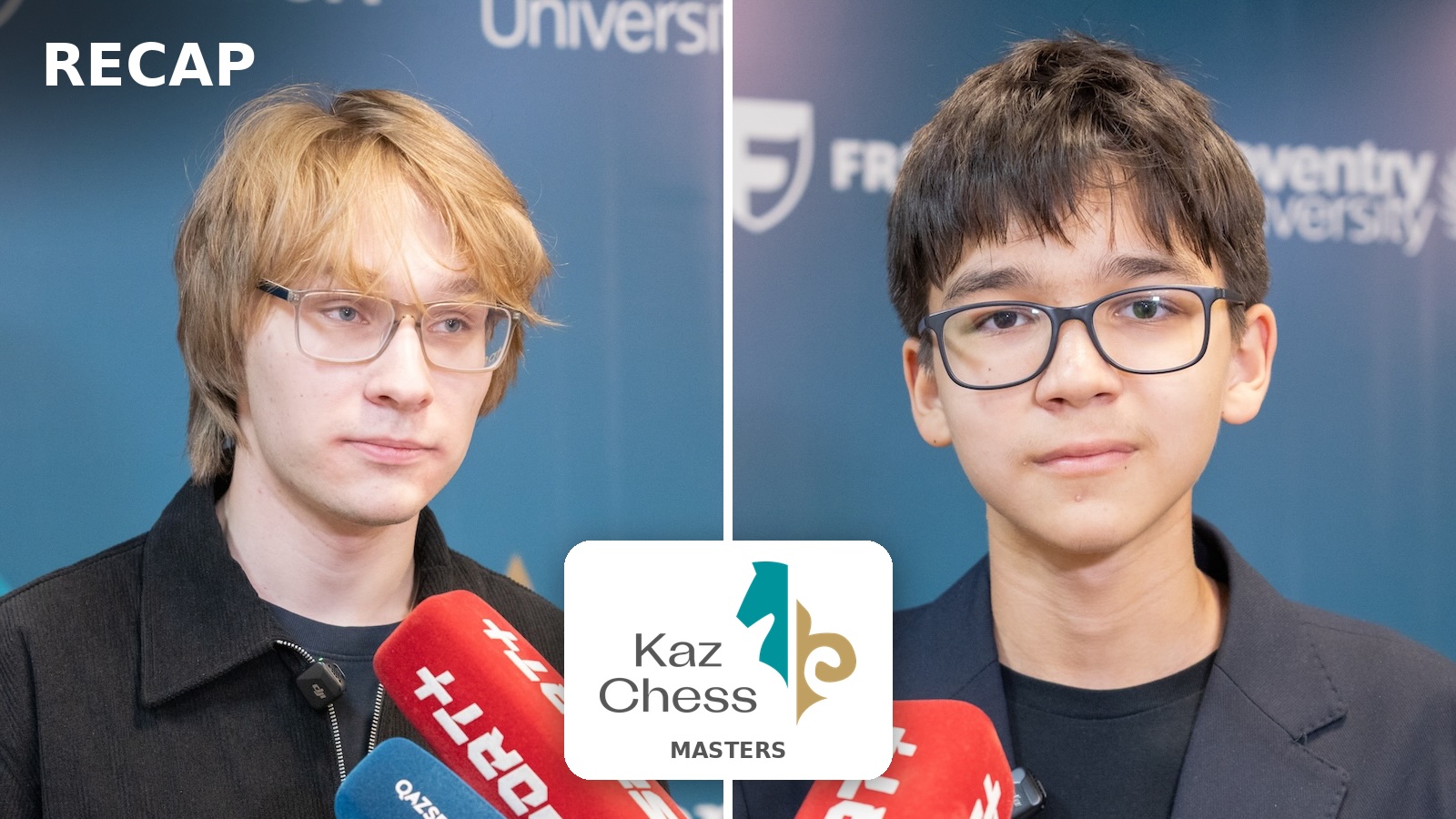

Denis Lazavik Wins KazChess Masters Unbeaten as 14-Year-Old Mark Smirnov Scores GM Norm
Denis Lazavik is closing in on a major rating milestone after winning the KazChess Masters in Almaty with an unbeaten 6.5 points from nine rounds. The 19-year-old finished half a point ahead of the only other undefeated player, Daniil Dubov, and collected the tournament’s first prize of 7 million Kazakhstani tenge—approximately $15,500.
The event also produced a breakthrough performance from 14-year-old International Master Mark Smirnov. The rising Kazakh talent placed fourth, earned his second grandmaster norm and added 25.9 rating points. His result offered a glimpse of the depth of young chess talent emerging in Kazakhstan.
Lazavik’s steady rise continues
Already a familiar name to online chess fans, Lazavik has built a reputation through high-profile rapid and blitz results. In 2026, he defeated Hikaru Nakamura in a closely contested online match before beating the world number-two again to reach the final of another major speed-chess event. Although Magnus Carlsen proved to be the obstacle in both finals, Lazavik’s performances established him as one of the most formidable young players in faster time controls.
His progress in classical chess has been more gradual. Lazavik has spoken openly about finding the format demanding, citing the time commitment, travel and difficulty of locating tournaments that offer attractive playing conditions and prize money. He has also identified opening preparation and calculation in complicated positions as areas he wants to strengthen.
Even so, his over-the-board results have increasingly matched his online reputation. After crossing the 2600 rating mark in 2025, Lazavik continued to collect points in strong events. His KazChess Masters victory added another 12 rating points, taking his live rating to approximately 2647.8 and placing him around 72nd in the world. He is now within striking distance of 2650.
“I considered myself one of the tournament favorites,” Lazavik said. “I had performed well in previous competitions and hoped to keep that momentum going. Of course, there were challenges, but overall I played well and didn’t lose a single game.”
A fast start set the tone
Lazavik began with an important win over top seed Shakhriyar Mamedyarov, a three-time Azerbaijani champion. Mamedyarov had worked his way toward a defensible position, but an attempt to collect material with his bishop gave Lazavik the chance to seize the initiative. The game quickly turned into a decisive victory for the young grandmaster.
The result prompted playful online speculation about Lazavik’s place among the world’s leading players. The jokes reflected the attention he has attracted, but his tournament performance was serious business: four wins, five draws and no losses against a competitive field.
One of his most convincing victories came in round four against Nodirbek Vokhidov, a two-time Uzbek Olympiad player. Vokhidov’s 20…b5? allowed Lazavik to launch a dangerous kingside attack with 21.f4!, and the position soon became difficult to defend. Further wins over International Masters helped secure the title without requiring a dramatic final-round escape.
The victory earned Lazavik the tournament’s top prize. Dubov received 5 million tenge—about $11,000—for second place, while Vokhidov took third and 3.5 million tenge, approximately $8,000.
Dubov finishes second without a loss
Dubov, aged 30, was the oldest competitor in a field that included five teenagers. He also completed the tournament unbeaten, but one fewer win left him half a point behind Lazavik. His campaign began with a victory over Mark Smirnov, setting up a strong event that ultimately brought him the runner-up finish.
Vokhidov claimed third place, while Smirnov finished fourth after the tie-break rules separated the two players on the same score. For the young Kazakh, however, the placing was only part of the story: his performance delivered another important step toward the grandmaster title.
Smirnov’s second norm signals a major breakthrough
Smirnov’s 25.9-point rating gain lifted his live rating to approximately 2464.9. He is now around 35 points short of the 2500 rating requirement for the grandmaster title and needs one more norm. Having previously won the World Under-12 and World Under-14 Championships, he is already among Kazakhstan’s most promising young players.
The teenager was pleased with the result but felt he could have done even better. He said he started slowly and found his rhythm only around the middle of the tournament, suggesting that a stronger opening stretch might have put him higher in the standings.
Smirnov singled out his 70-move win over a 16-year-old Kazakh grandmaster as his toughest game. He had allowed a winning position to slip, but recovered his composure and eventually found the precise 55…d2! to convert the advantage. The game demonstrated both his tactical alertness and his ability to keep fighting after a setback.
His most striking finish came in the final round against a two-time Kazakh champion. Smirnov sacrificed a rook to break through, producing one of the tournament’s most memorable moments. The combination was a fitting conclusion to a performance that blended resilience with youthful attacking imagination.
Kazakhstan’s next generation makes its case
Lazavik praised Smirnov’s achievement, calling a grandmaster norm at 14 a “very serious result.” He also noted the strong support chess receives in Kazakhstan and the number of talented players developing there.
The KazChess Masters brought together five local competitors and international opponents at Coventry University in Almaty from October 26 to November 3. Beyond the prize money and rating gains, the tournament highlighted a wider question for the chess world: can Kazakhstan build on its established chess culture and develop a generation capable of challenging the rising powerhouses of India and Uzbekistan?
Smirnov’s norm, alongside Lazavik’s continued climb, suggests the country has promising foundations. Turning those individual breakthroughs into lasting international strength will depend on sustained coaching, competitive opportunities and support for young players. For now, the Almaty event gave Kazakh chess fans plenty to celebrate—and offered a compelling preview of the talent that could shape the game’s future.