
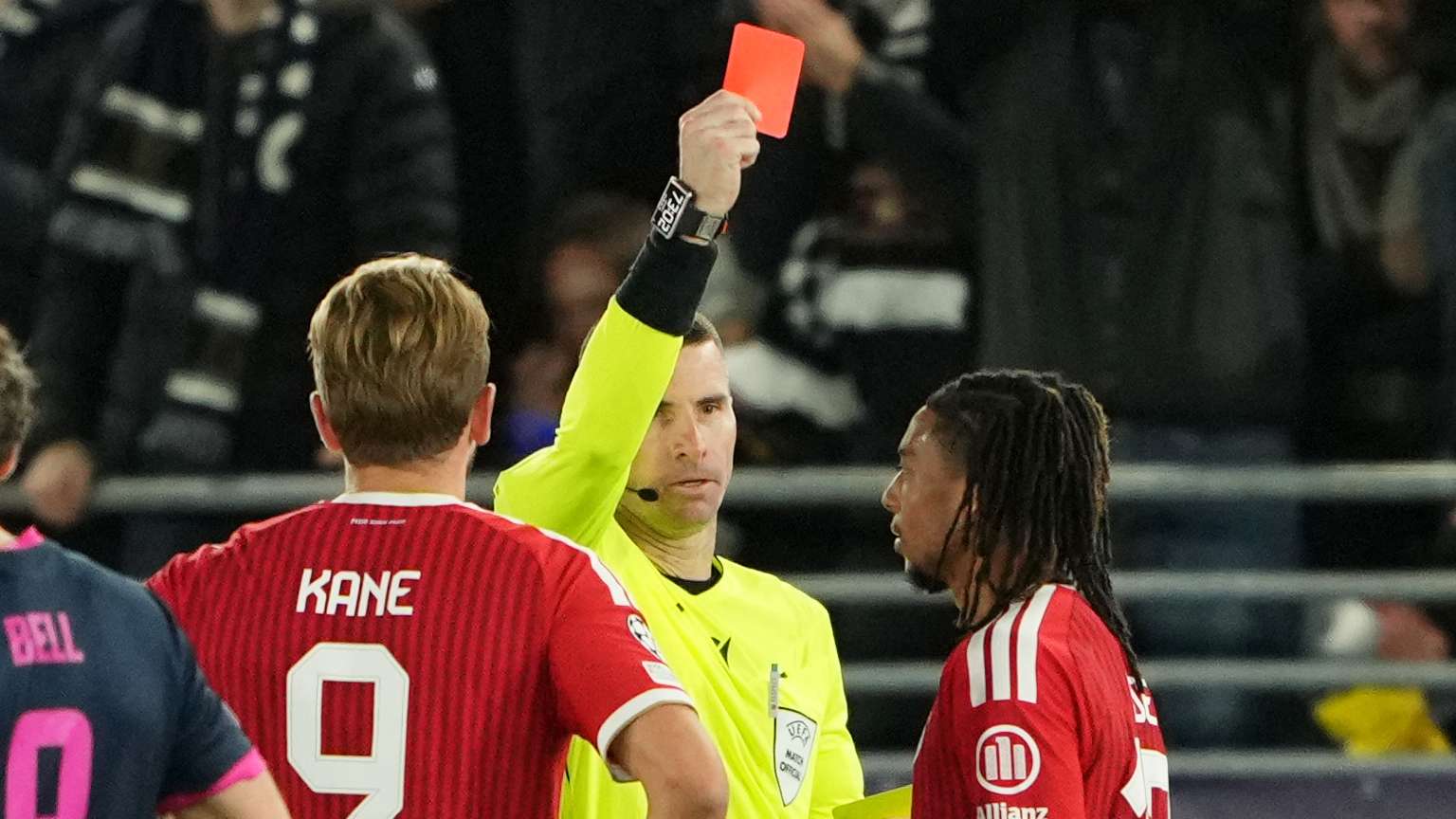

Bayern Munich’s Dramatic Champions League Night Turns on Michael Olise Red Card
Bayern Munich’s Champions League campaign took an unexpected turn after a chaotic encounter with Norwegian underdogs Viking, in which the German side lost control of a hard-earned advantage following Michael Olise’s second-half dismissal. Harry Kane had appeared to put Bayern on course for a memorable comeback with a clinical brace, but the winger’s bizarre red card shifted the mood and left the England captain facing fresh frustration as European disciplinary concerns came into focus.
The match offered a sharp reminder that Champions League football rarely follows a straightforward script. Bayern brought the greater reputation and attacking talent, while Viking arrived with the freedom of a team eager to test itself against elite opposition. The result was a contest that swung between Bayern’s attacking quality and the Norwegian side’s determination, with Olise’s sending-off becoming the defining moment.
Harry Kane Leads Bayern’s Fightback
Kane’s two goals gave Bayern a platform to recover after Viking had made life difficult. The striker’s finishing was a familiar demonstration of his value: calm in front of goal, alert to opportunities, and capable of turning a tense spell into renewed momentum. His brace suggested Bayern had found the response required to take control of a match that had threatened to slip away from them.
For Bayern, Kane’s performance was especially important because the team needed more than possession and pressure. Viking’s compact approach challenged the visitors to find space, move the ball quickly, and make decisive choices in the final third. Kane supplied the cutting edge, converting opportunities with the kind of efficiency that has made him central to Bayern’s attack.
His goals also appeared to change the emotional balance of the game. Bayern had worked their way back into contention, and the comeback gave the German side a chance to impose its experience. Yet football can turn in an instant. Rather than building on Kane’s contribution, Bayern were forced to rethink their approach after losing Olise.
Olise’s Dismissal Changes the Match
Olise’s second-half red card transformed the contest. The winger’s dismissal was described as bizarre, and its timing made the consequences particularly severe. Bayern had been fighting to protect the progress of their comeback; suddenly, they had to manage the remainder of the match with ten players and fewer options in attack.
Playing a man down affects more than a team’s defensive shape. It can force a side to withdraw an attacker, narrow its pressing, and spend longer without the ball. Bayern therefore faced a difficult balancing act: preserve their lead or attacking threat while limiting the spaces Viking could exploit. The dismissal gave the Norwegian side an opening and made every subsequent phase more demanding for the visitors.
For Olise, the incident will prompt scrutiny over the decision-making that led to his exit and the effect on his team. For Bayern, the immediate concern is practical: how to adapt when a key wide player is unavailable, and how to prevent a promising European performance from being undermined by avoidable disruption. The incident also underlined how important discipline can be in high-pressure football, particularly when a match is finely balanced.
Viking Show the Value of Belief
Viking’s challenge was not simply to contain Bayern. The Norwegian club had to remain organised, take advantage of moments when possession turned over, and believe that the contest could still be influenced even after Kane’s goals. Facing a major European side can place enormous demands on a less-fancied opponent, but Viking’s persistence helped ensure the game remained unpredictable.
That resilience is one reason matches between established powers and ambitious challengers can be so compelling. Bayern entered with the expectation of controlling the occasion, yet Viking’s energy and refusal to fade made the encounter uncomfortable. Once Olise was sent off, the underdogs had a clearer route back into the contest, even if Bayern’s quality remained a threat.
Viking’s performance also provides a useful reminder for supporters assessing European fixtures: reputation can shape expectations, but it does not decide the result. A disciplined game plan, strong commitment, and the ability to react to turning points can narrow the gap between clubs with very different resources and experience.
Kane’s European Suspension Adds Another Concern
The match carried a further complication for Kane, who was left frustrated by the prospect of an impending European suspension. For a player so important to Bayern’s attack, any absence could have consequences beyond one team selection. Kane’s goals provide a focal point for the forward line, while his movement and link-up play help create opportunities for teammates.
A suspension would also arrive at an awkward time if Bayern are trying to build consistency in the Champions League. European campaigns often depend on fine margins, and missing a leading scorer can force a coach to alter both personnel and tactics. Bayern would need other attackers to assume greater responsibility, while the midfield might be asked to contribute more directly in the final third.
The situation highlights the broader importance of discipline across a long tournament. A player can deliver a decisive performance and still leave the team facing a selection problem. Kane’s brace was a major positive, but the uncertainty surrounding his availability means Bayern cannot focus only on the goals he scored. They must also plan for the possibility that he will not be available for a future European fixture.
What the Result Means for Bayern’s Champions League Campaign
For Bayern, the encounter is likely to be judged as both a warning and an opportunity to learn. Kane’s finishing showed that the team has the quality to recover from difficult situations, but Olise’s dismissal exposed the risks of losing composure at a crucial stage. Champions League contenders are often tested not only by their opponents’ attacking ability but by their own capacity to remain disciplined when pressure rises.
The coaching staff will need to review the sequence that led to the red card and consider how Bayern can manage similar situations. That could mean improving their response after a dismissal, adjusting defensive cover on the wings, or ensuring the team remains compact without abandoning its attacking identity. These details matter because a single incident can change the rhythm of an entire European night.
Any prediction about Bayern’s next Champions League performance should therefore account for both sides of the story. Kane remains a powerful attacking presence, and Bayern possess the experience to recover from a turbulent match. At the same time, suspensions and disciplinary setbacks can disrupt momentum, while opponents such as Viking have shown that Bayern can be pushed when their structure is unsettled.
A Chaotic Night With Lessons for Both Teams
The meeting between Bayern Munich and Viking delivered a dramatic mix of comeback football, clinical finishing, and a controversial turning point. Kane’s brace gave Bayern hope and showcased his importance, but Olise’s second-half dismissal handed the Norwegian side renewed belief and left the visitors with difficult questions to answer.
For supporters, the match was a reminder of why European football remains so compelling: even a team with Bayern’s pedigree can be forced into a fight, and a single decision can reshape the entire contest. Bayern will hope to turn the experience into a lesson, while Viking can take confidence from their ability to challenge a leading club. The next chapter of the campaign will reveal whether Kane’s goals become the lasting headline—or whether the red card proves the moment that defined Bayern’s night.

