
India Storm Into Commonwealth Kabaddi Championship Semifinals With 48–20 Win Over Tanzania
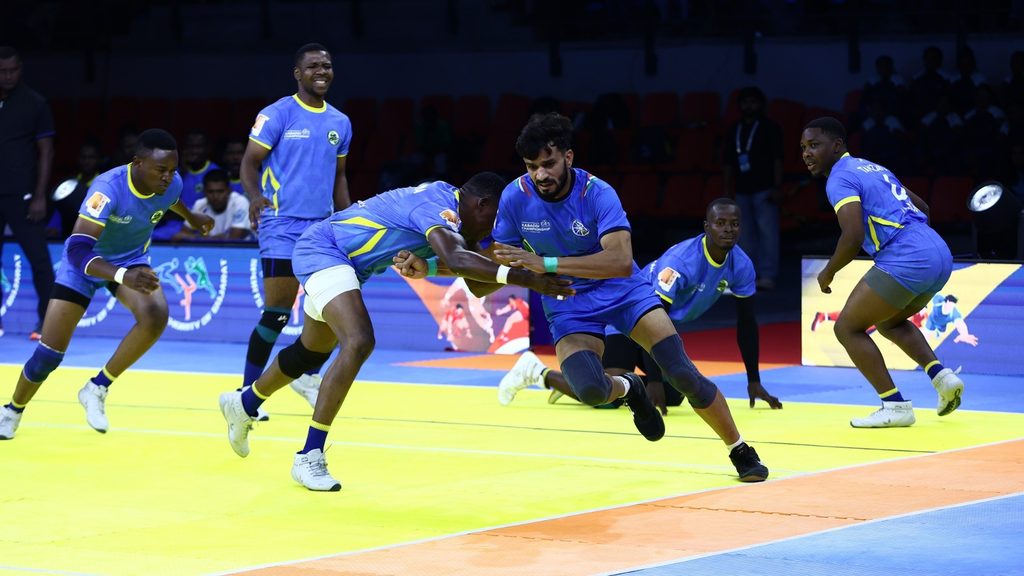
India’s men’s kabaddi team secured a place in the semifinals of the inaugural Commonwealth Kabaddi Championship after delivering a commanding 48–20 victory over Tanzania at Veer Savarkar Stadium in Ahmedabad. A balanced performance across raiding and defence helped the hosts control the contest and keep their title campaign firmly on course.
India collected 30 raid points and 10 tackle points, while forcing Tanzania into six all-outs. The visitors managed 15 raid points and five tackle points but could not match India’s scoring pressure or defensive organisation. The result confirmed India’s progress to the knockout stage, with one group match still to come.
India’s raiders set the pace
Neeraj Narwal led India’s attack, scoring 12 points from 16 raids. His six bonus points were particularly valuable, allowing India to keep the scoreboard moving even when he did not secure a touch. Narwal’s measured approach helped the team maintain pressure without relying exclusively on high-risk raids.
Naveen Kumar and Shivam Patare added nine points apiece, giving India multiple sources of attacking threat. Naveen scored nine raid points from 11 raids, while Patare matched that return from the same number of attempts. Their efficiency helped India stretch Tanzania’s defence and created opportunities for further scoring runs.
The combined contribution from the three leading raiders gave India an effective attacking foundation. Rather than depending on one player to carry the contest, the hosts were able to rotate their pressure and make Tanzania respond to different styles of raiding. That variety is important in kabaddi, where defenders must quickly adjust their formation and decision-making to each opponent.
Defence turns pressure into a decisive advantage
India’s defensive unit was just as influential as its raiders. Shubham Shinde topped the tackle chart for the hosts with five tackle points, while Deepak recorded three and Pravesh Malik added two. Their combined work limited Tanzania’s scoring opportunities and helped India convert defensive stops into momentum.
The six all-outs proved a major difference between the sides. In kabaddi, an all-out not only removes every player from the opposing team but also awards additional points and gives the team that secured it a chance to build a substantial lead. India’s repeated ability to finish defensive sequences therefore had an impact beyond the individual tackles, strengthening its control of the match.
India’s performance also reflected the value of coordination between the raiders and defenders. A successful tackle can provide the platform for a confident raid, while sustained attacking pressure can force opponents into hurried decisions. Against Tanzania, the hosts maintained that cycle effectively, keeping the visitors from building a consistent response.
Tanzania’s Sultania offers a bright spot
Juma Sultania was Tanzania’s most productive player, scoring 13 points from 20 raids, including nine bonus points. His return showed that the visitors remained competitive in individual attacking moments, even as India controlled the overall contest.
Sultania’s performance was a notable feature of the match because he continued to find ways to collect points against a disciplined defence. However, Tanzania struggled to turn those individual gains into sustained team momentum. India’s collective scoring and ability to secure all-outs ultimately outweighed the visitors’ strongest contributions.
Semifinal place secured, Sri Lanka next
The victory guarantees India a place in the semifinals of the first Commonwealth Kabaddi Championship. The knockout match is scheduled for October 30 at 8:00 PM, giving the team a clear target as it looks to carry its group-stage form into the decisive phase of the tournament.
Before the semifinals, India will face Sri Lanka in its final group-stage match on October 29 at 8:00 PM. Although qualification is already secured, the fixture remains an important opportunity to maintain rhythm, test combinations and sharpen execution ahead of the knockout round. A strong finish could also help the squad build confidence before facing a higher-stakes challenge.
What the result means for India’s title campaign
India’s 48–20 win offers encouraging signs for a team aiming to compete for the championship. The side showed depth in attack through Narwal, Naveen and Patare, while Shinde and the defensive unit supplied the stops needed to turn pressure into a sizeable margin. That balance is often essential in tournament kabaddi, where matches can shift quickly and teams need reliable contributions in every phase.
The next test will be maintaining that composure against Sri Lanka and then adapting to the demands of semifinal competition. Knockout matches can be more tactical and closely contested, making discipline, communication and efficient raids especially important. India will want to preserve the strengths shown in Ahmedabad while avoiding unnecessary errors.
For supporters following the Commonwealth Kabaddi Championship, the result reinforces India’s status as a serious contender, but the work is not finished. The group-stage finale offers one more chance to build momentum before the semifinals. With a productive raiding trio, an organised defence and the advantage of playing in Ahmedabad, India has placed itself in a strong position as its pursuit of the inaugural title continues.