
Vinícius Júnior’s Disallowed Goal and Red Card Turn Real Madrid’s Win Over Villarreal Into a Flashpoint
Real Madrid’s home match against Villarreal delivered a dramatic swing from celebration to controversy after Vinícius Júnior was sent off for pulling an opponent’s hair during a counter-attack. The Brazilian appeared to have scored a brilliant second goal for Madrid, but a video review led the referee to cancel the finish and dismiss him for violent conduct.
The incident became the defining moment of a game that had seemed to offer Vinícius a timely return to form. Instead, it left Real Madrid facing fresh questions about discipline, the use of video review and the forward’s response to a difficult spell. Madrid ultimately held on to their advantage, but the red card ensured the result came with a significant talking point.
A rapid counter-attack ends in controversy
Madrid’s move began in midfield and developed at speed. Vinícius helped carry the ball forward before releasing it to the left, where Jude Bellingham continued the attack. The Brazilian then surged into the penalty area and finished the move, seemingly putting Real 2-0 ahead in the 71st minute.
The celebration was immediate. José Mourinho ran toward the huddle near the corner flag to embrace the substitute, while the players in white gathered around their teammate. For a moment, the goal looked like the perfect response to Vinícius’ recent difficulties: a lively run, a decisive finish and a chance to make an impact after returning to the bench.
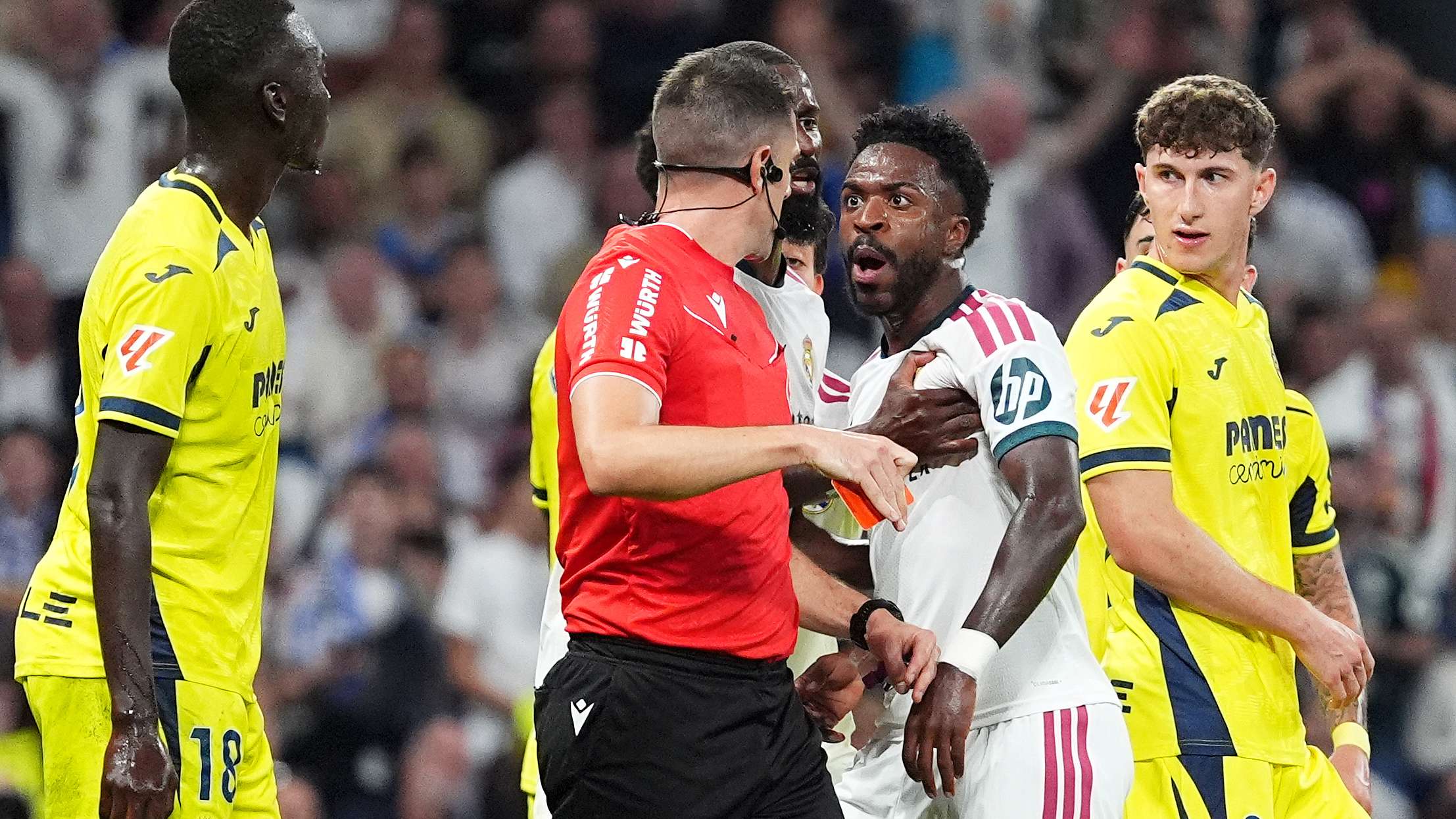
But referee Isidro Díaz de Mera was asked to review the build-up on the pitchside monitor. The footage showed that, during the midfield contest, Vinícius had grabbed Villarreal defender Nathan Saliba by the hair and pulled him back. The action disrupted Saliba’s attempt to track the attack and gave the Madrid forward an advantage as the counter developed.
After reviewing the footage, the referee ruled out the goal and showed Vinícius a red card. The decision transformed what had looked like a routine celebration into a heated confrontation. Vinícius appeared first stunned and then furious, while Antonio Rüdiger and Arda Güler moved to restrain him as he approached the referee.
Why the referee’s decision mattered
The key issue was not the quality of Vinícius’ finish but what happened earlier in the move. A goal can be disallowed when a serious offence occurs in the attacking phase that leads directly to it. In this case, the referee judged that the hair pull was sufficiently serious to warrant a dismissal for violent conduct, rather than simply a foul and a yellow card.
Such decisions are likely to prompt debate among supporters, particularly when a review changes both the score and the number of players on the pitch. For Madrid fans, the sequence was especially difficult to accept: the same action that appeared to produce a two-goal cushion instead removed the goal and left their team short-handed.
However, the incident also underlined why players are expected to avoid grabbing, striking or otherwise targeting an opponent away from the ball. In modern football, video review can expose off-the-ball conduct that might once have gone unnoticed. The prediction for future matches is clear: players who engage in such actions will face a greater risk of retrospective or in-game punishment when footage is available.
Vinícius’ difficult stretch continues
The red card arrived at a sensitive point in Vinícius’ season. The forward had scored only once in the campaign before the match and was left out of the starting XI in Madrid’s first fixture after the international break. His appearance from the bench offered an opportunity to respond on the pitch, and the counter-attack suggested he might be ready to do so.
Instead, the incident overshadowed his contribution. Vinícius remains one of Real Madrid’s most influential attacking players, known for his pace, direct dribbling and ability to turn defensive situations into dangerous breaks. But his impact can also be affected by emotional moments, and the dismissal raises questions about how he manages frustration and physical duels when the pressure is high.
Any suspension will be an additional setback for a side that relies on his ability to stretch opponents and create space for teammates. Madrid will need to assess their options in attack, while Vinícius will have to wait for another chance to turn a difficult week into a positive story.
Diomande delivers for Madrid
Despite losing Vinícius and seeing his apparent goal erased, Real Madrid held on to their lead. Their decisive breakthrough had come in the 63rd minute, when new signing Yan Diomande scored his first goal for Los Blancos after receiving a pass from Fede Valverde.
The 19-year-old Ivorian had started in place of Vinícius, making his contribution particularly notable. His goal gave Madrid the platform to manage the rest of the contest, even after the late drama left them with ten men. The team’s defensive response helped preserve the result and prevented Villarreal from taking advantage of their numerical edge.
For Diomande, the finish could prove an important early milestone. A first goal at a major club can build confidence, especially for a young player adapting to a new team and a demanding competition. His performance also gives Madrid another attacking option as they navigate a busy schedule.
LaLiga title race remains tight at the top
The result mattered beyond the individual incident, with the LaLiga standings continuing to take shape. Barcelona strengthened their position by beating Getafe, despite being without top scorer Raphinha. Goals from Anthony Gordon in the second minute, Gabriel Jesus in the 30th and Jules Koundé in the 73rd secured a 3-0 victory.
Barcelona’s maximum haul of 24 points put them five points ahead of Atlético Madrid, who won 2-1 away to Deportivo Alavés, and six clear of Real Madrid. Those gaps leave Madrid with work to do, but the season remains long enough for the standings to change quickly. Every dropped point—and every suspension—could matter as the title race develops.
For now, Madrid can take encouragement from securing the win and from Diomande’s breakthrough. Yet the match will be remembered chiefly for a goal that never counted and a red card that changed the mood at the Bernabéu. Vinícius’ next response, on and off the pitch, may be just as important as the result itself.