
Alireza Firouzja Ends Hikaru Nakamura’s Bullet Brawl Winning Streak
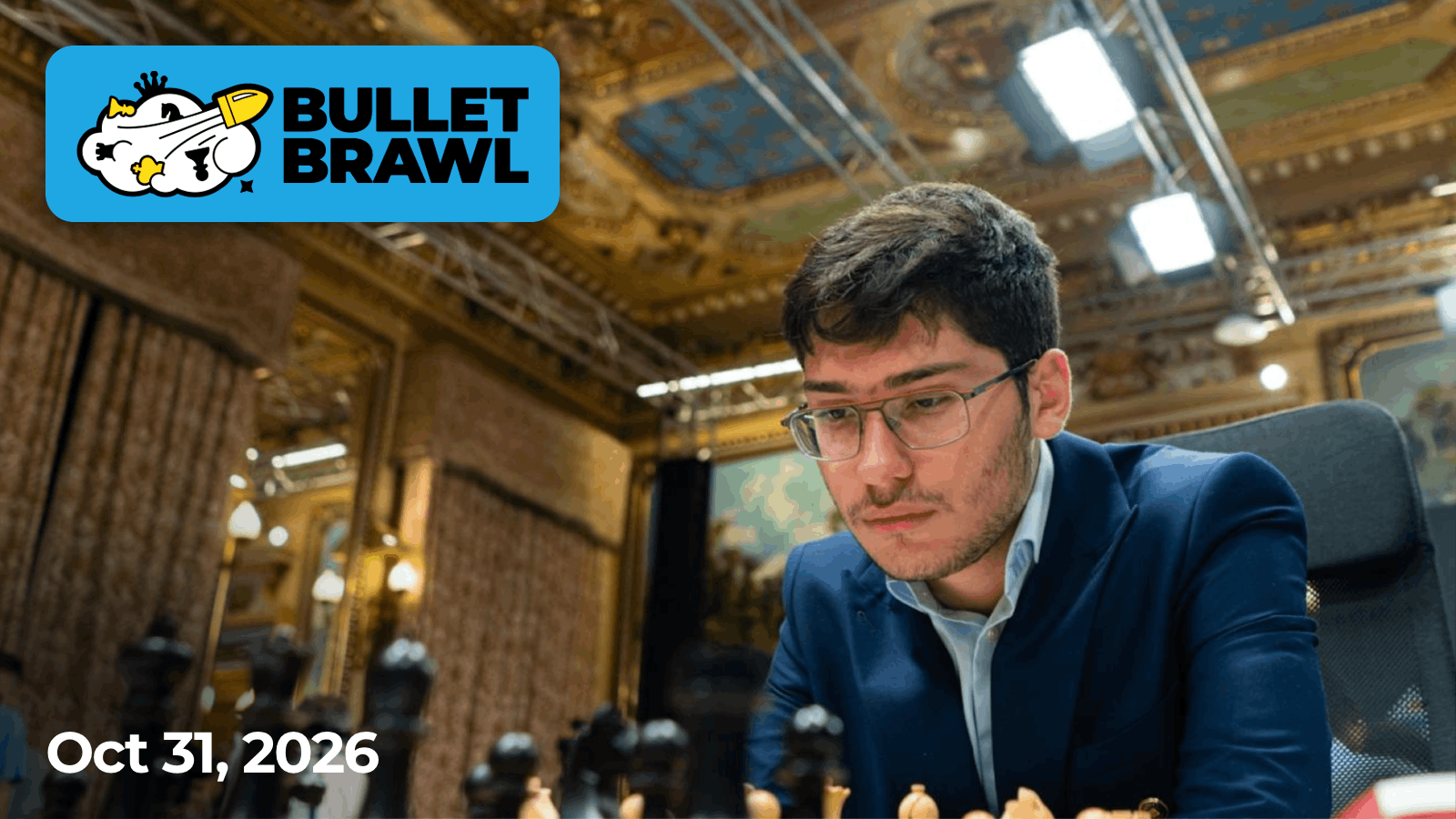
Alireza Firouzja claimed first place in a fiercely competitive edition of Chess.com’s Bullet Brawl, ending Hikaru Nakamura’s remarkable run of victories in the weekly chess arena. Firouzja scored 170 points in the 232-player event, finishing four points ahead of Nakamura and 11 ahead of third-place finisher Ediz Gurel.
Nakamura looked poised to extend his winning streak after a dominant start, but a late surge from Firouzja—and a costly off-arena game for the American—changed the contest’s direction. The result gave Firouzja another major online bullet title and moved him into a tie for ninth on Bullet Brawl’s all-time winners list, despite having played fewer editions than many of the players around him.
Elite Field Makes for a High-Pressure Arena
The tournament drew 232 players, including seven super-grandmasters, making it one of the strongest fields in Bullet Brawl’s history. Alongside Nakamura and Firouzja were Magnus Carlsen, Maxime Vachier-Lagrave, Arjun Erigaisi, Parham Maghsoodloo and other leading players. Regular Bullet Brawl contenders also joined the lineup, while rising stars such as Gurel and Faustino Oro added further depth.
Oro finished 10th, ahead of several established elite players. Gurel, meanwhile, secured third place with 159 points, while Matthias Bluebaum and Reza Mahdavi tied on 136 points. Women’s International Master Melika Mohammadi placed 19th overall and won the $100 best women’s prize.
Nakamura’s Powerful Start—and an Unexpected Detour
Nakamura began at a blistering pace, scoring 14 points from his first 15 games. His opening run included two victories over Firouzja, giving the American an early advantage in the race for first. In one of those games, Nakamura gave up his queen for a rook and bishop, then demonstrated how active pieces and precise coordination can outweigh material in fast chess.
He also produced a sharp tactical win against Bluebaum, finding the striking move 15.Bxe6!! and converting the resulting advantage with little difficulty. Such moments showed why Nakamura remains one of the most formidable bullet players: he can calculate quickly, but he is also adept at making practical decisions under severe time pressure.
By the final quarter of the two-hour arena, Nakamura had built a 16-point lead. Then came an unusual interruption. After refreshing his page, he accidentally entered a game in a separate lobby rather than the tournament arena. He did not realize the mistake until the game had ended, and the lost opportunity reduced his lead to 13 points.
The error did not immediately decide the event, but it gave Firouzja and Gurel a clearer route back into contention. In a format where every game can affect the standings—and where players must manage both the clock and the tournament interface—even a brief lapse can carry a significant cost.
Firouzja’s Late Charge Turns the Race Around
Firouzja responded with a remarkable finish, scoring 13.5 points from his final 15 games against elite opposition. His closing run put sustained pressure on Nakamura and made the final stretch a contest of momentum as much as chess skill.
Among Firouzja’s wins was a hard-fought game against Vietnamese grandmaster Tuan Minh Le. In a complicated middlegame, Firouzja found a timely intermediate move—known in chess as an intermezzo—that shifted the position in his favor. The tactic helped him maintain his charge through a demanding sequence of opponents.
The decisive meeting between Firouzja and Nakamura came near the end of the arena. Firouzja chose an unusual approach against Nakamura’s opening, answering the Caro-Kann’s first move with 2…d6!? rather than the more familiar 2…d5. The choice led to an Old Indian-style setup and took the game away from well-trodden territory. Firouzja handled the resulting position effectively and secured a crucial victory.
He followed that result with an 11-move win over Haowen Xue and a 25-move draw against Gurel. Those final games provided enough of a cushion to hold off Nakamura and seal the title.
Final Standings and Prize Money
Firouzja finished on 170 points, with Nakamura second on 166. Gurel took third with 159, while Bluebaum and Mahdavi shared fourth and fifth place on 136 points. Xue finished sixth with 133, followed by Amin Tabatabaei on 129. Vachier-Lagrave and Semyon Puzyrevsky each scored 125, while Oro completed the top 10 with 124.
The top prizes went to Firouzja, who earned $400; Nakamura, who received $250; and Gurel, who collected $150. Bluebaum earned $100, as did Mohammadi for the best women’s result.
Firouzja Joins Bullet Brawl’s All-Time Winners
Nakamura remains the most successful player in Bullet Brawl history, with 72 career victories. Daniel Naroditsky is second with 32, followed by Oleksandr Bortnyk on 17 and Andrew Tang on 15. Gurel’s third-place finish adds to a strong record in the event: he has 10 wins, including two in 2026.
Firouzja’s latest triumph brings his career total to three Bullet Brawl titles, placing him level with several other multiple-time winners. His position on the leaderboard is especially notable given his comparatively limited participation. The result also underlines how quickly the standings can change when elite players meet in bullet chess, where preparation matters but speed, intuition and composure are often decisive.
What Is Bullet Brawl?
Bullet Brawl is a weekly Chess.com arena featuring titled players and leading specialists in fast chess. Each event runs for two hours with a 1+0 time control: each player starts with one minute and receives no increment after making a move. The format rewards quick pattern recognition and practical decision-making, while leaving little room to recover from a mistake.
The next Bullet Brawl is scheduled for Saturday, November 7, at 12 p.m. ET, 18:00 CET and 10:30 p.m. IST. Fans can review the games from this edition to revisit Firouzja’s late surge, Nakamura’s tactical play and the key encounters that shaped the final standings.