
Pat Cummins backs Australia’s batting flexibility after Matthew Renshaw’s Durban heroics
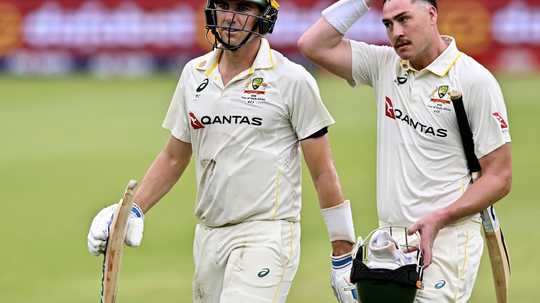
Australia captain Pat Cummins says the team will keep its options open when settling the batting order for the second Test against South Africa, even after Matthew Renshaw made a powerful case for a regular place at No. 5. Renshaw scored 272 runs across the Durban Test, helping Australia recover from a difficult start and secure a commanding victory.
The left-hander’s innings of 190 in the first innings and 82 in the second transformed a match that had threatened to slip away from Australia. The visitors were 124 for 6 on the opening day before Renshaw helped steady the innings and build the platform for a turnaround. His performance has prompted fresh discussion about where he should bat when the teams meet again in Gqeberha.
For supporters following the series, the selection question is an intriguing one: should Australia preserve the successful arrangement from Durban, or return to a preferred structure if Cameron Green is fit? Any cricket prediction about the second Test line-up remains uncertain until the team assesses Green’s abdominal injury and considers the conditions. Cummins, however, made clear that Renshaw’s results will be difficult to overlook.
Renshaw adds a new option to Australia’s top order
Renshaw moved into the middle order because Green was unavailable, rather than because Australia had decided to make him a permanent No. 5. Even so, his success has given the selectors a valuable alternative. Cummins acknowledged that it would take a strong reason to shift Renshaw after such a decisive performance.
“It’s got to be pretty compelling to move Renshaw from there,” Cummins said, while noting that Australia would first consider the pitch and other conditions in Gqeberha. He also pointed to Travis Head’s ability to bat at No. 5, and said Renshaw still has the qualities to open. In Cummins’ view, the Durban Test has added another useful skill to Renshaw’s game rather than necessarily defining his long-term position.
That distinction matters for Australia. A player who can succeed both at the top and in the middle order gives the selectors more room to respond to injuries, opposition tactics and the demands of a particular surface. Instead of treating the batting order as fixed, the team can consider which combination best suits the next match.
Nic Maddinson’s recall creates more selection flexibility
Australia’s options have also expanded through the recall of Nic Maddinson, whose return to Test cricket came nearly a decade after his previous appearance. Maddinson was moved into an opening role, a significant selection call that was influenced in part by Renshaw’s recent success in the middle order in one-day cricket.
The move worked in the broader sense that it allowed Australia to reshape the top of the order without disturbing several established positions. Cummins said the team has strong preferences for Marnus Labuschagne at No. 3 and Steve Smith at No. 4, while the lower middle order has also appeared settled. Bringing Maddinson into the group, he explained, has created more potential arrangements around the opening and No. 5 positions.
Those possibilities include moving Head to No. 5, keeping Renshaw there or considering Maddinson for the role. Australia could also choose different openers depending on the conditions. Cummins even suggested that the batting order might vary between innings if the match situation makes a change worthwhile.
Such adaptability can be especially useful in a Test series played across different venues. A pitch that offers early movement may call for one approach, while a slower surface could reward a different balance of patience, stroke-making and experience. Australia’s challenge will be to use its flexibility without disrupting the partnerships and roles that have brought consistency to the side.
A five-day grind rewarded Australia’s patience
The Durban win was not only a story of individual runs. Cummins described the match as a more traditional Test contest, built around patience and sustained pressure rather than a rapid exchange of momentum. Australia had to absorb a difficult opening, wait for opportunities and then make the most of the moments when the game began to turn.
That approach was a point of emphasis for the team. Cummins said Australia had previously missed chances to grind through challenging passages and allow a match to develop. In Durban, the side showed greater discipline after falling behind, with Renshaw’s innings providing the recovery and the rest of the team helping protect the advantage once Australia moved ahead.
The captain was particularly pleased that Australia did not surrender its lead after working hard to establish it. He said the team’s standards remained high through the final stages, an important detail in a Test where the early position had been so precarious. The result offered a reminder that patience can be as decisive as aggressive scoring, especially away from home.
What Australia’s selection decision could mean in Gqeberha
Green’s fitness is likely to be central to Australia’s next selection meeting. If he is available, the selectors must decide whether to restore him immediately, retain the combination that succeeded in Durban or make another adjustment. Renshaw’s form makes a straightforward return to the previous order less certain, while Maddinson’s presence gives the team additional ways to balance the top six.
Conditions will also shape the decision. Australia will need to assess the Gqeberha pitch, the likely demands on its openers and the best way to support Labuschagne and Smith in the middle order. Cummins said the team would take time to review those factors rather than commit to a fixed plan immediately.
For now, Renshaw has strengthened his case with a performance that combined resilience and control. His 190 helped rescue Australia from a vulnerable position, and his second-innings 82 ensured the recovery was not a one-off. Whether he remains at No. 5 or returns to opening, his ability to cover multiple roles has become a genuine asset.
Australia’s Durban victory therefore leaves the team with both a result and a selection puzzle. Cummins’ comments suggest the side is comfortable adapting its batting order rather than relying on one rigid template. As the second Test approaches, the most reliable cricket prediction is that Australia will weigh form, fitness and conditions together—and that Renshaw’s outstanding match will remain central to the conversation.