
Why Manchester City Fans Brought Inflatable Bananas to Liverpool
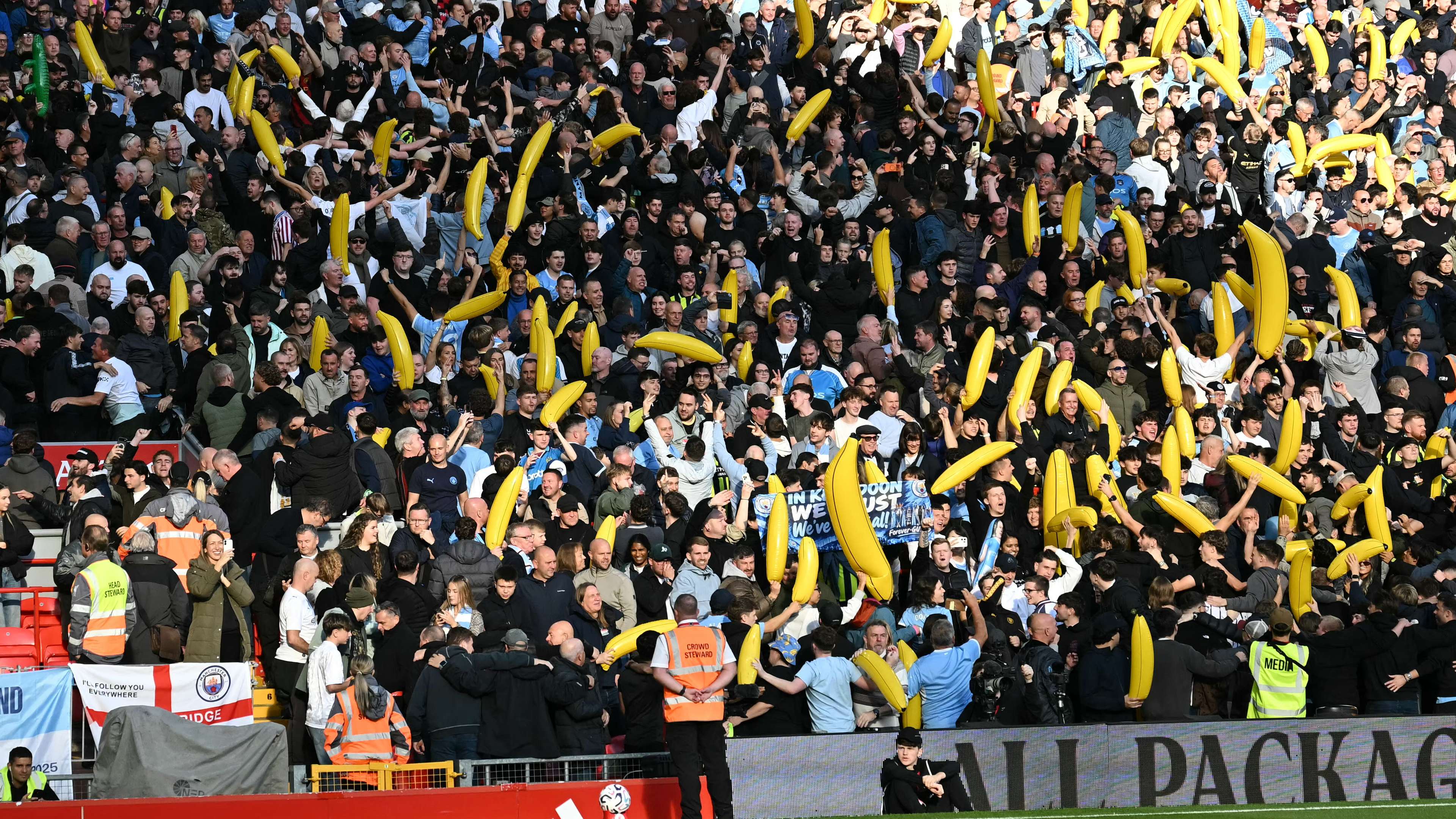
When Manchester City supporters raised inflatable bananas during their team’s emphatic 3-0 victory over Liverpool, the unusual display looked like little more than a piece of football terrace humour. But the fruit has a long history at City, reaching back to a difficult era when jokes and chants helped supporters cope with disappointment on the pitch.
The bananas also carried a more immediate message. City fans were reacting to the intense scrutiny surrounding the club’s financial case, which had become a major talking point in the days before the match. In a stadium filled with boos, banners and pointed chants, the bright inflatable props offered a familiar form of gallows humour—and a reminder that the club’s supporters have faced setbacks before.
The origins of Manchester City’s banana tradition
Manchester City’s banana story is generally traced to the 1987–88 season, when the club had fallen out of English football’s top division and was competing in the second tier. According to accounts reported by The Mirror, supporter Frank Newton brought an imitation banana to a home match against Plymouth Argyle at Maine Road.
The gesture was linked to striker Imre Varadi, a popular City player who scored 31 goals in 81 appearances for the club. A supporter had reportedly nicknamed him “Imre Banana,” and the joke gradually became part of the crowd’s repertoire. As results and performances offered little to celebrate, fans turned the nickname into a chant and the banana into a visual symbol of their irreverent support.
That humour was not simply a response to one poor match. Relegation had left City supporters watching their club struggle to regain its place among England’s leading sides. The inflatable fruit provided a way to create an atmosphere, entertain fellow fans and turn frustration into something communal. On Boxing Day in 1987, as many as 10,000 City supporters are said to have travelled to an away game at Stoke City carrying bananas of various kinds.
Football humour in a difficult era
The tradition emerged during a troubled period for English football more broadly. Stadiums were often in poor condition, crowd violence was a serious concern, and hooliganism damaged the reputation of clubs and supporters. The consequences of violence were especially stark after the 1985 Heysel disaster, where 39 people died before the European Cup final between Liverpool and Juventus in Brussels. English clubs were subsequently excluded from European competition for several years.
Against that bleak backdrop, the banana became part of a distinctive terrace culture: noisy, inventive and sometimes deliberately absurd. Stories differ over exactly how the object first became associated with City, but its connection to Varadi and the club’s late-1980s struggles remains central to the tradition. For many fans, it represents a capacity to laugh through hard times rather than a reference to any single result.
Why the bananas returned for the Liverpool match
City supporters have brought bananas back for notable occasions over the decades. Their appearance at Anfield during the 3-0 win was especially striking because the match arrived at a tense moment for the club. After a lengthy international break, it gave fans their first major opportunity to make a public statement following a verdict in the Premier League’s financial case against Manchester City.
An independent commission found the club guilty of 114 of 115 alleged breaches of financial regulations. The case has attracted enormous attention because potential sanctions could be severe, depending on the outcome of the process. Possible consequences discussed publicly have included points deductions, changes to past honours and even relegation. Those outcomes are not automatic, however, and the case remains subject to the relevant legal and appeal procedures.
City have appealed against the commission’s findings. The timetable for a final decision is uncertain, and the complexity of the proceedings means supporters and rivals may have to wait for clarity. Until then, the allegations and possible penalties are likely to remain a constant part of the conversation around the club—alongside the team’s results, players and title ambitions.
A hostile reception and a familiar response
The atmosphere in Liverpool reflected the scale of the controversy. As Pep Guardiola’s side, including striker Erling Haaland, entered the pitch, home supporters greeted them with loud boos. Banners referenced the financial allegations, while chants targeted the visiting club. Tensions had also been visible outside the stadium, where fans exchanged insults and provocative gestures as the team bus arrived.
In that setting, the inflatable bananas worked on several levels. They recalled a decades-old City tradition, gave home supporters a visual response to the hostility and offered a moment of levity amid a serious dispute. Their presence did not resolve the questions facing the club, but it showed how football supporters often use symbols and humour to express loyalty when their team is under pressure.
What the fan reaction says about Manchester City
Supporters’ attachment to a club is rarely based only on trophies. For long-standing City fans, the club’s history includes relegations, difficult seasons and years far removed from the success of its modern era. That perspective helps explain why some supporters say they would remain loyal even if the current case led to major sporting consequences.
Oasis guitarist and lifelong City supporter Noel Gallagher expressed that sentiment in comments to The Athletic, saying that a return to the second tier would not deter him. He recalled enduring worse relegations and joked that he would follow the club even if it had to play a thousand matches behind closed doors in Uganda. His remarks captured a familiar fan outlook: results and divisions can change, but allegiance is harder to shift.
That loyalty should not be confused with a verdict on the financial case. Fans can support their club while still waiting for the appeal process to establish what happened and what consequences, if any, are justified. In the meantime, the bananas offer a colourful reminder that City’s identity was shaped long before its recent dominance.
Football prediction: what comes next?
On the pitch, City’s convincing win at Liverpool reinforced their ability to perform under intense attention, but one result cannot predict the outcome of a long season—or the club’s legal appeal. Any football prediction about City’s future must account for both sporting variables, such as form and injuries, and the uncertainty surrounding the case. The timing and details of any final ruling could influence the club’s planning, but no specific punishment should be treated as certain before the process concludes.
For now, the inflatable bananas remain an unmistakable piece of Manchester City folklore. They began as a joke during a period of decline, became a symbol of resourceful terrace culture and resurfaced when the club again found itself at the centre of a storm. At Anfield, they reminded everyone that football is shaped not only by goals and verdicts, but also by the supporters who keep turning up—sometimes with a song, sometimes with a banner, and occasionally with a giant banana.