
Referees’ Committee Backs Yellow Card for Maffeo’s Challenge on Mbappé
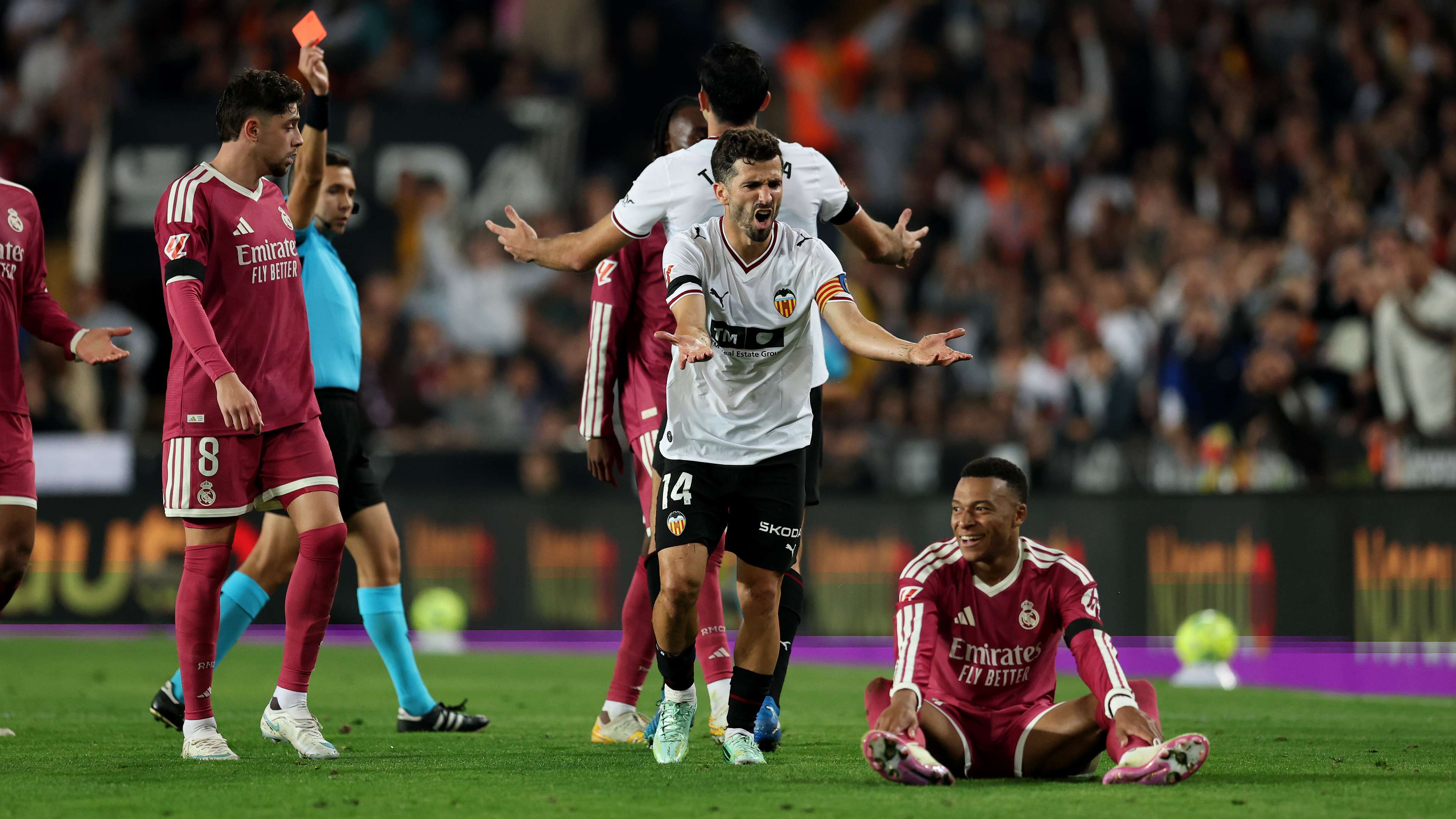
Spain’s Technical Committee of Referees has backed Alejandro Hernández Hernández’s decision to caution Valencia defender Pablo Maffeo for his challenge on Kylian Mbappé, ruling that the incident did not merit a red card. The decision followed a heated debate during Real Madrid’s 3-0 victory at the Mestalla, where players on the Madrid bench argued that Maffeo had denied the forward a clear goalscoring opportunity.
The committee’s explanation was featured in Tiempo de Revisión, a programme published on the Spanish Football Federation’s official X account. By reviewing the footage and setting out the relevant criteria, the programme aimed to clarify why the referee awarded a direct free kick and a yellow card rather than sending Maffeo off.
How the Mbappé–Maffeo Incident Unfolded
The challenge occurred as Mbappé and Maffeo contested an aerial ball. According to the committee’s assessment, the Valencia defender pushed the Real Madrid striker from behind, causing him to fall. The contact was judged to be a foul, with a direct free kick the appropriate restart.
The more contentious question was the disciplinary sanction. Madrid’s players believed the foul had stopped Mbappé from advancing towards goal and called for a red card. Some Valencia supporters, by contrast, disputed whether the contact was enough to warrant a foul at all. The committee’s review addressed both points: it confirmed that Maffeo committed an offence, but concluded that the incident did not meet the threshold for a sending-off.
Why the Committee Ruled Out a Red Card
A red card for denying an obvious goalscoring opportunity is not automatic whenever a defender fouls an attacker near goal. Referees must consider several factors, including the attacker’s position, the direction of play, the likelihood of gaining or keeping control of the ball, and the number and location of defenders who could intervene.
In this case, the committee highlighted one decisive detail: Mbappé was not in control of the ball when Maffeo made contact. That meant the forward had not yet secured possession or established the clear opportunity required for a denial-of-goalscoring-opportunity dismissal. In the committee’s view, the foul interrupted a promising Real Madrid attack, but did not prevent an obvious chance to score.
The distinction matters in football because the difference between a promising attack and a clear goalscoring opportunity can determine whether a player receives a yellow or red card. A foul may be tactical and still fall short of the stricter criteria for a dismissal. The committee therefore considered a caution proportionate to the circumstances.
Referee Decision Stands After Review
The review effectively closes the debate over Hernández Hernández’s call, at least from the refereeing authorities’ perspective. The committee supported the on-field decision: a direct free kick for the foul and a yellow card for Maffeo. Its conclusion also reflects a broader principle of match officiating: referees assess not only the force or location of contact, but the attacker’s realistic opportunity to reach and control the ball.
That context helps explain why the incident produced such sharply divided reactions. From Madrid’s perspective, Mbappé’s pace and position suggested he could have turned the situation into a dangerous break. Valencia’s supporters saw an aerial contest in which the ball was still available. The committee’s ruling did not endorse the view that no foul occurred; instead, it separated the foul itself from the question of whether it warranted a red card.
Real Madrid’s Win Overshadowed by the Controversy
Real Madrid ultimately left the Mestalla with a 3-0 victory in the 12th round of the Spanish league. Yet the Maffeo challenge became one of the match’s main talking points, drawing attention even before the opening goal. The disagreement underlined how a single disciplinary decision can shape the narrative around a game, particularly when it involves a high-profile forward such as Mbappé.
For fans following the title race, the result was more straightforward than the debate over the card. Madrid secured all three points, while the refereeing review offered an official explanation for a moment that had fuelled anger among the visiting players and discussion among viewers. The verdict may not persuade every supporter, but it clarifies how the committee applied the rules to the available footage.
What the Ruling Means for Future Decisions
The case is a useful reminder that a foul near goal does not automatically qualify as a red-card offence. Control of the ball is central to the assessment, alongside the attacker’s path to goal and the likelihood that the opportunity would have developed. In the Maffeo–Mbappé incident, the committee judged that the attack was promising but not yet an obvious chance to score.
That distinction is important for players, coaches and supporters seeking a consistent understanding of football’s disciplinary rules. While match officials must make decisions in real time, post-match reviews can explain the reasoning behind close calls and show how the same criteria are intended to apply across different games.
For anyone making a football prediction or assessing the likely impact of refereeing decisions on a team’s prospects, the episode also illustrates how disciplinary outcomes can influence a match without necessarily changing its final result. Real Madrid won comfortably, but the committee’s review ensured that the yellow card—and the reasoning behind it—remained a major part of the conversation after the final whistle.