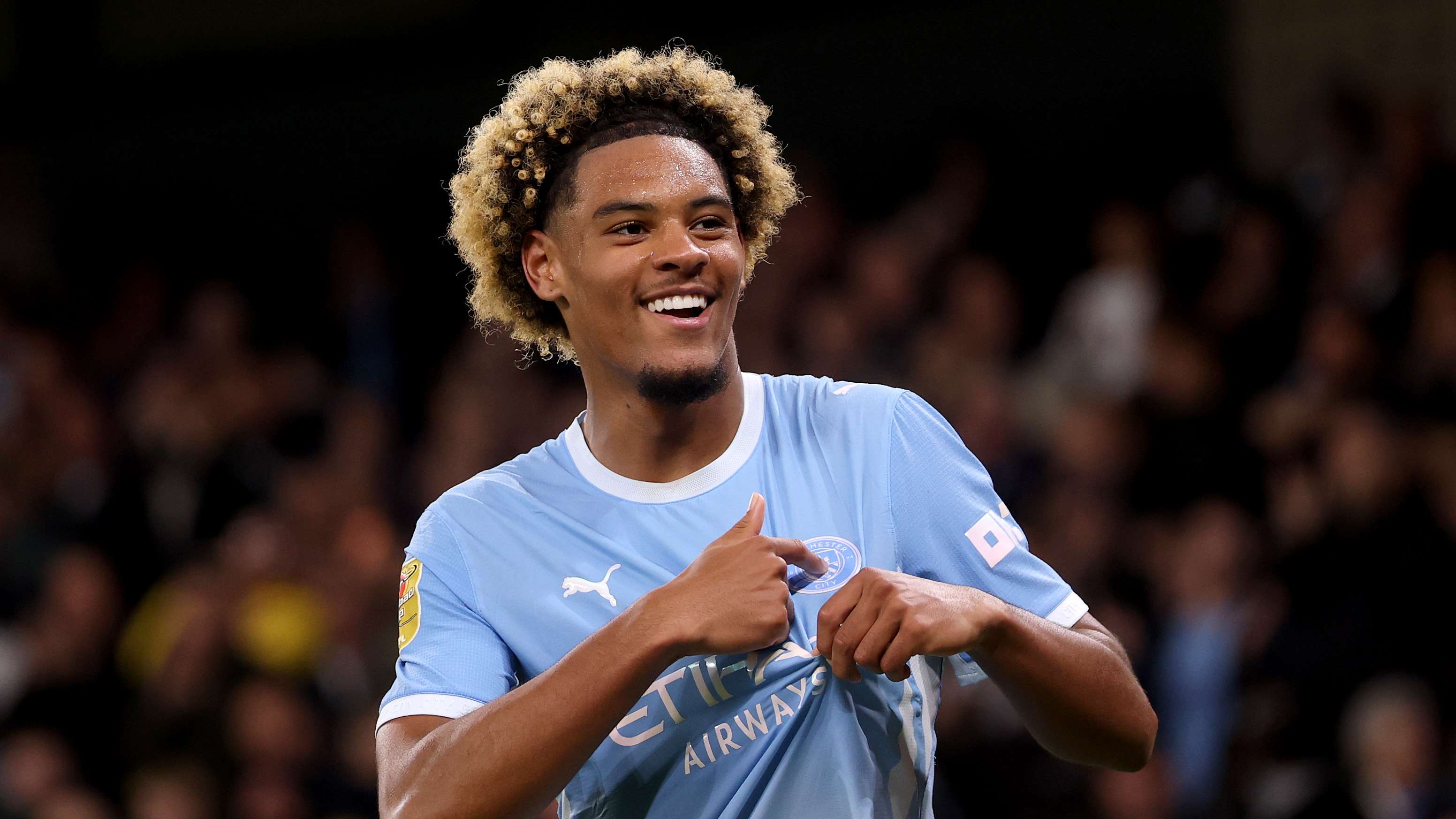

Who Is Floyd Samba? Manchester City’s Teenager Steps Into Haaland’s Role
Manchester City’s Champions League victory over AEK Athens brought an unexpected name into the spotlight. With Erling Haaland watching from the bench, 17-year-old academy prospect Floyd Samba led the line in a 5-1 win—an opportunity few young players could have anticipated so early in their careers.
The decision raised an obvious question: how did a teenager whose natural position is central midfield end up replacing one of the world’s most prolific strikers? Samba’s rapid rise, his family’s deep football connections and his eligibility for several national teams have all added to the interest. For City supporters, he is a promising academy graduate. For Germany, England, France and Congo, he could become a future international prospect.
Why Samba Started Ahead of Haaland
Haaland had arrived in strong form, scoring twice in City’s 5-0 Premier League win over Ipswich Town to take his league total to 12 goals. He was included in the squad for the Athens match, but a minor knock meant he remained on the bench throughout the game. City were also without Antoine Semenyo, who had suffered an injury expected to keep him out for several weeks.
With senior attacking options limited, coach Enzo Maresca turned to Samba. The teenager, who stands around 1.83 metres tall, is primarily a central midfielder rather than a conventional number nine. It was a bold selection, but not an entirely new experiment: City had already tried him in attack during the Carabao Cup earlier in the season.
Samba did not score or provide an assist against AEK Athens, and he was substituted in the 63rd minute. Nevertheless, his performance was considered a success. Maresca praised the academy players involved, including Samba, Ryan McAidoo and Kaden Braithwaite, and described the young striker’s display as good overall.
A Midfielder With a Scorer’s Instinct
Samba’s first senior start came in September against Norwich City in the Carabao Cup. Maresca later explained that he had only considered using the youngster as a striker in the days before the match. When asked whether he had played as a number nine before, Samba said he had not. The coach still believed the experiment was worth trying—and the result was emphatic.
Samba scored twice in City’s 5-0 win, turning an unfamiliar role into a memorable breakthrough. Maresca was careful not to label him a natural centre-forward, but said the teenager had performed well. The goals quickly attracted attention, with some media coverage hailing him as a potential new star. Samba himself sounded excited after the performance, calling the debut an amazing experience and saying he believed a big career lay ahead.
That cup appearance was more than a short-lived headline. It showed why adaptable young footballers can be valuable in a demanding first-team squad. Samba’s midfield background may help him link play, find space between defenders and contribute to pressing, even when he is asked to operate closer to goal. His Champions League start offered another test of those qualities against senior opposition.
What Comes Next at Manchester City?
Despite his impressive early opportunities, regular first-team football is far from guaranteed. Samba returned to the youth set-up after his Norwich brace and waited more than a month for another senior call-up. He had previously been named in a Premier League squad without making it onto the pitch, and he was not included for City’s 2-1 league defeat to Aston Villa.
A League Cup match against Brighton could provide another chance for minutes, particularly if senior players are rested. But the competition for places is intense. Haaland remains City’s leading striker, while Semenyo’s eventual return would provide another attacking option. Samba also faces a crowded midfield group, where established and emerging players are competing for opportunities.
A winter loan has reportedly been considered as a way to give the teenager more regular senior football. A temporary move could help him develop through consistent appearances, although no clear arrangement has emerged. A permanent departure appears unlikely given City’s investment in his development and the potential he has already shown. The club’s wider uncertainty, including the possibility of serious consequences connected to its financial case, may also influence longer-term planning, but Samba’s immediate challenge is to keep progressing on the pitch.
A Manchester City Family With Football in Its Blood
Samba was born in Macclesfield and has been part of City’s academy since under-nine level. His connection to the club is shared by his family. Older brother Tyrone plays as a left winger for the under-21s and was among the supporters watching Floyd’s Champions League appearance. Their younger brother Emerson, aged 12, is also involved in football and currently plays as a defender.
Floyd has said that he and his brothers still play together at home, where friendly games can quickly become competitive. Emerson, he has joked, is already so tall that he comes up to his shoulder. The boys’ father, Christopher Samba, knows the professional game well: the former centre-back made 171 Premier League appearances and also played in Germany’s Bundesliga for Hertha BSC.
Could Samba Become a Future Germany International?
One of the most intriguing parts of Samba’s story is his international future. He holds German citizenship through his family background and made his debut for Germany’s under-19 team under coach Hanno Balitsch shortly after scoring against Norwich. Before that, he had represented England at youth level.
His options may extend beyond those two countries. With family ties that provide eligibility for France and the Democratic Republic of Congo, Samba has time to consider which national team best fits his ambitions. He has not yet made a senior commitment, leaving the door open as his career develops.
That situation invites comparisons with Jamal Musiala, who also played for English youth teams before choosing Germany. Musiala represented Germany at under-16 level, later featured for England’s under-17 and under-21 sides, and ultimately committed to the German national team in 2021. His path is not a blueprint Samba must follow, but it illustrates how a player’s international decision can evolve over time.
A Prospect to Watch, Not Yet a Finished Product
Samba’s blend of dribbling, close control and vision has encouraged observers to imagine what he might become. His name may suggest Brazilian flair, but his development is rooted in Manchester City’s academy, where tactical versatility and technical quality are central to the club’s style. For now, the teenager is best viewed as a promising prospect rather than a ready-made replacement for Haaland.
His Champions League appearance was a significant milestone, not a guarantee of regular selection. The next stage will depend on how he handles limited opportunities, develops physically and finds the right balance between midfield duties and attacking responsibilities. Still, scoring twice on his first senior start and then stepping into a European fixture at 17 gives him a compelling platform. For City fans—and anyone following the next generation of football talent—Floyd Samba is a name worth keeping in mind.