
Arda Güler’s Sevilla Incident Sparks VAR Debate After Real Madrid Goal
Arda Güler’s performance against Sevilla has become a talking point for reasons beyond his goal. The Real Madrid midfielder remained on the pitch after a disputed challenge on Peque Fernández, prompting angry protests from Sevilla players and renewed questions about how VAR handles potential red-card incidents in Spanish football.
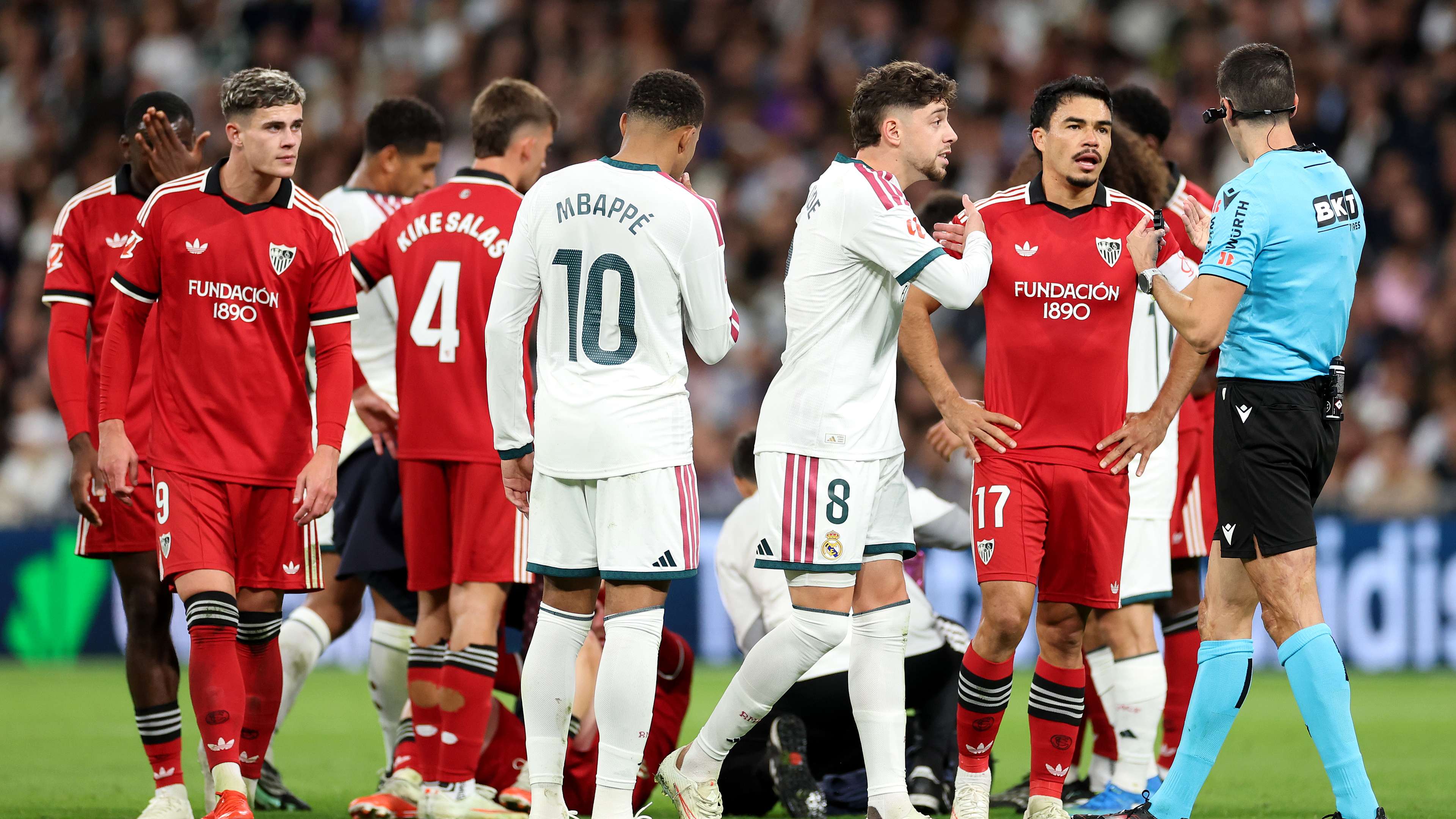
The controversy began in the 22nd minute, when Sevilla tried to stop a Real Madrid counter-attack. Peque went to ground after contact involving Güler’s arm. Sevilla’s players immediately surrounded referee Busquets Ferrer, arguing that the Turkish international had struck their teammate with an elbow and should be sent off for violent conduct.
The referee did not show Güler a card, and the video assistant referee did not recommend an on-field review. Although VAR officials examined the sequence, the available replays were reportedly inconclusive: they did not clearly establish the exact point of contact or demonstrate the force of the movement. As a result, the decision to keep Güler on the pitch stood.
Kike Salas questions the decision
Sevilla defender Kike Salas voiced his frustration during a half-time interview with Movistar. He said he believed his side had been controlling the match before Güler’s goal and backed Peque’s account of the incident, even though he had not yet watched a clear replay himself.
“He told me that he struck him clearly with his elbow, and I trust him,” Salas said, adding that he considered the action worthy of a red card. He also questioned why VAR had not asked the referee to review the footage, saying he planned to watch the replay after the interview.
Salas’s comments reflected Sevilla’s broader complaint: the players felt the incident deserved more than a quick review from the VAR room. However, the distinction between checking an incident and recommending a pitchside review is important. VAR can advise the referee to look again only when it identifies a clear and obvious error or a serious missed incident. If the footage does not provide convincing evidence, the original decision is generally allowed to stand.
Güler’s goal intensified Sevilla’s anger
The timing made the dispute even more combustible. Just eight minutes after the challenge, Güler put Real Madrid ahead with a composed finish, converting a decisive pass from Diomande. For Sevilla, the goal arrived while frustration over the earlier decision was still fresh, turning a contentious moment into a central part of the match narrative.
Kylian Mbappé then extended Madrid’s advantage a few minutes later, completing a sharp individual move. Sevilla were left to consider how the game might have unfolded if Güler had been dismissed. A red card would have forced Madrid to play with ten men and could have changed the balance of possession, the visitors’ attacking options and the tactical decisions required from both benches.
That alternative remains a matter of speculation, not certainty. Football matches rarely turn on a single incident alone, and Sevilla would still have needed to make the most of any numerical advantage. Nevertheless, the sequence—an alleged elbow, no dismissal, and a goal from the player at the centre of the protests—gave the Andalusian side a strong reason to feel aggrieved.
Protests bring further bookings
The dispute also had consequences for Sevilla beyond the initial decision. The protests that followed resulted in yellow cards for Huijsen and Félix Correa, adding disciplinary tension to an already heated contest. Such reactions can be costly: players who continue to challenge a referee risk bookings, while the team’s focus can shift away from its defensive shape and match plan.
For Madrid, Güler’s continued presence offered an immediate sporting benefit. He remained available to influence the attack and soon delivered the opening goal. His finish also ensured that the incident would be discussed not simply as a refereeing question, but as a turning point that appeared to reward the side that had escaped a potential dismissal.
What the controversy means for VAR and football predictions
The episode is likely to renew debate about consistency in VAR decisions. Supporters often expect video technology to provide a definitive answer, but its effectiveness depends on the quality and angle of the footage. When contact is partly obscured or the force of an action is difficult to judge, a review may not resolve the disagreement. That uncertainty can leave players, coaches and fans dissatisfied, particularly when the disputed moment is followed by a goal.
For analysts making a football prediction about future matches, incidents like this are a reminder to consider more than team form and individual quality. Refereeing decisions, disciplinary risk and the emotional response to a controversial call can all influence the rhythm of a game. A team that feels wronged may become more aggressive, lose concentration or struggle to maintain its tactical structure; an opponent may use the disruption to seize momentum.
Still, predictions should not treat one contentious call as proof that a result was inevitable. Madrid’s attacking quality was evident in both Güler’s finish and Mbappé’s contribution, while Sevilla’s argument rests on an incident the officials judged insufficient for a red card after review. The most balanced assessment is that the decision had the potential to reshape the contest, but the match’s outcome also depended on how both teams performed afterward.
A debate that is unlikely to end quickly
Sevilla’s players believe Güler should have been sent off; the VAR team evidently did not find enough evidence to recommend that the referee take another look. Until clearer footage or further explanation emerges, the incident will remain open to interpretation.
What is certain is that Güler’s goal and the disputed challenge are now inseparable in the story of the match. The controversy has placed the spotlight on VAR’s threshold for intervention, the difficulty of judging contact from limited angles and the way a single decision can shape the mood of a football game. For Sevilla, the question will be whether the call altered their chances. For Madrid, the focus will be on a decisive victory in which Güler answered the pressure with a goal.